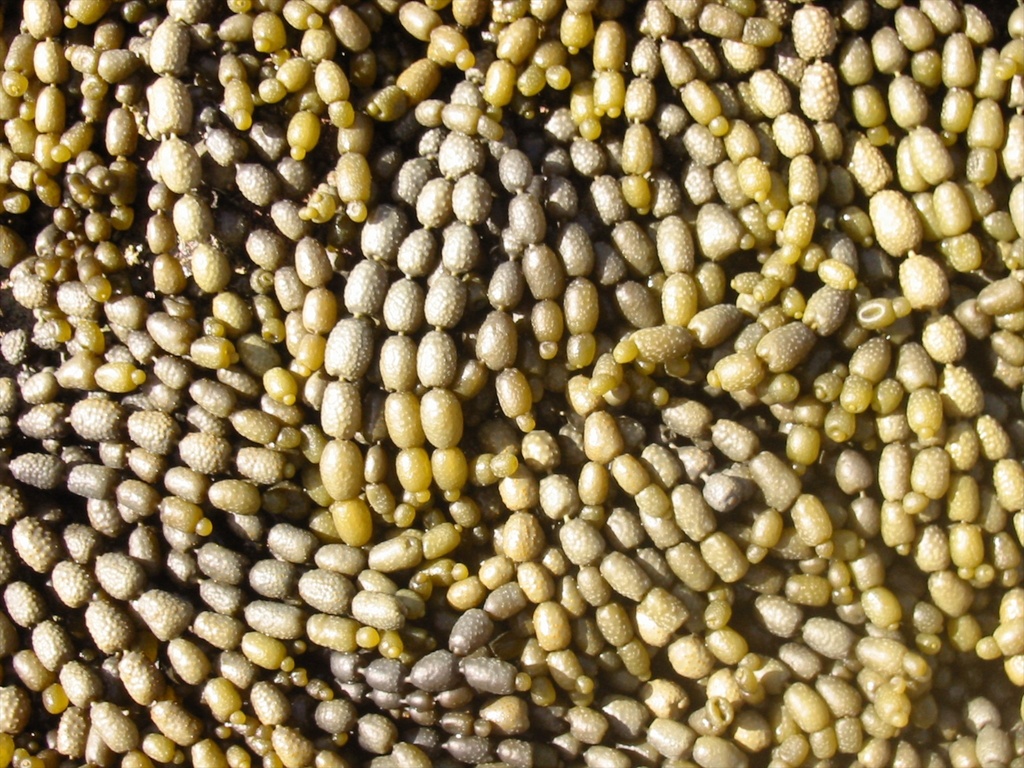
Neptune's necklace
Hormosira banksii
Hormosira banksii, also known as Neptune's necklace, Neptune's pearls, sea grapes, or bubbleweed) is a species of seaweed (brown algae, Fucales) native to Australia and New Zealand. It is abundant on low-energy rocky reefs at midtide levels, where it outcompetes other algal species due to its high tolerance to desiccation. This is because it has a slimy layer that conserves moisture. The thallus of this species is made up of strings of olive-brown, spherical, gas-filled pneumatocysts,...
From the article Hormosira on Wikipedia (CC BY-SA), quoted section by section
Description
Hormosira is a perennial species of seaweed (brown algae, Fucales). It is abundant on low-energy rocky reefs within the intertidal zone, where it outcompetes other algal species due to its high tolerance to desiccation. Plants vary significantly in morphology. The thallus (or frond) of the species is made up of strings of olive-brown, spherical, gas-filled pneumatocysts (or beads), which taper towards a small holdfast. While the holdfast attaches strongly to a substrate, it can be easily dislodged by human trampling. The spheres are buoyant and rise to the surface of the water during high tide, allowing plants to move with the flow of the current and obtain more sunlight. Hormosira also produces a slime layer to reduce desiccation, and plants often grows in high densities, which reduces their surface area exposed to the sun and further reduce dehydration. Due to the buoyant thallus, Hormosira plants can drift out to sea over considerable distances, and floating plants can remain fertile for several weeks.
Range & habitat
Hormosira is native to southeastern Australia (including Tasmania, Lord Howe Island and Norfolk Island) and New Zealand. Despite substantial morphological variation across its range, the species represents a single species and the genus Hormosira is monotypic. Genetic analyses of mitochondrial COI and microsatellite DNA sequence data have indicated that there is low genetic variation across the range of the species in Australia.
Wikipedia: “Distribution”
What it does
Hormosira reproduces sexually and is monoecious. The sex organs (conceptacles) are on the surface of the beads, and are visible to the naked eye as rough-looking dimples. Hormosira produces eggs throughout the year, but its peak reproduction is often confined to July–October (at least in northern New Zealand) when the sea temperature is around 14 °C, as the viability of the eggs can be low in high sea temperatures such as 17–22 °C. At high tide, the eggs are released directly into the surrounding water. The eggs are negatively buoyant they sink to the substrate to develop for several days before becoming attached. All individuals release at the same time, maximising fertilisation. The species can also reproduce asexually from broken and dislodged fragments.
Wikipedia: “Reproduction”
At the table
Due to the species' high iodine content, Tasmanian schoolchildren were once urged to eat a bead a day to keep the goitres away.
Wikipedia: “Uses”
Where it lives
Recorded sightings
—
geo-referenced records in GBIF, from museums, herbaria and field observers.
Drag the globe to turn it. Dots are where records exist, not a range map; darker means more records.
In the stacks
Searching the stacks…
Every page naming Hormosira banksii in the Biodiversity Heritage Library →
This page is assembled live from iNaturalist, GBIF, Wikipedia, the Source Library and the Internet Archive. It is not yet part of the hand-edited codex. iNaturalist taxon 342806.