- Fungi Including Lichens
- ›Basidiomycete Fungi
- ›Higher Basidiomycetes
- ›Mushrooms, Bracket Fungi, Puffballs, and Allies
- ›Russulales
- ›Albatrellaceae
- ›Scutiger
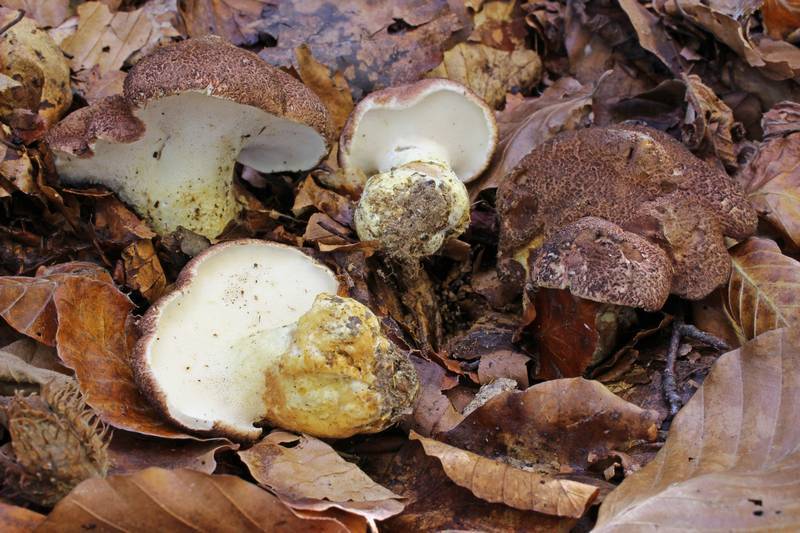
Goat's Foot Polypore
Scutiger pes-caprae
Scutiger pes-caprae is a species of fungus in the family Albatrellaceae. It was first described officially as a species of Polyporus by Christian Hendrik Persoon in 1818. In recent decades, it was known most commonly as a species of Albatrellus until molecular research published by Canadian mycologist Serge Audet in 2010 revealed that it was more appropriate in an emended version of the genus Scutiger.
From the article Scutiger pes-caprae on Wikipedia (CC BY-SA), quoted section by section
Description
The brownish cap is 6–20 centimetres (2+1⁄2–8 in) wide, tending towards a convex kidney shape, sometimes lobed, and flattening with age. There are 1–2 whitish pores per millimetre that may discolor pink or greenish. The usually decurrent tubes are up to 5 mm long. The stem is 2.5–8 cm (1–3+1⁄4 in) long and 1–4 cm (1⁄2–1+1⁄2 in) thick; it is usually larger at the base, where several mushrooms may be conjoined. The flesh is 5–20 millimetres (1⁄4–3⁄4 in) thick and whitish, slowly bruising pinkish; it tastes mild. The spore print is whitish.
Similar species. Scutiger ellisii, Laeticutis cristata, and Jahnoporus hirtus bear similarities.
Range & habitat
It is found in western North America, under conifers and on rotting wood, from August to February. It is somewhat more common in the south than Albatrellus ellisii.
Wikipedia: “Distribution and habitat”
At the table
The caps of young European specimens are reportedly edible, but chewy, after thorough cooking.
Wikipedia: “Uses”
Where it lives
Recorded sightings
—
geo-referenced records in GBIF, from museums, herbaria and field observers.
Drag the globe to turn it. Dots are where records exist, not a range map; darker means more records.
In the stacks
Searching the stacks…
Every page naming Scutiger pes-caprae in the Biodiversity Heritage Library →
This page is assembled live from iNaturalist, GBIF, Wikipedia, the Source Library and the Internet Archive. It is not yet part of the hand-edited codex. iNaturalist taxon 341963.