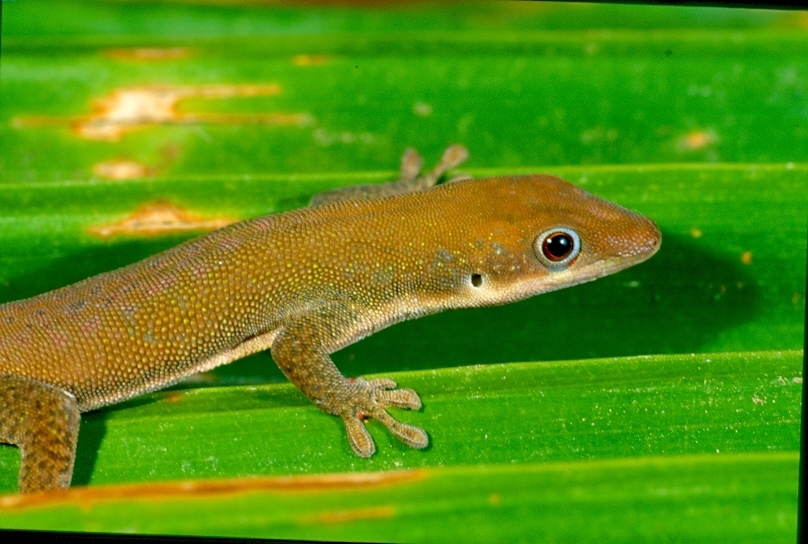
Zanzibar Day Gecko
Phelsuma dubia
Phelsuma dubia, also known as dull day gecko, olive day gecko, Zanzibar day gecko or green day gecko, is a diurnal species of gecko. It is about 15 centimetres (5.9 in) in length and lives on the western coast of Madagascar, in the Comoros, and the coast of East Africa. It typically inhabits trees and can also be found near human dwellings. The Dull day gecko feeds on insects and nectar.
From the article Phelsuma dubia on Wikipedia (CC BY-SA), quoted section by section
Description
This lizard belongs to the medium-sized day geckos. It can reach a maximum length of approximately 15 cm. The body colour varies between grayish green, grayish brown and bluish green. The tail may be bright blue. A rust-coloured stripe extends from the nostril to the eye. There is a red v-shaped stripe on the snout. On the back there often are brownish or red-brick coloured dots. A gray lateral stripe extends from the eye to the hind leg. The ventral side is off-white coloured. Juveniles have a light brown dorsal surface with little light blue spots. The tail of neonates is yellow.
Range & habitat
This species inhabits the west coast of Madagascar in the general area of Majunga. It can also be found in the Comoros, in Zanzibar, and some coastal areas of mainland Tanzania.
Wikipedia: “Distribution”
What it does
These day geckos feed on various insects and other invertebrates. They also like to lick soft, sweet fruit, pollen, nectar and balsamic vinegar.
Wikipedia: “Diet”
Where it lives
Recorded sightings
—
geo-referenced records in GBIF, from museums, herbaria and field observers.
Drag the globe to turn it. Dots are where records exist, not a range map; darker means more records.
In the stacks
Searching the stacks…
Every page naming Phelsuma dubia in the Biodiversity Heritage Library →
This page is assembled live from iNaturalist, GBIF, Wikipedia, the Source Library and the Internet Archive. It is not yet part of the hand-edited codex. iNaturalist taxon 34059.