On eBird ↗
Standard-winged Nightjar
Live sightings near you, the range map, bar charts of when it is seen, and Macaulay Library photos and recordings.
Standard-winged Nightjar
Caprimulgus longipennis
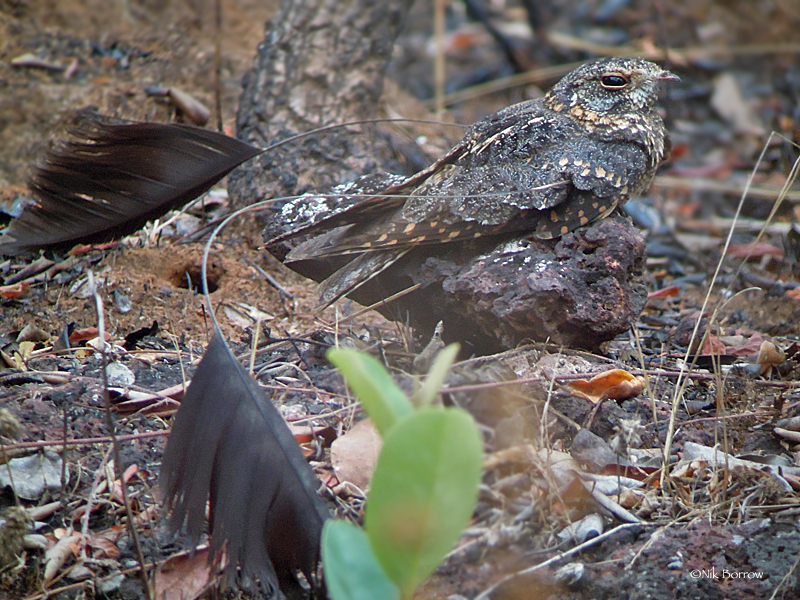
The standard-winged nightjar (Caprimulgus longipennis) is a nocturnal bird in the nightjar family. Previously placed with the pennant-winged nightjar (Caprimulgus vexillarius) in their own genus, Macrodipteryx, it is native to Africa and displays extreme sexual dimorphism. During the breeding season, males will grow broad ornamental flight feathers longer than their body.
From the article Standard-winged nightjar on Wikipedia (CC BY-SA), quoted section by section
Description
When roosting on the ground during the day, this medium-sized (20–23 centimetres (7.9–9.1 in) long) nightjar is mainly variegated grey, with a browner collar. It has a shadowy form with easy, silent moth-like flight; this nightjar is relatively short-tailed, and lacks white in the wings or tail. The song is a churring trill. The adult male grows ornamental feathers during the breeding season which consists of a broad secondary flight feather on each wing elongated to up to 53.5 centimetres (21.1 in), over twice the length of the bird's body. In normal flight, these feathers trail behind, but in display flight they are displayed like standards. These large feathers have been postulated as a feature developed through intense sexual selection. Outside the breeding season, the female is distinguished from the male by its smaller size and similarity to the pennant-winged nightjar, notably the patch of white on the throat and dark barring on the belly.
Range & habitat
The standard-winged nightjar is a resident breeder in Africa from southern Senegal east to Ethiopia. It spends the non-breeding season in the Sahel region to the north. Its habitat includes lightly wooded savanna, with some scrub, as well as agricultural land in thickly wooded savanna. It has been observed at elevations as high as 2,030 metres (6,660 ft) in Ethiopia, but is typically found from sea level up to elevations of 1,400 metres (4,600 ft).
Wikipedia: “Distribution and habitat”
What it does
Like other nightjars, the standard-winged nightjar feeds on insects in flight, their mouths opening wide for moths and beetles. It flies at dusk, when the highest quantity of prey is available, though its foraging patterns change depending on moonlight, with later, more nocturnal foraging correlated with higher levels of moonlight. It may also feed on swarms of insects disturbed by fires and artificial lights, a behaviour which has been linked to bird strike by cars when their lights illuminate roads. During breeding season, male and (less frequently) female standard-winged nightjars will gather in patches of soil with little vegetation to forage and for males to perform display flights. Such behaviour has been considered a form of lekking. Outside of breeding season, standard-winged nightjars have been observed traveling in groups of up to 20 individual birds. No nest is made; in each clutch, two elliptical, slightly glossy eggs are placed upon bare sandy soil.
Wikipedia: “Behaviour”
Listen
Looking for field recordings…
Where it lives
Recorded sightings
—
geo-referenced records in GBIF, from museums, herbaria and field observers.
Drag the globe to turn it. Dots are where records exist, not a range map; darker means more records.
In the stacks
Searching the stacks…
Every page naming Caprimulgus longipennis in the Biodiversity Heritage Library →
This page is assembled live from iNaturalist, GBIF, Wikipedia, the Source Library and the Internet Archive. It is not yet part of the hand-edited codex. iNaturalist taxon 339629.