- Fungi Including Lichens
- ›Basidiomycete Fungi
- ›Higher Basidiomycetes
- ›Mushrooms, Bracket Fungi, Puffballs, and Allies
- ›Agaricomycetidae
- ›boletes and allies
- ›Suillineae
- ›Suillaceae
- ›Suillus
- ›Suillus
- ›Diversipedes
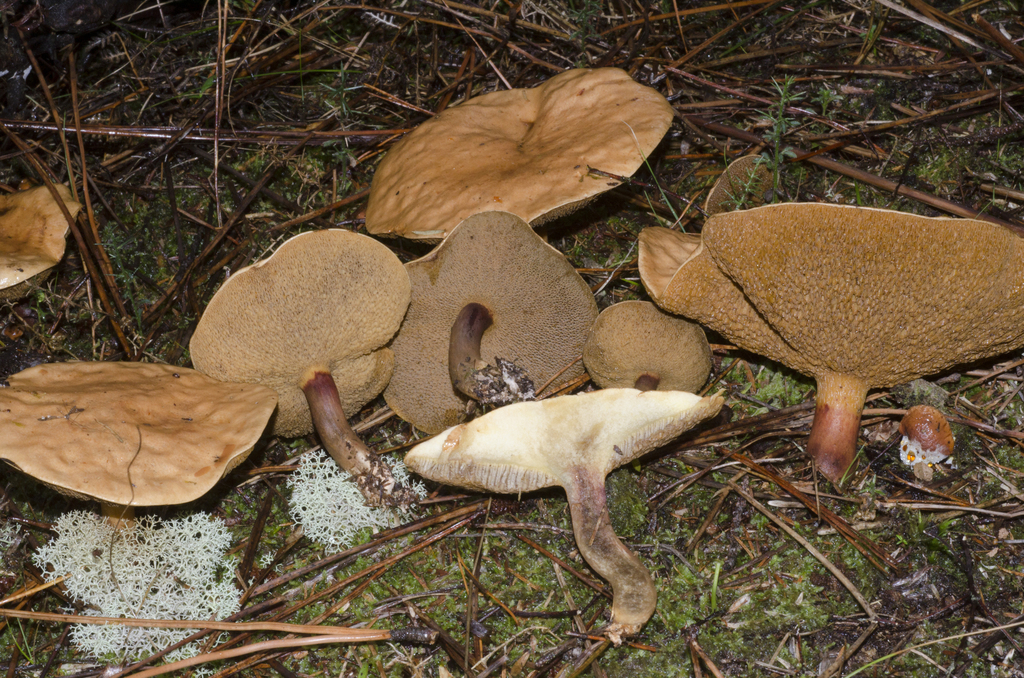
Bovine Jack
Suillus bovinus
Suillus bovinus, also known as the Jersey cow mushroom or bovine bolete, is a pored mushroom of the genus Suillus in the family Suillaceae. It was initially described as Boletus bovinus by Carl Linnaeus in 1753, and given its current binomial name by Henri François Anne de Roussel in 1806.
Suillus bovinus produces spore-bearing fruit bodies, often in large numbers, above ground. The mushroom has a convex grey-yellow or ochre cap reaching up to 10 cm (4 in) in diameter, which flattens with age. Like other boletes, it has tubes extending downward from the underside of the cap, rather than gills; spores escape at maturity through the tube openings, or pores. The pore surface is yellow. The stipe, more slender than those of other Suillus boletes, lacks a ring.
From the article Suillus bovinus on Wikipedia (CC BY-SA), quoted section by section
Description
The fruit body—colloquially called a mushroom—of Suillus bovinus is a basidiocarp which is smaller and daintier than most other boletes. The cap is initially convex, then flat with a wavy margin and a grey-yellow or ochre with pink tinge in some specimens. It ranges from 3–10 cm (1+1⁄4–4 in) in diameter and has a sticky skin. The flesh is whitish, yellowish or clay-coloured and has a fruity smell. Sometimes turning a pink tinge when bruised, the flesh is spongy and rubbery. Like other boletes, it has pores instead of gills that make up the hymenophore on the underside of the cap. Suillus bovinus has a characteristic compound pore layer, consisting of an outer layer of coarse, angular pores overlaying an inner layer of finer pores. The pores are grey- to olive-yellow and generally decurrent, comprising yellow to olive-yellow tubes that measure 0.3–1 cm (1⁄8–3⁄8 in) long. The stipe is 4–6 cm (1+1⁄2–2+1⁄4 in) tall, similar in colour to the cap, and tends to be narrower towards the base. With a diameter of 0.5–0.8 cm (1⁄4–3⁄8 in), it is more slender than those of other boletes.
The spore print is an olive-brown colour. The oval to spindle-shaped spores have dimensions of 8–10 by 3.5–4.5 μm. Basidia (spore-bearing cells) are cylindrical to narrowly club-shaped, measuring 22.4–33.4 by 5.8–8.0 μm. They bear four sterigmata (each holding a single spore), which are up to 6.8 μm long. …
Range & habitat
Suillus bovinus is found in conifer woods and plantations across Europe, including subalpine regions in the Alps, up to altitudes of 800 m (2500 ft). It is common in Lithuania, where it associates with Scots pine (Pinus sylvestris), the only naturally occurring pine in that country. Preferred soils of S. bovinus are often acidic, sand-based, or sometimes calcareous (chalky) and moraine. In Asia, it has been recorded in Taiwan, and in Japan, where it associates with Japanese red pine (Pinus densiflora). In China, it has been recorded from provinces Anhui, Fujian, Guangdong, Hunan, Jiangxi, and Zhejiang. Suillus bovinus has been introduced into other areas. In North America, where it is thought to have been introduced with Scots pine, it is found in the eastern United States, including North Carolina, Pennsylvania, Vermont, and the Adirondack Mountains of New York. It has been recorded infrequently under Scots pine in Australia, where it has been found as far north as southern Queensland, and in more southerly locations including New South Wales and Kuitpo Forest. It has been recorded in New Zealand. In South Africa, it grows with Pinus radiata.
Wikipedia: “Distribution and habitat”
What it does
Suillus bovinus is mycorrhizal, forming symbiotic associations with living trees by enveloping the tree's underground roots with sheaths of fungal tissue. Field work in pine forests in Sweden analysing the population structure of Suillus bovinus found that mushrooms were more abundant in younger forests and forests with disturbed areas, which contained a higher number of genets (colonies)—700 to 5700 per hectare—compared with 30 to 120 genets per hectare in mature stands. Older colonies in mature forests could be 17.5 m (57+1⁄2 ft) in diameter against 1.7–5.3 m (5+1⁄2–17+1⁄2 ft) diameter in young forests. Spore-bearing mushrooms (sporocarps) produce a huge number of spores (estimated in a Finnish study at 240 million to 1.2 billion per mushroom), of which only a small number grow successfully; this large number is thought to explain the larger numbers of colonies in disturbed and young forests, while the fungus' vegetative spread becomes more important in established forests. Colonies of S. bovinus do not overlap, which indicates they suppress each other's growth. The median lifespan of a colony was estimated to be 36 years. Field work conducted in Swedish pine forests suggested that S. variegatus suppressed the growth of S. bovinus, as there was a negative correlation in occurrence.
A Finnish study published in 1997 found that bacterial communities under P. …
Wikipedia: “Ecology”
At the table
Suillus bovinus tastes mild and is edible, although it is not highly regarded. When cooked, it releases a lot of fluid, which can be collected and reduced or strained to make a sauce. Its flavour is made more intense by drying. The soft and rubbery consistency of older specimens—as well as their proneness to maggot infestation—renders them almost inedible. Fruit bodies are part of the later summer diet of the red squirrel in Eurasia, which collects the mushrooms and stores them in tree forks for a ready food supply after the onset of frost. There are several fly species that often use S. bovinus fruit bodies to rear their young, including Bolitophila rossica, Exechia separata, Exechiopsis indecisa, Pegomya deprimata, and Pegohylemyia silvatica.
Wikipedia: “Edibility”
Where it lives
Recorded sightings
—
geo-referenced records in GBIF, from museums, herbaria and field observers.
Drag the globe to turn it. Dots are where records exist, not a range map; darker means more records.
In the stacks
Searching the stacks…
Every page naming Suillus bovinus in the Biodiversity Heritage Library →
This page is assembled live from iNaturalist, GBIF, Wikipedia, the Source Library and the Internet Archive. It is not yet part of the hand-edited codex. iNaturalist taxon 337850.