- Animals
- ›Chordates
- ›Vertebrates
- ›Ray-finned Fishes
- ›Spiny-rayed fishes
- ›Freshwater Sunfishes, Grunters, and Allies
- ›Morwongs, Hawkfishes, and Allies
- ›Trumpeters
- ›Latridopsis
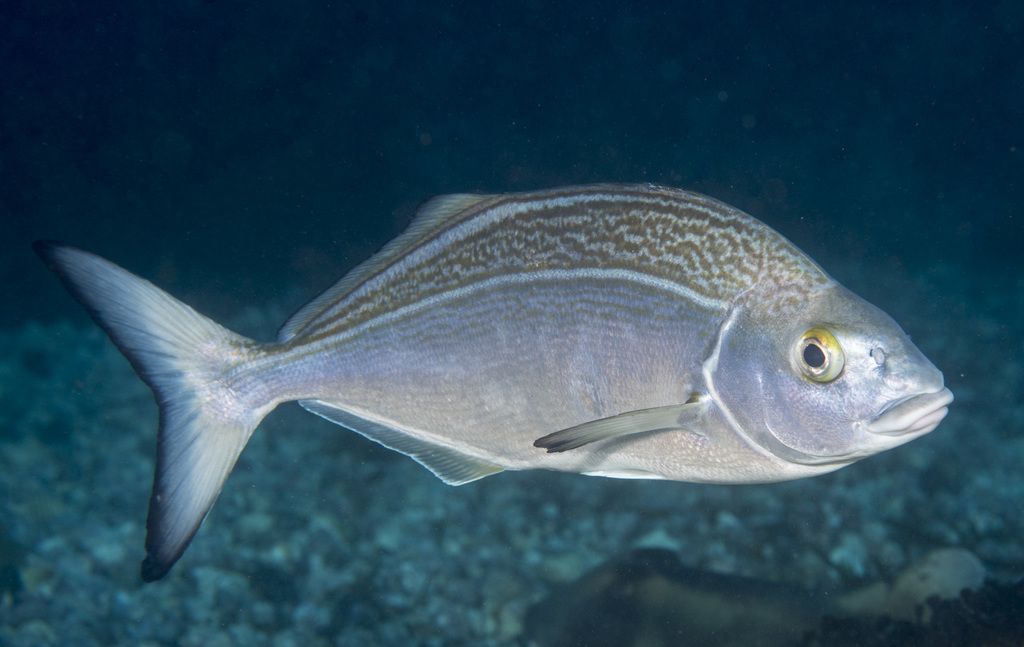
Bastard Trumpeter
Latridopsis forsteri
Latridopsis forsteri, the bastard trumpeter or copper moki, is a species of trumpeter native to the eastern Indian Ocean and southwestern Pacific Ocean around Australia(Robe, South Australia, to Sydney, New South Wales, and around Tasmania) and New Zealand. This species is found at depths of from 20 to 160 metres (66 to 525 ft) over the continental shelf. It can reach a length of 65 centimetres (26 in) TL. This species is commercially important.
From the article Latridopsis forsteri on Wikipedia (CC BY-SA), quoted section by section
Description
Latridopsis forsteri has a rather elongated, compressed and moderately deep body with a shallow caudal peduncle. The dorsal and anal fins are low, the continuous dorsal fin has a deep incision between the spiny and the soft rayed parts. The dorsal fin has 17 spines and 37-42 soft rays while the anal fin has 3 spines and 31-37 soft rays. The blunt pectoral fin has 16-19 rays with the upper rays being longer than the lower. The caudal fin is markedly forked. This species attains a maximum total length of 65 cm (26 in). The overall colour of this species is silver-grey marked with short, irregular brown or greenish-brown longitudinal lines on the upper flanks. The adults have a dark margin to the caudal fin. The pectoral fin also has a black margin and the eye is yellowish-white.
Range & habitat
Latridopsis forsteri is native to the eastern Indian Ocean and southwestern Pacific Ocean around Australia from Victor Harbor, South Australia, to Port Stephens, New South Wales, and around Tasmania. In New Zealand it is found from Stewart Island in the south north to the Three Kings Islands and east to the Chatham Islands. This species inhabits coastal waters down as deep as approximately 60 m (200 ft). It is typically found swimming above sandy bottoms in the vicinity of rocky reefs. The larger adults normally aggregate in small schools over deeper, less sheltered reefs. The juveniles are small thin and transparent, this stage is termed 'paper fish', are found in schools over rocky reefs in shallower waters.
Wikipedia: “Distribution and habitat”
In human culture
Latrodopsis forsteri is known as the “bastard trumpeter” in Australia, about which the Australian ichthyologist Gilbert Percy Whitley said "These endearing terms are given to distinguish them from the so-called Real Trumpeter (Latris lineata), another fine fish, which grows to 4 ft. and 60 lb., also to suggest that the two may hybridize and also because fishermen think the immature ones are sterile.”
== References ==
Wikipedia: “In culture”
Where it lives
Recorded sightings
—
geo-referenced records in GBIF, from museums, herbaria and field observers.
Drag the globe to turn it. Dots are where records exist, not a range map; darker means more records.
In the stacks
Searching the stacks…
Every page naming Latridopsis forsteri in the Biodiversity Heritage Library →
This page is assembled live from iNaturalist, GBIF, Wikipedia, the Source Library and the Internet Archive. It is not yet part of the hand-edited codex. iNaturalist taxon 337744.