On eBird ↗
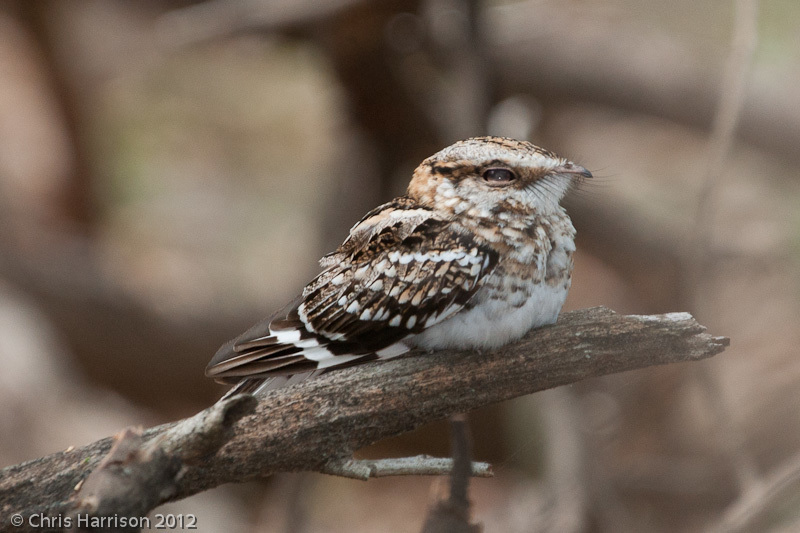
White-tailed Nightjar
Live sightings near you, the range map, bar charts of when it is seen, and Macaulay Library photos and recordings.
White-tailed Nightjar
Hydropsalis cayennensis
The white-tailed nightjar (Hydropsalis cayennensis) is a species of nightjar in the family Caprimulgidae. It is found in the Netherlands Antilles, Barbados, Brazil, Colombia, Costa Rica, Ecuador, French Guiana, Guyana, Martinique, Netherlands Antilles, Panama, Suriname, Trinidad and Tobago and Venezuela. Its natural habitats are subtropical or tropical seasonally wet or flooded lowland grassland and heavily degraded former forest.
From the article White-tailed nightjar on Wikipedia (CC BY-SA), quoted section by section
Description
The white-tailed nightjar is 20 to 22.5 cm (7.9 to 8.9 in) long. Males weigh 33 to 40 g (1.2 to 1.4 oz) and females 32 to 38 g (1.1 to 1.3 oz). Males of the nominate subspecies have grayish brown uppersides with brown to blackish brown speckles and streaks. Their face has a white or buffy supercilium and "moustache". The hindneck has a broad tawny buff collar. The wings are generally grayish to blackish brown with tawny and buffy markings. A white band shows on both the spread and folded wing. The tail appears slightly forked; all but the innermost pair of feathers are partially to completely white. The chin and throat are white. The breast is buff with a cinnamon tinge, brown bars, and bold white spots. The belly and flanks are white with a pale buff wash. The nominate females are darker overall. They do not have white on the wings or tail. The throat is buffy, the breast brownish, and the belly buff with brown bars. H. c. albicauda is similar to the nominate, but the male's belly has a strong buff tinge and the female's underparts are dark brownish buff. H. c. aperta has a longer wing and tail than the nominate. It is similar to albicauda though the female's upper- and underparts are darker. H. c. insularis is paler than the nominate and possibly smaller. Its upperparts, especially the crown, are buffier. H. c. …
Range & habitat
It is found in the "ABC Islands", Brazil, Colombia, Costa Rica, Ecuador, French Guiana, Guyana, Martinique, Panama, Suriname, Trinidad and Tobago and Venezuela. The white-tailed nightjar is a bird of open landscapes such as savanna, pastures, scrubby grasslands, and hillsides with scattered bushes and thickets.
Wikipedia: “Distribution and habitat”
What it does
The white-tailed nightjar is nocturnal. It mostly forages by sallying from the ground or perches but also will hunt in flight low over open grasslands. Its diet is insects but is not known in detail. It roosts on the ground during the day.
Wikipedia: “Feeding”
Listen
Looking for field recordings…
Where it lives
Recorded sightings
—
geo-referenced records in GBIF, from museums, herbaria and field observers.
Drag the globe to turn it. Dots are where records exist, not a range map; darker means more records.
In the stacks
Searching the stacks…
Every page naming Hydropsalis cayennensis in the Biodiversity Heritage Library →
This page is assembled live from iNaturalist, GBIF, Wikipedia, the Source Library and the Internet Archive. It is not yet part of the hand-edited codex. iNaturalist taxon 337418.