- Fungi Including Lichens
- ›Basidiomycete Fungi
- ›Higher Basidiomycetes
- ›Mushrooms, Bracket Fungi, Puffballs, and Allies
- ›Cantharellales
- ›Tulasnellaceae
- ›Tulasnella
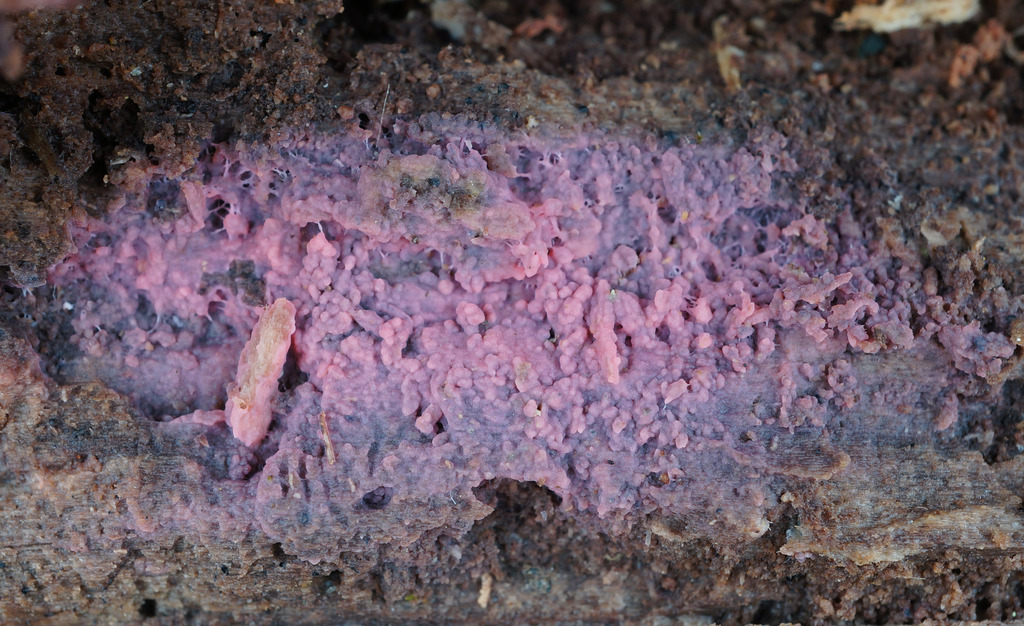
Tulasnella violea
Tulasnella violea is a species of fungus in the order Cantharellales. Basidiocarps (fruit bodies) are typically smooth, ceraceous (waxy), violet-pink or lilaceous to grey, and occur on the underside of fallen branches and logs. It is one of the more conspicuous Tulasnella species and appears to be distributed worldwide. Though normally saprotrophic, Tulasnella violea can form a mycorrhizal association with orchids.
From the article Tulasnella violea on Wikipedia (CC BY-SA), quoted section by section
Description
Basidiocarps (fruit bodies) are effused, smooth, ceraceous (waxy), violet-pink to grey. Microscopically the hyphae are 3.5–5(−7) μm wide, lacking clamp connections. The basidia are mostly clavate, 8–16 x 5–9 μm. The sterigmata are globose to ellipsoid, becoming clavate, fusiform, or mitriform (mitre-shaped), 4.5–6.5 μm wide, variously extending up to 35 μm long. The majority of basidiospores are globose to broadly ellipsoid, 5.5–9 x 5.5–7.5 μm. The anamorph produces monilioid hyphae (chains of swollen hyphal compartments), with compartments up to 8.5 μm diam.
== References ==
Where it lives
Recorded sightings
—
geo-referenced records in GBIF, from museums, herbaria and field observers.
Drag the globe to turn it. Dots are where records exist, not a range map; darker means more records.
In the stacks
Searching the stacks…
Every page naming Tulasnella violea in the Biodiversity Heritage Library →
This page is assembled live from iNaturalist, GBIF, Wikipedia, the Source Library and the Internet Archive. It is not yet part of the hand-edited codex. iNaturalist taxon 335992.