- Plants
- ›Vascular Plants
- ›Ferns
- ›Adder's-tongues, Fork Ferns, and Allies
- ›adder's-tongues and allies
- ›adder's-tongue family
- ›Helminthostachyoideae
- ›Helminthostachys
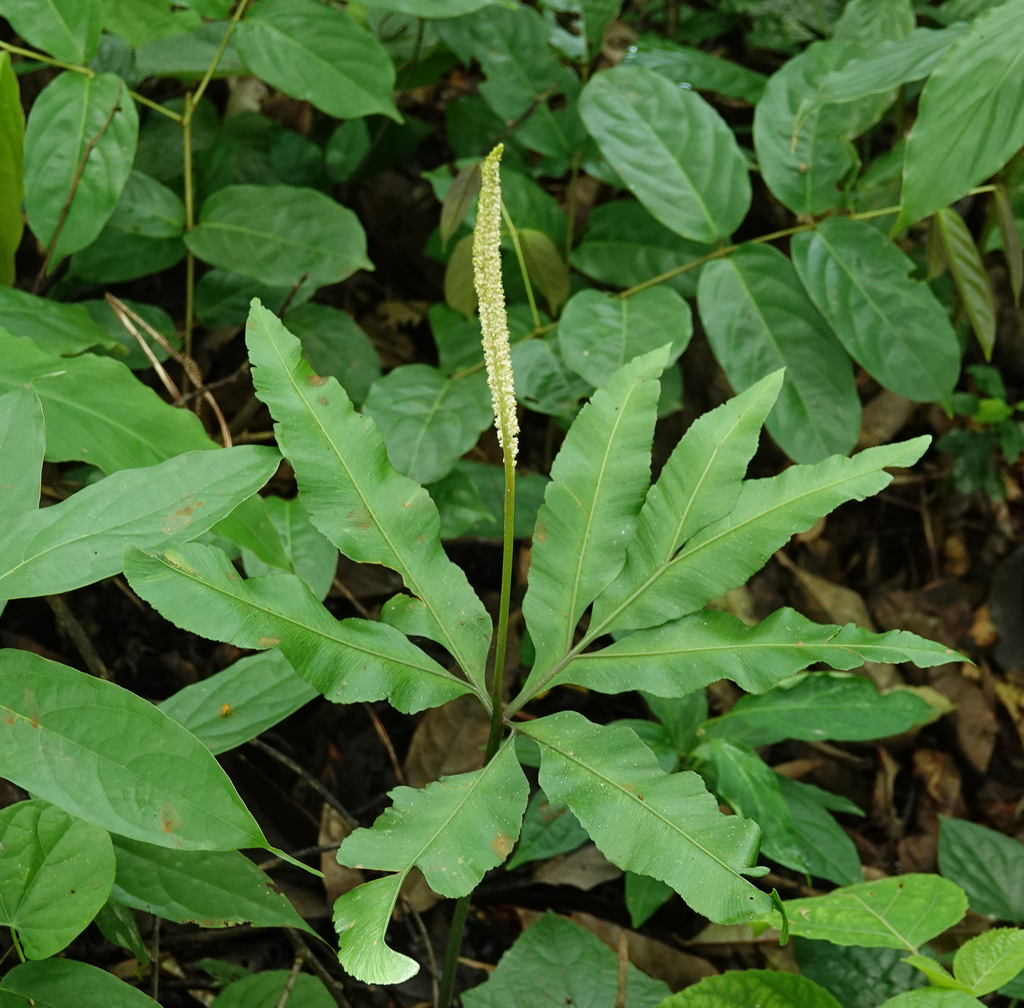
Flowering Fern
Helminthostachys zeylanica
Helminthostachys zeylanica is a terrestrial, herbaceous fern of southeastern Asia and Australia, commonly known as kamraj and tunjuk-langit. The species is like the other members of its family, it has clusters of sporangia on stems of fertile, spike-like fronds.
The rhizome of this annual plant is short, creeping, underground, and stout. They can bear either a solitary frond or several fronds. Leaves are lanceolate with the margins entire or irregularly serrate.
From the article Helminthostachys zeylanica on Wikipedia (CC BY-SA), quoted section by section
At the table
The roots of this plant are a popular medicine in China, where they are known as "Di wu gong". The roots are harvested during the wet season in July–August. Only wild plants are harvested. In Malaysia, the leaves are dried and smoked to treat bleeding nose. The plant is eaten as a vegetable and used medicinally for impotence in India. It is known in the Philippines as túkod-langit. Although the basic pharmacology of some of its components suggests it may possess certain antiinflammatory actions, the available scientific literature does not document clinical efficacy.
Wikipedia: “Uses”
Where it lives
Recorded sightings
—
geo-referenced records in GBIF, from museums, herbaria and field observers.
Drag the globe to turn it. Dots are where records exist, not a range map; darker means more records.
In the stacks
Searching the stacks…
Every page naming Helminthostachys zeylanica in the Biodiversity Heritage Library →
This page is assembled live from iNaturalist, GBIF, Wikipedia, the Source Library and the Internet Archive. It is not yet part of the hand-edited codex. iNaturalist taxon 332970.