- Animals
- ›Arthropods
- ›Chelicerates
- ›Arachnids
- ›Spiders
- ›Typical Spiders
- ›Entelegyne Spiders
- ›Thomisoidea Spiders
- ›Crab Spiders
- ›Thomisinae
- ›Thomisini
- ›Thomisus
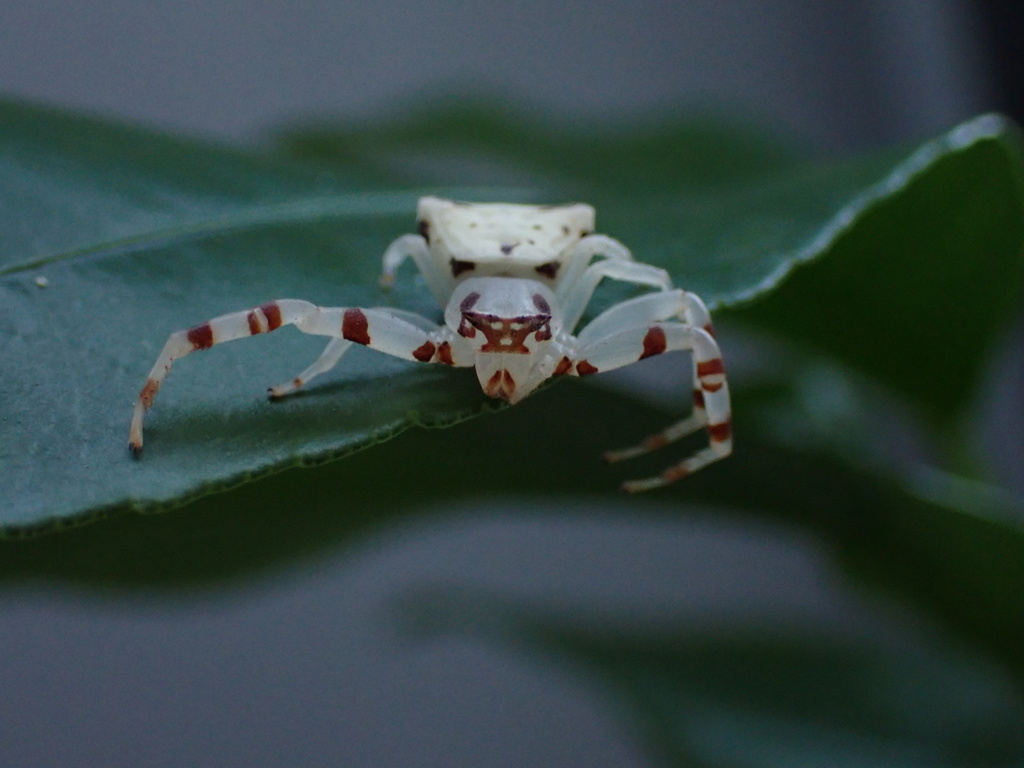
Masked Crab Spider
Thomisus labefactus
Thomisus labefactus is a species of crab spider in the family Thomisidae. It was first described by German arachnologist Ferdinand Karsch in 1881.
From the article Thomisus labefactus on Wikipedia (CC BY-SA), quoted section by section
Description
Like other crab spiders, T. labefactus exhibits sexual dimorphism. Females can reach up to 9 mm in total length, while males are considerably smaller at approximately 6.3 mm. The species shows considerable color variation, with some individuals appearing yellowish-white with brown markings, while others may be more uniformly colored. Females typically have a yellowish-white abdomen with distinctive brown muscle impressions arranged in the center of the upper half, and two rows of smaller similar markings along the outer edges. Mature specimens often display two deep black spots on the corners of the abdomen connected by a bluish streak. The legs are yellow with white markings, and the anterior legs (I and II) bear spines on the metatarsi and tibiae. Males are much darker in coloration and less distinctively marked than females. The cephalothorax is reddish-brown with darker edges, and the abdomen lacks the prominent black corner spots found in females.
Range & habitat
T. labefactus has been recorded from Korea, Japan, China, Taiwan, and Thailand. The species appears to be widely distributed across East and Southeast Asia.
Wikipedia: “Distribution”
What it does
The species has been observed to be somewhat nomadic but constructs a protective nest when guarding eggs. Females create this nest by drawing together the edges of a leaf with irregularly spaced silk threads to form an enclosure around a shallow cocoon containing the eggs. The dedication to egg protection is notable, as females will not abandon their eggs regardless of disturbance. Young spiders, measuring approximately 2 mm in length, have been observed overwintering under bark.
== References ==
Wikipedia: “Ecology”
Where it lives
Recorded sightings
—
geo-referenced records in GBIF, from museums, herbaria and field observers.
Drag the globe to turn it. Dots are where records exist, not a range map; darker means more records.
In the stacks
Searching the stacks…
Every page naming Thomisus labefactus in the Biodiversity Heritage Library →
This page is assembled live from iNaturalist, GBIF, Wikipedia, the Source Library and the Internet Archive. It is not yet part of the hand-edited codex. iNaturalist taxon 332452.