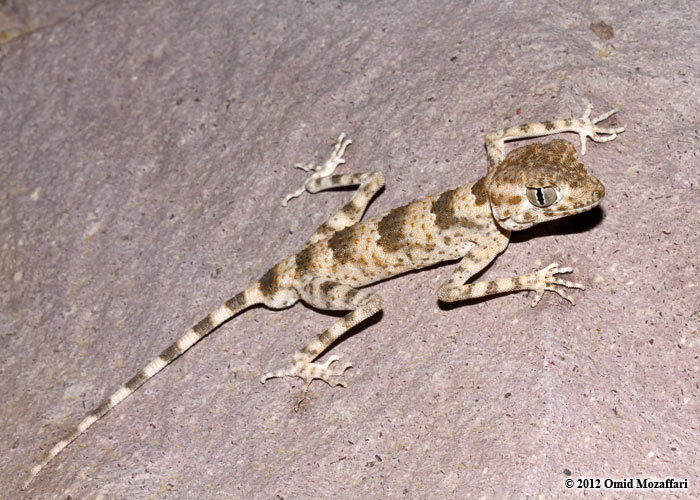
Persian Spider Gecko
Agamura persica
The Persian spider gecko (Agamura persica) hails from semidesert regions of Iran, Pakistan, and Afghanistan, where temperatures range from extreme summer day highs to extreme winter night lows.
Its long, slender legs and tail give it a spider-like impression and allow it to climb in its rocky habitat. The toes are slender, clawed, and angularly bent. It shares this feature with a number of other species and is classified as an angular-toed gecko. Two other species, Agamura femoralis (Smith, 1933) and Agamura misonnei (De Witte, 1973), have been placed in the genus, but Anderson (1999) and Khan (2003) referred them to the genus Rhinogekko.
From the article Persian spider gecko on Wikipedia (CC BY-SA), quoted section by section
In human culture
The Persian spider gecko inhabits rocky and stony terrain close to sandy semidesert, on hill slopes and barren plains. It is primarily nocturnal, but can be found during the day basking at temperatures of about 17.5 °C (air) and 15.5 °C (surface), and active at surface temperatures as high as 44 °C. Agamura's "well-developed (but immovable) upper 'eyelid'" is an adaptation to diurnal life. The lid serves as a sort of "sunshade". The Persian spider gecko reaches breeding size at 18 to 24 months of age. Its breeding period is from March to May, eggs are laid in June, and juveniles appear in September.
Wikipedia: “Natural history”
Where it lives
Recorded sightings
—
geo-referenced records in GBIF, from museums, herbaria and field observers.
Drag the globe to turn it. Dots are where records exist, not a range map; darker means more records.
In the stacks
Searching the stacks…
Every page naming Agamura persica in the Biodiversity Heritage Library →
This page is assembled live from iNaturalist, GBIF, Wikipedia, the Source Library and the Internet Archive. It is not yet part of the hand-edited codex. iNaturalist taxon 33179.