- Animals
- ›Chordates
- ›Vertebrates
- ›Reptiles
- ›Snakes and Lizards
- ›Lizards
- ›Iguanas and Allies
- ›Dragons and Chameleons
- ›Chameleons
- ›Madagascar Leaf Chameleons
- ›Brookesia
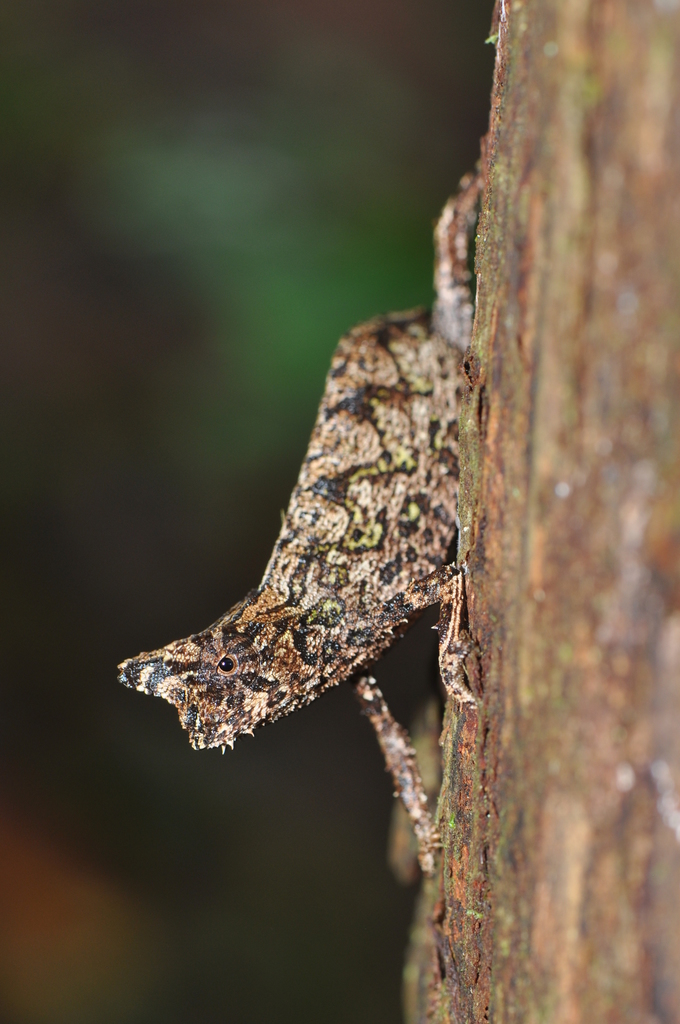
Perinet Leaf Chameleon
Brookesia therezieni
Brookesia therezieni, also known as the Perinet leaf chameleon, is a species of lizards in the family Chamaeleonidae. The species is endemic to eastern Madagascar. The International Union for Conservation of Nature (IUCN) classed the species as Least Concern. B. therezieni was initially described as a species new to science by Édouard-Raoul Brygoo and Charles Antoine Domergue in 1970.
From the article Brookesia therezieni on Wikipedia (CC BY-SA), quoted section by section
Range & habitat
Endemic to eastern Madagascar, Brookesia therezieni is found in the type locality of the species, Périnet, which is why it is known as the Perinet leaf chameleon. It is also found in the east-central area of Madagascar: An'Ala, Ankeniheny, Andasibe, Anjanaharibe, Mantadia, and Imerimandroso. It can be found at elevations between 900 and 1,500 m (3,000 and 4,900 ft) above mean sea level, and is estimated to be found over an area of 30,444 km2 (11,754 sq mi). Its preferred natural habitat is forest.
Wikipedia: “Distribution and habitat”
In human culture
The specific name, therezieni, is in honor of French hydrobiologist Yves Thérézien.
Wikipedia: “Etymology”
Where it lives
Recorded sightings
—
geo-referenced records in GBIF, from museums, herbaria and field observers.
Drag the globe to turn it. Dots are where records exist, not a range map; darker means more records.
In the stacks
Searching the stacks…
Every page naming Brookesia therezieni in the Biodiversity Heritage Library →
This page is assembled live from iNaturalist, GBIF, Wikipedia, the Source Library and the Internet Archive. It is not yet part of the hand-edited codex. iNaturalist taxon 32925.