- Animals
- ›Chordates
- ›Vertebrates
- ›Reptiles
- ›Snakes and Lizards
- ›Lizards
- ›Iguanas and Allies
- ›Dragons and Chameleons
- ›Chameleons
- ›Trioceros
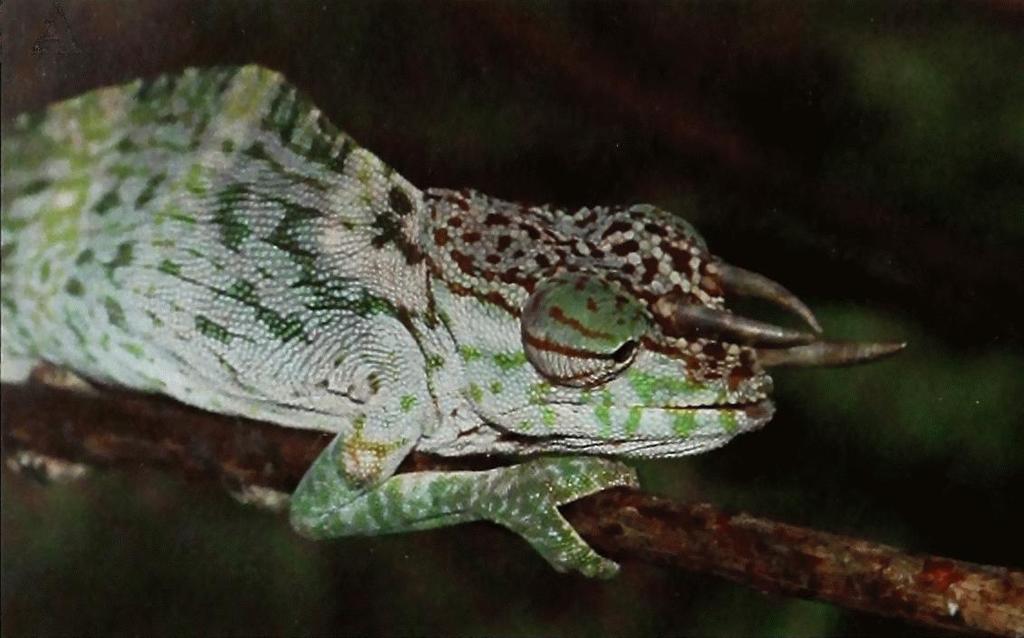
Owen's Chameleon
Trioceros oweni
Owen's chameleon (Trioceros oweni), also commonly known as Owen's three-horned chameleon, is a species of lizard in the family Chamaeleonidae. The species is native to forests in central Africa. Named after British naval officer and explorer William Fitzwilliam Owen, it was first described in 1831 by the naturalist John Edward Gray, and is the type species of the genus Trioceros.
From the article Owen's chameleon on Wikipedia (CC BY-SA), quoted section by section
Description
Like many other chameleons, Owen's chameleon has a prehensile tail and a single claw on each toe. Males have three smooth horns, while females lack horns but have loose skin on their hind legs that gives the impression of wearing baggy trousers. On average, adult Owen's chameleons range from 25 to 28 centimetres (9.8 to 11 inches) in total length (tail included), while a typical weight is around 75 grams (2.6 ounces). The species is generally arboreal and will leap from branch to branch or to the ground in order to avoid predators; it tends to feed on insects and other arthropods.
Wikipedia: “Description and behavior”
Range & habitat
Owen's chameleon can be found in much of tropical central Africa, from the Niger Delta in Nigeria in the north, to Angola in the south, and Burundi in the east. It inhabits dense evergreen and semi-deciduous forests at altitudes lower than 800 m (2,600 ft) above sea level, usually living in large trees. The type locality for the species is the island of Bioko in Equatorial Guinea.
Wikipedia: “Distribution and habitat”
Where it lives
Recorded sightings
—
geo-referenced records in GBIF, from museums, herbaria and field observers.
Drag the globe to turn it. Dots are where records exist, not a range map; darker means more records.
In the stacks
Searching the stacks…
Every page naming Trioceros oweni in the Biodiversity Heritage Library →
This page is assembled live from iNaturalist, GBIF, Wikipedia, the Source Library and the Internet Archive. It is not yet part of the hand-edited codex. iNaturalist taxon 32828.