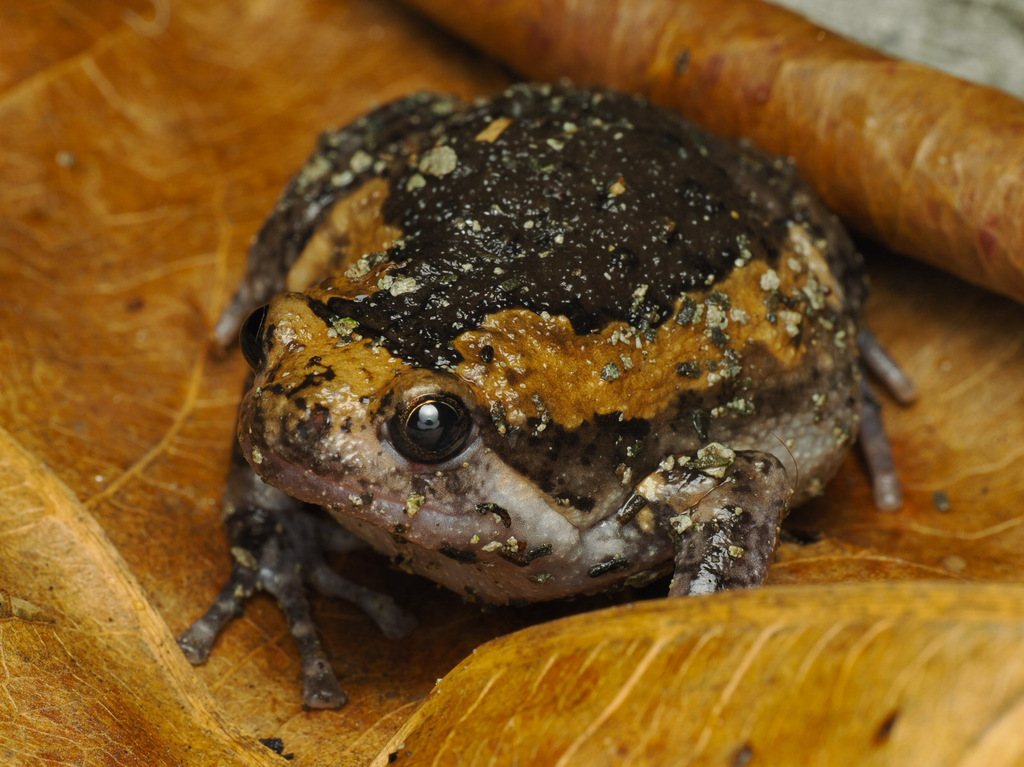
Asian Painted Frog
Kaloula pulchra
The banded bullfrog (Kaloula pulchra) is a species of frog in the narrow-mouthed frog family Microhylidae. Native to Southeast Asia, it is also known as the Asian painted frog, digging frog, Malaysian bullfrog, common Asian frog, and painted balloon frog. In the pet trade, it is sometimes called the chubby frog. Adults measure 5.4 to 7.5 cm (2.1 to 3.0 in) and have a dark brown back with stripes that vary from copper-brown to salmon pink.
The banded bullfrog lives at low altitudes and is found in both urban and rural settings, as well as in forest habitats. They bury themselves underground during dry periods and emerge after heavy rainfall to emit calls and breed. They feed primarily on ants and termites; predators of adults and tadpoles include snakes, dragonfly larvae, and snails. When threatened, they inflate their lungs and secrete a noxious white substance. The species is prevalent in the pet trade and is a potential invasive species being introduced in Taiwan, the Philippines, Guam, Singapore, Borneo, and Sulawesi.
From the article Banded bullfrog on Wikipedia (CC BY-SA), quoted section by section
Description
The banded bullfrog is medium-sized with a stocky, triangular body and a short snout. Males grow to a snout–vent length (SVL) of 5.4 to 7.0 cm (2.1 to 2.8 in) and females are slightly larger, reaching an SVL of 5.7 to 7.5 cm (2.2 to 3.0 in). Other than the slight difference in length, there is very limited sexual dimorphism. They have a body weight of 80–120 g (2.8–4.2 oz). The back is dark brown with stripes that vary from copper-brown to salmon pink, and the abdomen is cream-colored. Tadpoles are about 0.5 cm (0.20 in) long after hatching and reach an SVL of about 1.1 cm (0.43 in) at the end of metamorphosis. They have an oval body that is brown or black with a pale belly, a round snout, and a moderately long, tapered tail with yellow speckles and tall fins. The eyes are relatively small and the side of the head, with black or dark gray irises and a golden ring around the pupil. They do not possess any tail filament. During metamorphosis, their eyes increase in size and bulge and they develop slender limbs and digits with rounded tips. The tadpoles metamorphose beginning at two weeks.
Range & habitat
The species is native to Southeast Asia. It is common over a range from northeastern India, and Nepal, to southern India and Sri Lanka to southern China (especially Hainan) and Myanmar, and south to the islands of maritime Southeast Asia. Its wide distribution, compared to the related species Kaloula assamensis, has been attributed to its burrowing ability. The banded bullfrog has been found at elevations between sea level and 750 m (2,460 ft) above sea level. It can occur in both urban and rural settings, and in forest habitats.
As an invasive species. The banded bullfrog is a potential invasive species. It has been introduced through both the pet trade and maritime transport, and has become established in Taiwan, the Philippines, Guam, Singapore, Borneo, and Sulawesi. Some specimens have been observed in Australia and New Zealand. Its introduction into the Philippines was likely accidental, via contamination of plant nursery materials or stowaways on ships and boats. Several species, likely introduced through the pet trade, were observed in Florida in 2006 and 2008; however, as of 2011, the population is under control and there is no evidence of reproduction. The frog was observed at an airport in Perth, Australia, and at a cargo port in New Zealand, but no established invasive population has been found in either country as of 2019.
Wikipedia: “Distribution and habitat”
What it does
Breeding is stimulated by heavy monsoon rains, after which the frogs relocate from underground to rain pools or ponds. They are more commonly found on wetter nights, and while they are not reproductively active during dry periods, their gonads remain ripe so that they can mate soon after rainfall. In India, the male frogs call after the monsoon season begins in April or May. The pulses of the calls recorded in India were 28–56 per second with a frequency range of 50–1760 Hz. In Thailand the dominant frequency was 250 Hz (duration 560–600 ms long) and 18–21 pulses per call. Their form is suited for walking and burrowing rather than jumping. They are able to survive dry conditions by burying themselves in the ground and waiting for rain; the burrowing also helps them avoid predators. When burrowing they dig their way down hindlimb first and use their forelimbs to push themselves several inches under the soil, where they can remain for the duration of the dry season. Banded bullfrogs hide under leaf litter during the daylight hours and eat in the evening. They have been found in trees and have been observed hunting termites in them.
Diet, predators, and parasites. In the wild, the banded bullfrog primarily eats ants and termites. It also feeds on other small invertebrates including flies, crickets, moths, grasshoppers, and earthworms. …
Wikipedia: “Behaviour and ecology”
In human culture
The banded bullfrog was first described in 1831 by the British zoologist John Edward Gray, as Kaloula pulchra (pulchra meaning "beautiful" in Latin). Cantor (1847) described the species under the name Hylaedactylus bivittatus, which was synonymized with K. pulchra by Günther (1858). The subspecies K. p. hainana was described by Gressitt (1938) as having a shorter snout and hind legs compared to the nominate subspecies, K. p. pulchra. A former subspecies in Sri Lanka, originally named K. p. taprobanica by Parker (1934), has since been reclassified as a separate species, Uperodon taprobanicus. Bourret (1942) described a subspecies K. p. macrocephala that is now considered by several authors to be a distinct species, K. macrocephala. According to Darrel Frost's Amphibian Species of the World, common names for Kaloula pulchra include the Malaysian narrowmouth toad, Asian painted frog, digging frog, painted bullfrog, Malaysian bullfrog, painted burrowing frog, common Asian bullfrog, painted balloon frog, and painted microhylid frog. It is also known as the chubby frog in the pet trade.
Wikipedia: “Taxonomy and etymology”
Listen
Looking for field recordings…
Where it lives
Recorded sightings
—
geo-referenced records in GBIF, from museums, herbaria and field observers.
Drag the globe to turn it. Dots are where records exist, not a range map; darker means more records.
In the stacks
Searching the stacks…
Every page naming Kaloula pulchra in the Biodiversity Heritage Library →
This page is assembled live from iNaturalist, GBIF, Wikipedia, the Source Library and the Internet Archive. It is not yet part of the hand-edited codex. iNaturalist taxon 326303.