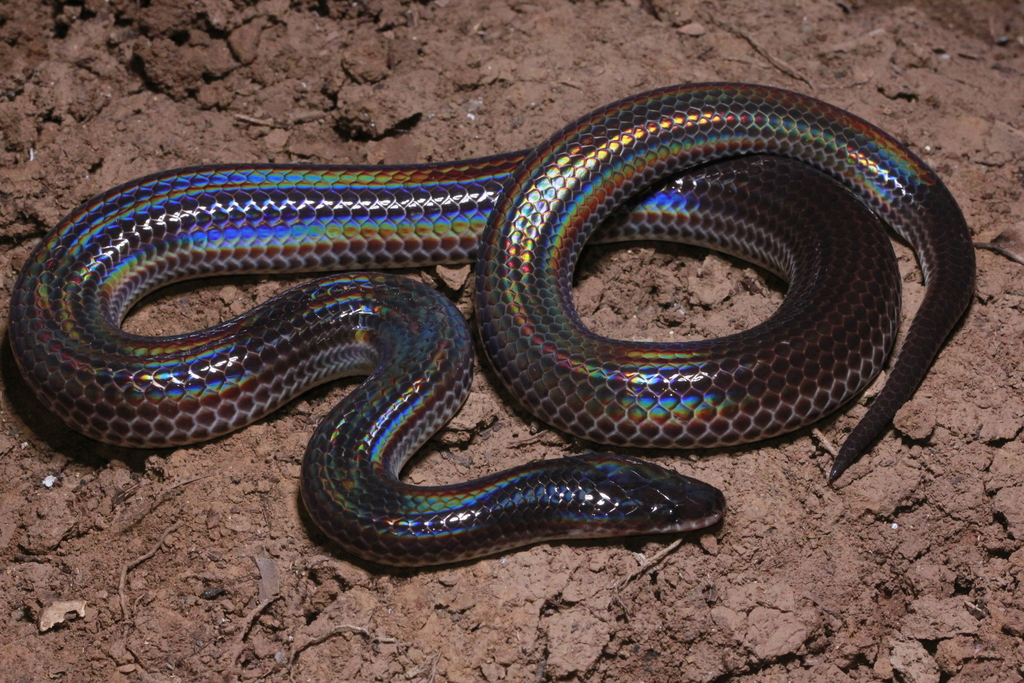
Asian Sunbeam Snake
Xenopeltis unicolor
Xenopeltis unicolor, commonly known as the sunbeam snake, common sunbeam snake or iridescent snake, is a non-venomous sunbeam snake species found in Southeast Asia and some regions of Indonesia. This is a primitive snake known for both its highly iridescent scales and its ability to reproduce quickly, as it is oviparous and as such can lay up to 10 eggs at a time. No subspecies are currently recognized.
From the article Xenopeltis unicolor on Wikipedia (CC BY-SA), quoted section by section
Description
Grows to an average of about 1 m (3 ft 3 in). The color is reddish brown, brown or blackish with an unpatterned withish-grey venter. A fossorial species, the head is wedge-shaped and narrow with little neck delineation, which makes it easy to push through the soil. Its most defining characteristic is its iridescent, highly polished scales that give this snake its common name. They have a layer of dark pigmentation just below the surface on each scale that enhances the iridescence. The young look very similar to the adults, except that they have a strong white "collar" of scales evident just below the head. This coloration fades within the first year. They have two cone opsins allowing for the potential of dichromatic color vision. Xenopeltis unicolor has two postocular scales, supralabial formula 3-2-3, 181 – 196 ventrals, and 26 – 31 pairs of subcaudals. This is a primitive form of snake with both boid and python characteristics; which family it belongs to is still a matter of debate.
Range & habitat
Found in China (Guangdong and Yunnan), Myanmar, the Andaman and Nicobar Islands, Vietnam, Laos, Cambodia, Thailand, West Malaysia, Penang Island, Singapore Island, East Malaysia (Sarawak), Indonesia (the Riau Archipelago, Bangka, Billiton, Sumatra, We, Simalur, Nias, the Mentawai Islands (Siberut), Borneo, Java and Sulawesi) and the Philippines (Balabac, Bongao, Jolo and Palawan). The type locality given is "Java".
Wikipedia: “Geographic range”
What it does
These snake are constrictors, killing their prey by suffocation in their muscular coils. They are fossorial and spend most of their time below ground. They may bite readily if handled roughly, but mostly just try to escape if picked up. They are also observed to vibrate their tails in a rattlesnake-like fashion when they feel threatened.
Wikipedia: “Behaviour”
Where it lives
Recorded sightings
—
geo-referenced records in GBIF, from museums, herbaria and field observers.
Drag the globe to turn it. Dots are where records exist, not a range map; darker means more records.
In the stacks
Searching the stacks…
Every page naming Xenopeltis unicolor in the Biodiversity Heritage Library →
This page is assembled live from iNaturalist, GBIF, Wikipedia, the Source Library and the Internet Archive. It is not yet part of the hand-edited codex. iNaturalist taxon 32407.