On eBird ↗
Micronesian Imperial-Pigeon
Live sightings near you, the range map, bar charts of when it is seen, and Macaulay Library photos and recordings.
Micronesian Imperial Pigeon
Ducula oceanica
The Micronesian imperial pigeon (Ducula oceanica), also known as the Micronesian pigeon, and Belochel is a species of bird in the family Columbidae (doves). It is found in Palau, the Caroline Islands, the Marshall Islands and Nauru. Its habitats include montane forests, secondary forests, forests on beaches, and mangroves. It is threatened by hunting and deforestation, and the IUCN has assessed it as a near-threatened species.
From the article Micronesian imperial pigeon on Wikipedia (CC BY-SA), quoted section by section
Description
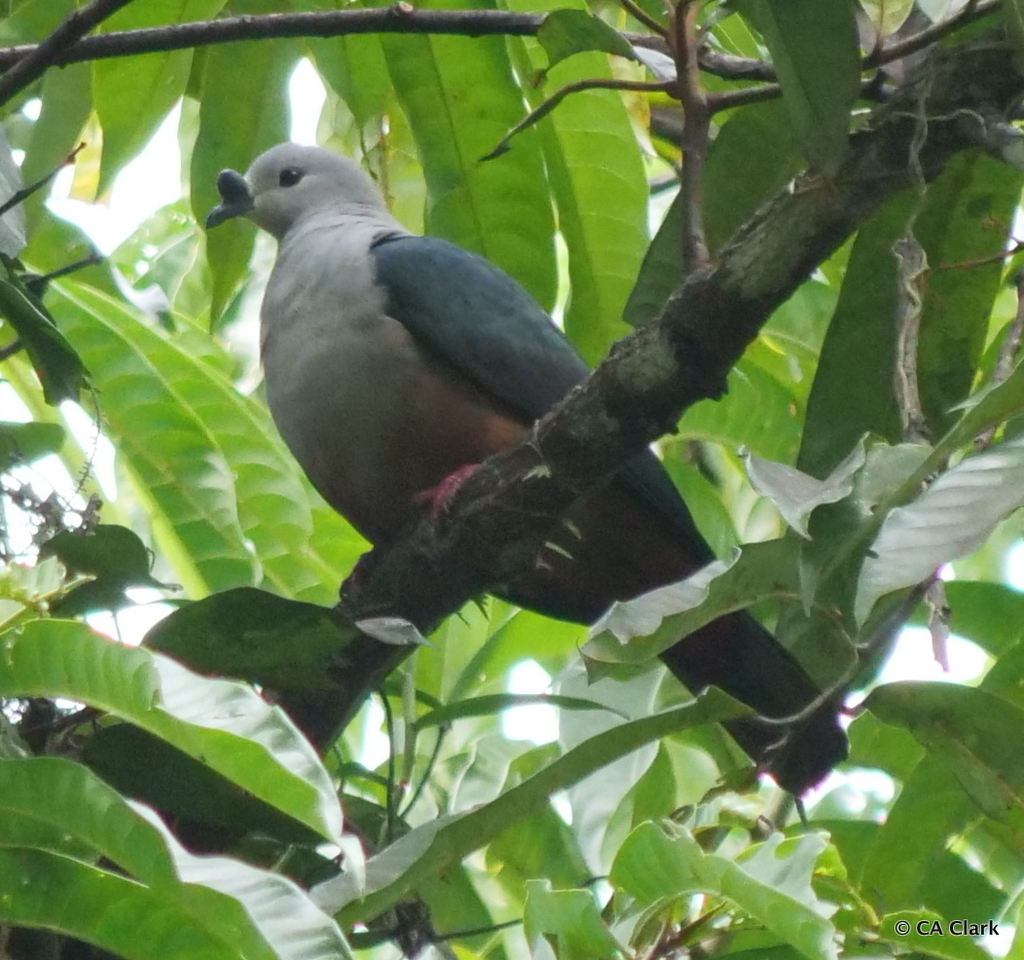
The Micronesian imperial pigeon is about 36 cm (14 in) long and weighs 340–406 g (12.0–14.3 oz). The head and neck are ashy grey. The back and wing coverts are dark green, reflecting dark blue. The flight feathers are blackish, with a green gloss. The breast is light grey, and the vent is dark rufous. The tail is blackish above and dark brown below. The beak is slaty black, and the cere is black. The eyes are reddish brown, and the feet are purplish red. The female and the juvenile birds are darker. The subspecies are distinguished by their size and the colour of their heads. This species of bird makes many different types of calls, which can sound like barking, cooing, or moaning. It can probably fly pretty well.
Range & habitat
The Micronesian imperial pigeon is found in the Marshall Islands, Yap, Chuuk, Pohnpei and Kosrae of Micronesia, Nauru, Kiribati and Palau. The populations on many of the Marshall Islands are probably extinct. On Pohnpei and Kosrae, it mostly lives in the mountains. In areas where it is not hunted, it is found in secondary forest, forest on beaches, and mangroves. It also occurs in coconut plantations. The species also occurred once in the Mariana Islands, where Holocene subfossil remains are found.
Wikipedia: “Distribution and habitat”
What it does
This pigeon is mostly solitary, usually observed in the canopy. It eats fruits and fleshy seeds. Its calls include a deep-throated bark grrow-row-row-ow, a moan, and mellow coos. Almost nothing is known about its breeding. The breeding season is probably the entire year.
Wikipedia: “Behaviour”
Listen
Looking for field recordings…
Where it lives
Recorded sightings
—
geo-referenced records in GBIF, from museums, herbaria and field observers.
Drag the globe to turn it. Dots are where records exist, not a range map; darker means more records.
In the stacks
Searching the stacks…
Every page naming Ducula oceanica in the Biodiversity Heritage Library →
This page is assembled live from iNaturalist, GBIF, Wikipedia, the Source Library and the Internet Archive. It is not yet part of the hand-edited codex. iNaturalist taxon 3228.