On eBird ↗
Rufescent Imperial-Pigeon
Live sightings near you, the range map, bar charts of when it is seen, and Macaulay Library photos and recordings.
Rufescent Imperial Pigeon
Ducula chalconota
The Rufescent Imperial Pigeon (Ducula chalconota), also known as the Shining Imperial Pigeon, is a rare species in the world of birds. According to The International Union for Conservative, this species is relatively unknown, and their concern is very minimal. The Union describes that this species is very stable and does not encounter threats from other species The trait of stability is vital in differentiating The Rufescent Imperial Pigeon from the other species confronting threats. This bird in specific does not frequently encounter threats because they are more reserved, quiet birds that tend to remain alone in their habitat. The habitat of these birds allows them to have the frequency of being independent but also gives them the chance to be with other birds. Rooting from the bird family in Columbidae, that also consists of pigeons and doves. In which this family is known for being frugivorous, meaning it primarily feeds on fruit, figs, and seeds.
From the article Rufescent imperial pigeon on Wikipedia (CC BY-SA), quoted section by section
Description
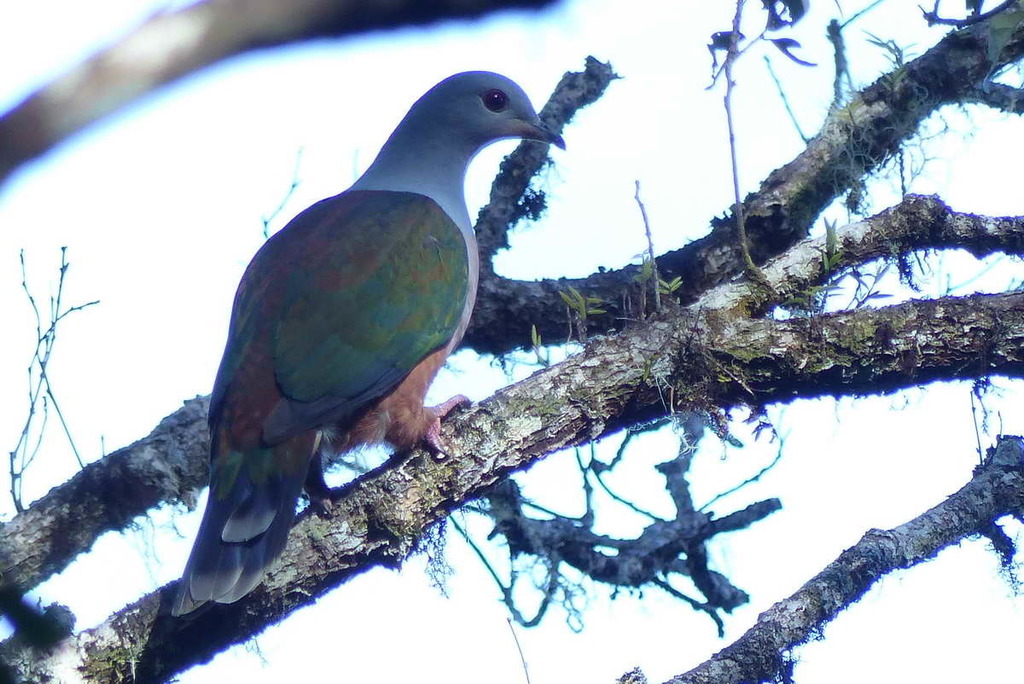
To compare, the Male Rufescent Imperial Pigeon is about 41 to 42 centimeters or about 16 to 17 inches in length. In contrast, females are smaller, about 37 to 39 centimeters or 15 inches long, and can be distinguished by slight color differences. Both weigh around 21-22 ounces. Rufescent Imperial Pigeons, both male and female, are larger than most of the other pigeon species. In the subspecies smaragdina, the head is slaty-grey. The back and wing coverts are metallic green, with bronzy and bluish reflections, and the flight feathers are darker and more bluish. The tail is blackish and has a blue gloss. The throat is cinnamon, and the breast is vinous. The belly and flanks are chestnut. The feet are red, the eye is reddish, and the beak is dark slate. The female is very similar to the male. The juvenile bird has a paler head and neck, and its breast is vaguely greyish. The subspecies chalconota has a reddish-purple iridescence on its mantle and back.
Range & habitat
The Rufescent Imperial Pigeon can be found in the deeper layers of the Montane Forest in New Guinea. The forest environment is the habitat to this pigeon's lifestyle because it allows Rufescent Imperial Pigeons to be at a high elevation level of 3,600 feet tall to around 8,200 feet high. Compared to other members of the Columbidae family, this elevation is high to be a habitat. Male and female Rufescent Imperial Pigeons can be found in these forests, primarily single, but sometimes they can be found in pairs (inaturalist).
Wikipedia: “Distribution and habitat”
What it does
It often sits in the middle layers of the forest, and it does not leave the forest. Usually silent, it hums slowly and mournfully and also gives a low hoo and a hollow knock. Duetting has been observed. It eats figs and fruits. The breeding is unknown except that individuals in breeding condition have been collected in February and March. Determining a Rufescent Imperial Pigeon is mainly done through visuals rather than vocals. This bird does not vocally express itself frequently, but when alarmed a hollow knock sound will echo through the forest. This hollow knock is known to sound like a slurred "woo". Coloring, though, is a more simplistic way to determine a rufescent imperial pigeon. Their chest is a pale-orange color that leads to a deep rufous belly and a black band in the tail. Females are distinguished by having a less reddish iridescence than males. Despite the fact that this bird is a pigeon, discovering a Rufescent Imperial Pigeon would be a very rare occurrence.
Wikipedia: “Behaviour”
Listen
Looking for field recordings…
Where it lives
Recorded sightings
—
geo-referenced records in GBIF, from museums, herbaria and field observers.
Drag the globe to turn it. Dots are where records exist, not a range map; darker means more records.
In the stacks
Searching the stacks…
Every page naming Ducula chalconota in the Biodiversity Heritage Library →
This page is assembled live from iNaturalist, GBIF, Wikipedia, the Source Library and the Internet Archive. It is not yet part of the hand-edited codex. iNaturalist taxon 3225.