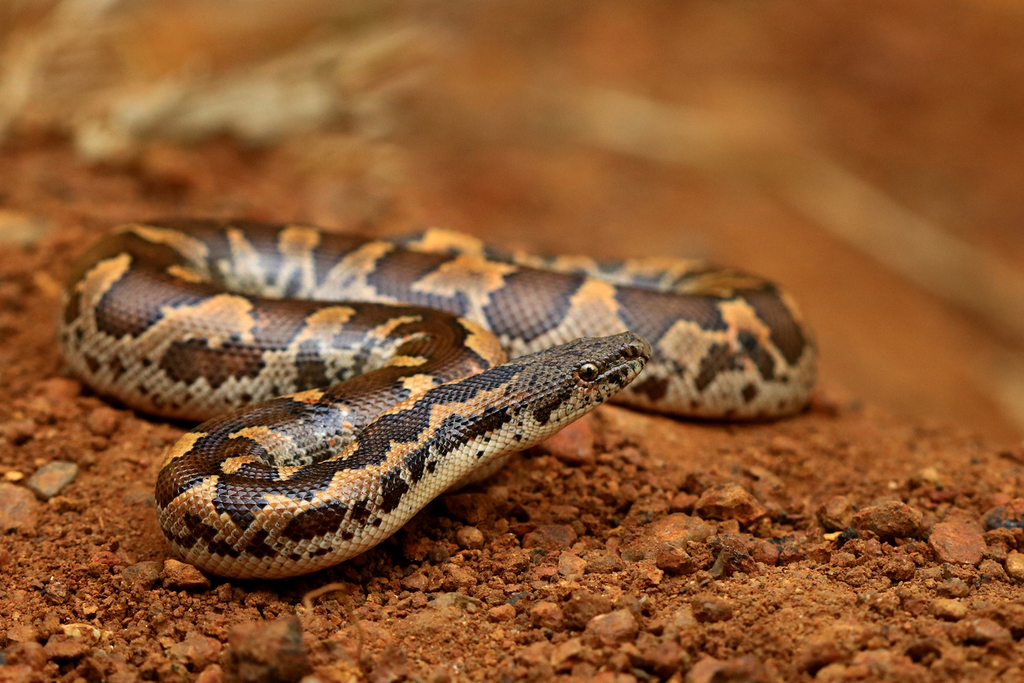
Rough-scaled Sand Boa
Eryx conicus
Common names: Russell's sand boa, rough-tailed sand boa, common sand boa.
Eryx conicus is a species of non-venomous snake in the subfamily Erycinae of the family Boidae. The species is native to southern Asia. No subspecies are recognised as being valid.
From the article Eryx conicus on Wikipedia (CC BY-SA), quoted section by section
Description
Adults of E. conicus may attain a total length of 3 feet 3 inches (99 cm), which includes a tail 3 inches (76 mm) long. The anterior maxillary and mandibular teeth are longer than the posterior. The head is covered with small scales. The eye is small with a vertical pupil. The dorsal scales are small and keeled. The tail is pointed, not or but very slightly prehensile. The rostral scale is twice as broad as long, slightly prominent, without an angular horizontal edge. The top of the head is covered with small obtusely keeled scales, except for the nasals and internasals which are enlarged. Interorbitals: 8 to 10. Circumorbitals: 10 to 15. The eye is separated from the labials by one or two rows of scales. Supralabial scales: 12 to 14. Dorsal scales tubercularly keeled, in 40 to 49 rows. Ventral scales: 162-186. The anal scale is single. Subcaudals: 17-24. The anterior dorsal scales are only feebly keeled, but these keels increase in size posteriorly to the point that they become so heavily keeled that it can make a squirming specimen really painful to handle. This also makes it look as if the front and rear ends belong to markedly different animals. Dorsally, the color pattern consists of a broad zigzag band or a series of dark brown blotches on a yellowish or brownish grey ground color. …
Range & habitat
E. conicus is found in India south of about 30°N latitude, Nepal, Bangladesh and in the northern arid region of Sri Lanka. The type locality given is "India orientali ".
Wikipedia: “Geographic range”
What it does
E. conicus is active at dusk and at night.In many rural villages across South Asia, particularly in India, a prevalent rural myth dictates that being "licked" or bitten by a Common Sand Boa will cause irregular white patches, skin discoloration, or permanent "tattoos" across the body
Wikipedia: “Behavior”
Where it lives
Recorded sightings
—
geo-referenced records in GBIF, from museums, herbaria and field observers.
Drag the globe to turn it. Dots are where records exist, not a range map; darker means more records.
In the stacks
Searching the stacks…
Every page naming Eryx conicus in the Biodiversity Heritage Library →
This page is assembled live from iNaturalist, GBIF, Wikipedia, the Source Library and the Internet Archive. It is not yet part of the hand-edited codex. iNaturalist taxon 32205.