- Animals
- ›Chordates
- ›Vertebrates
- ›Ray-finned Fishes
- ›Spiny-rayed fishes
- ›Freshwater Sunfishes, Grunters, and Allies
- ›Freshwater Sunfishes and relatives
- ›Old Wives
- ›Enoplosus
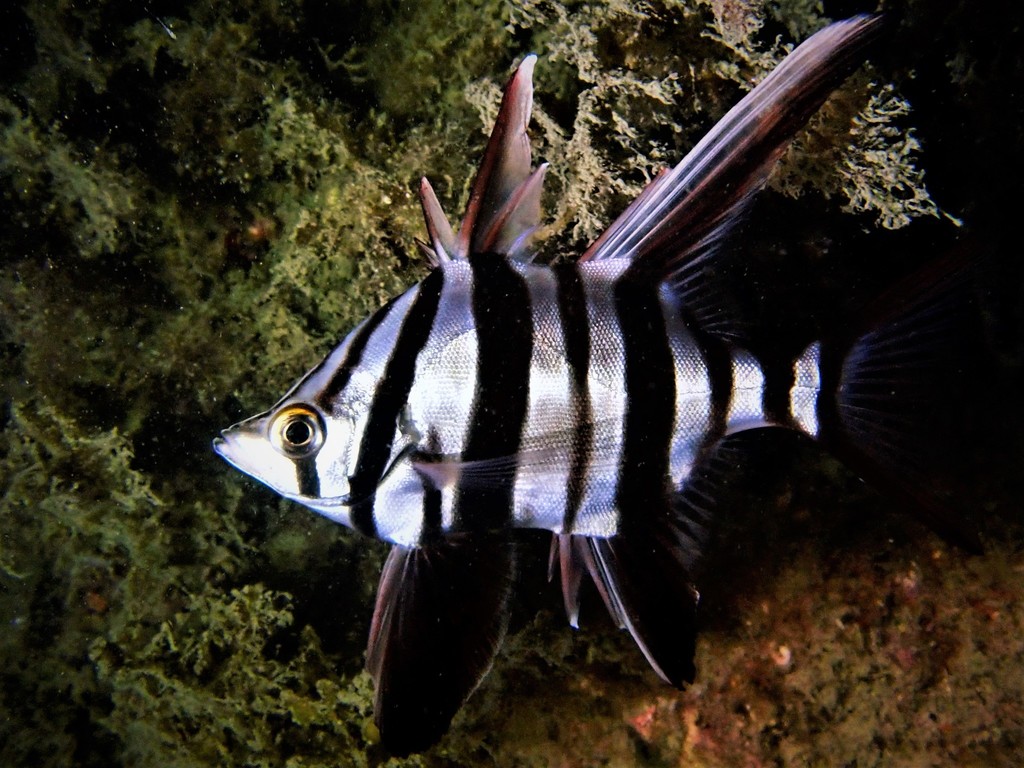
Old Wife
Enoplosus armatus
Enoplosus armatus, commonly referred to as the old wife (plural: old wives), is a species of centrarchiform ray-finned fish endemic to the temperate coastal waters of Australia. It is the only genus and species in the family Enoplosidae.
It has a deep and compressed body and concave forehead. These features are characteristic of typical butterflyfishes. However, the old wife is easily distinguished by its silver-and-black, vertical, zebra-striped coloration, and by its two prominent dorsal fins. The second dorsal fin is very long and sickle-shaped. The fish grows up to 50 cm long.
From the article Old wife on Wikipedia (CC BY-SA), quoted section by section
In human culture
The old wife was originally classified in the genus Chaetodon (with the typical butterflyfishes), but it is now classified as the sole modern species of its own family Enoplosidae and genus Enoplosus. Some fossils have also been added to the genus.
The first description of the species, one of the earliest for any Australian fish, was in 1790 by John White in his Journal of a Voyage to New South Wales though some sources give George Shaw (who assisted White in the preparation of his manuscript) as the species authority. White originally named it the long-spined chaetodon (Chætodon armatus) and described it as follows:
Whitish Chaetodon, with seven black stripes on the body. Six spines on the dorsal fin, the third very long. This appears to be a new and very elegant species of the genus Chaetodon. The total length of the specimen was not more than four inches. The colour a silvery white, darker, and of a bluish tinge on the back; the transverse fasciae, or bands, of a deep black; the fins and tail of a pale brown. …
Wikipedia: “History”
Where it lives
Recorded sightings
—
geo-referenced records in GBIF, from museums, herbaria and field observers.
Drag the globe to turn it. Dots are where records exist, not a range map; darker means more records.
In the stacks
Searching the stacks…
Every page naming Enoplosus armatus in the Biodiversity Heritage Library →
This page is assembled live from iNaturalist, GBIF, Wikipedia, the Source Library and the Internet Archive. It is not yet part of the hand-edited codex. iNaturalist taxon 322007.