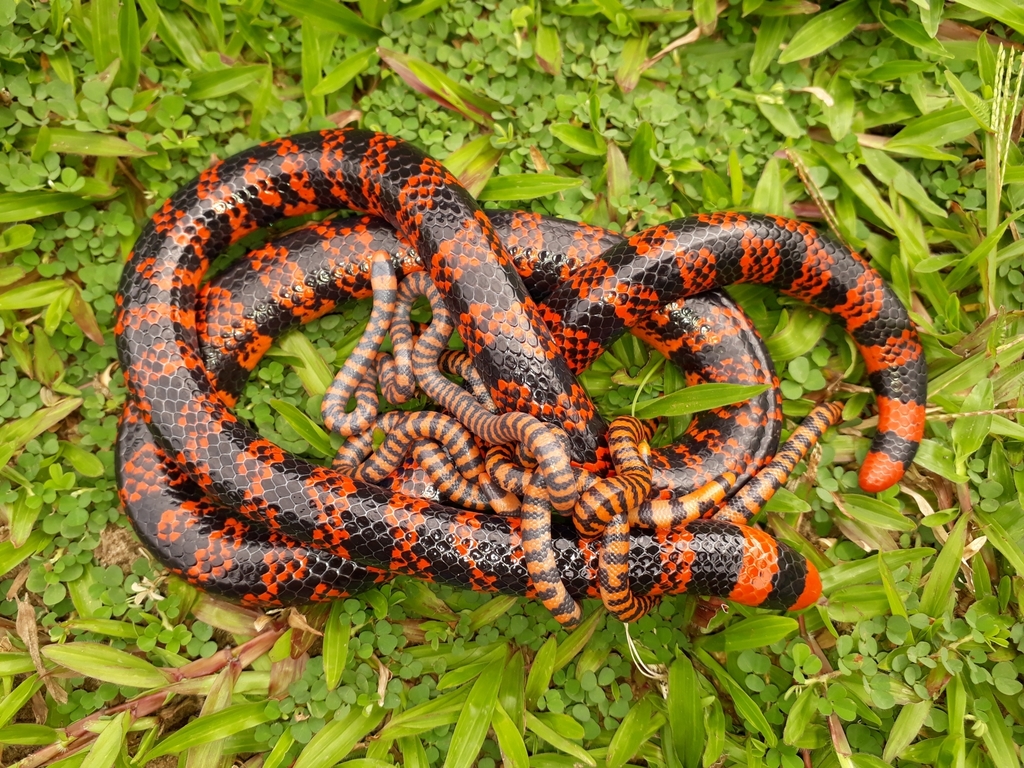
False Coral Snake
Anilius scytale
The Aniliidae are a monotypic family created for the monotypic genus Anilius that contains the single species Anilius scytale. Common names include the American pipe snake and false coral snake. It is found in South America. This snake possesses a vestigial pelvic girdle that is visible as a pair of cloacal spurs. It is ovoviviparous. It is non-venomous, and its diet consists mainly of amphibians and other reptiles. Two subspecies are recognized, including the nominate subspecies described here.
From the article Anilius on Wikipedia (CC BY-SA), quoted section by section
Description
This species is found in the Amazon rainforest of South America, the Guianas, and Trinidad and Tobago. It is a moderate-sized snake attaining a size of about 70 cm (28 in) in length. It is fossorial and is rarely seen. It is reported to be ovoviviparous and feeds on beetles, caecilians (burrowing legless amphibians), amphisbaenids or worm lizards (legless lizards), small fossorial snakes, fish (particularly swamp eels), and frogs. It forages for food on the ground, and sometimes in the water, at night. It has a cylindrical body of uniform diameter and a very short tail; it is brightly banded in red and black and its reduced eyes lie beneath large head scales. It is considered to be the snake that most resembles the original and ancestral snake condition, such as a lizard-like skull.
Range & habitat
It is found in the tropics of northern South America from southern and eastern Venezuela, Guyana, Suriname and French Guiana south through the Amazon Basin of Colombia, Ecuador, Peru, and Brazil. The type locality given is "Indiis".
Wikipedia: “Geographic range”
Where it lives
Recorded sightings
—
geo-referenced records in GBIF, from museums, herbaria and field observers.
Drag the globe to turn it. Dots are where records exist, not a range map; darker means more records.
In the stacks
Searching the stacks…
Every page naming Anilius scytale in the Biodiversity Heritage Library →
This page is assembled live from iNaturalist, GBIF, Wikipedia, the Source Library and the Internet Archive. It is not yet part of the hand-edited codex. iNaturalist taxon 32073.