- Animals
- ›Chordates
- ›Vertebrates
- ›Reptiles
- ›Snakes and Lizards
- ›Snakes
- ›Colubrid Snakes
- ›Natricine Snakes
- ›Aspidura
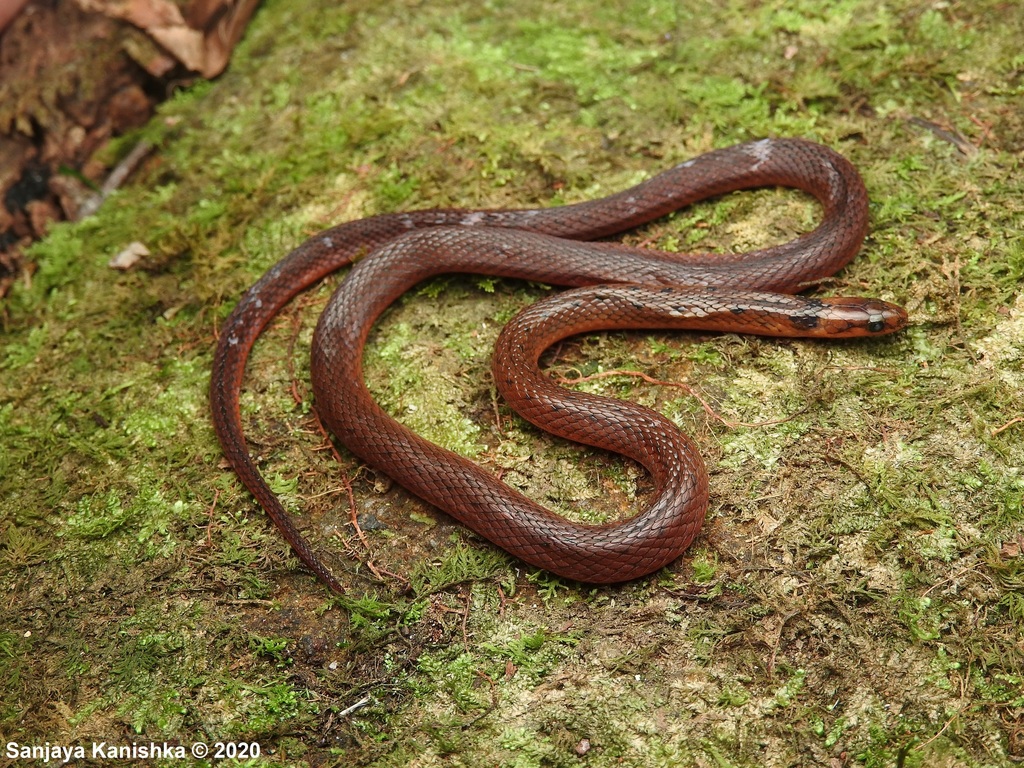
Ceylon Keelback
Aspidura ceylonensis
Aspidura ceylonensis, commonly black-spined snake and as කුරුන් කරවලා (kurun karawala) or රත් කරවලා (rath karawala) in Sinhala, is a colubird species endemic to Sri Lanka. Until recently, the snake was known as Haplocercus ceylonensis.
From the article Aspidura ceylonensis on Wikipedia (CC BY-SA), quoted section by section
Description
The head is long and the snout is broadly rounded. The neck is indistinct and the body is slender with cylindrical, short tail. The dorsal side is crimson brown with a black vertebral line, hence given the name. The dorsum of fore-body is brown. Laterally there are a series of black spots in a line and the neck region has a dark brown marking. The venter is crimson colored. Adults are 50 cm (20 in) in length. The midbody has 17 scale rows. There are 162–207 ventral scales and 37–56 subcaudal scales. The scales are smooth and iridescent.
Range & habitat
Aspidura ceylonensis is a semi-fossorial snake from submontane forests. Restricted to submontane forests and plantations of the Central Highlands, including Pussellawa, Gampola, Hatton, Knuckles, Balangoda, Pundaluoya, Ramboda, Kotagala, Namunukula, Mousakanda, Gammaduwa, and Kotmale, up to about 1,200 m (3,900 ft) of elevation.
Wikipedia: “Distribution”
What it does
It is a nocturnal and terrestrial snake that lives in damp soil, silted-up drains, beneath heaps of decaying leaves, and in similar places where there are earthworms, its primary prey.
Reproduction. Clutches of two to five eggs are produced in the months of August to November.
== References ==
Wikipedia: “Ecology”
Where it lives
Recorded sightings
—
geo-referenced records in GBIF, from museums, herbaria and field observers.
Drag the globe to turn it. Dots are where records exist, not a range map; darker means more records.
In the stacks
Searching the stacks…
Every page naming Aspidura ceylonensis in the Biodiversity Heritage Library →
This page is assembled live from iNaturalist, GBIF, Wikipedia, the Source Library and the Internet Archive. It is not yet part of the hand-edited codex. iNaturalist taxon 318635.