On eBird ↗
Red-knobbed Imperial-Pigeon
Live sightings near you, the range map, bar charts of when it is seen, and Macaulay Library photos and recordings.
Red-knobbed Imperial Pigeon
Ducula rubricera
The red-knobbed imperial pigeon (Ducula rubricera) is a bird species in the family Columbidae. It is found in the Bismarck Archipelago and the Solomon Islands archipelago. Its natural habitat is subtropical or tropical moist lowland forests.
From the article Red-knobbed imperial pigeon on Wikipedia (CC BY-SA), quoted section by section
Description
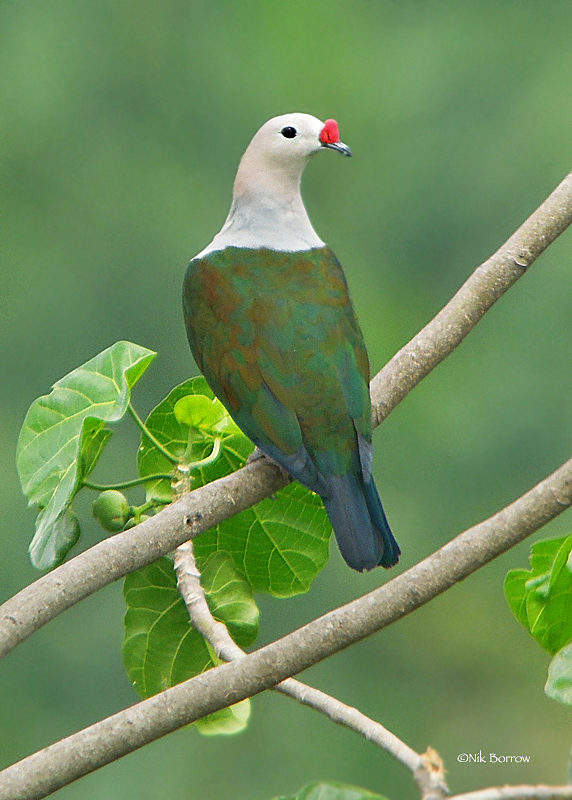
The red-knobbed imperial pigeon is a large pigeon with a pale pink to grey head, chestnut belly, and emerald green and bronzy wings. Its namesake feature, the red knob on the upper mandible, is the enlarged cere of the bird. Juveniles lack this enlarged cere, looking similar to Finsch's imperial pigeon. However, they lack the white eye ring and tail band of that species, and their reddish underside is paler than that of Finsch's imperial pigeon. The two subspecies differ mainly in coloration from the breast upwards. Ducula rubricera rubricera, the subspecies found in the Bismarck Archipelago, has a mostly pale pink breast, neck, nape, and crown. Ducula rubricera rufigula, the subspecies found in the Solomon Islands archipelago, has wholly light grey plumage from the breast upwards, with the exception of the throat and the cheeks.
Range & habitat
The red-knobbed imperial pigeon is endemic to Melanesia, being found throughout the Bismarck Archipelago and the Solomon Islands archipelago. Within the Bismarck Archipelago, it is found in New Ireland, New Britain, New Hanover, Umboi, Lolobau, Watom, Duke of York, Bougainville, and the island groups of Lihir, Tanga, Feni, and Tabar. In the Solomon Islands, it is found in at least Makira, the New Georgia Islands, Malaita, Santa Isabel, Choiseul, and Guadalcanal. It is typically found in both primary and secondary lowland rainforest, but can be found up to 1200 metres on Guadalcanal and Kolombangara. Though it is tolerant of degraded forest, gardens, cocoa plantations, and even urban areas, it is known to avoid heavily degraded or deforested areas and palm oil plantations.
Wikipedia: “Distribution and habitat”
What it does
Red-knobbed imperial pigeons are frugivorous, eating fruits such as those from the galip nut tree. They feed in the canopy, usually alone or in pairs, though they have been seen in groups of over 30 individuals, and are known to form smaller foraging groups of 5-10 individuals as well. This species is also known to forage with the claret-breasted fruit dove in New Georgia. Courtship has been observed during July-August. The pigeons bob their heads while cooing or whooping, and they may jump during the whooping displays. They also engage in flight displays. Red-knobbed imperial pigeons have been observed to nest in at least February, July, and August. In some areas at least, they nest in colonies within low vegetation. They lay only one egg.
Wikipedia: “Ecology”
In human culture
The species' generic name, Ducula, comes from the Nepalese word for imperial pigeons, dukul. The specific epithet, rubricera, comes from Latin ruber, meaning red, and Medieval Latin cera, meaning wax (referring to the cere). The subspecific epithet for the subspecies D. r. rufigula is derived from Latin rufus, meaning red, and gula, meaning throat, owing to the subspecies' noticeable pinkish throat surrounded mostly by grey. Other outdated common names for this species include New Ireland fruit-pigeon and red-cered pigeon.
Wikipedia: “Etymology”
Listen
Looking for field recordings…
Where it lives
Recorded sightings
—
geo-referenced records in GBIF, from museums, herbaria and field observers.
Drag the globe to turn it. Dots are where records exist, not a range map; darker means more records.
In the stacks
Searching the stacks…
Every page naming Ducula rubricera in the Biodiversity Heritage Library →
This page is assembled live from iNaturalist, GBIF, Wikipedia, the Source Library and the Internet Archive. It is not yet part of the hand-edited codex. iNaturalist taxon 3180.