On eBird ↗
Luzon Bleeding-heart
Live sightings near you, the range map, bar charts of when it is seen, and Macaulay Library photos and recordings.
Luzon Bleeding-heart
Gallicolumba luzonica
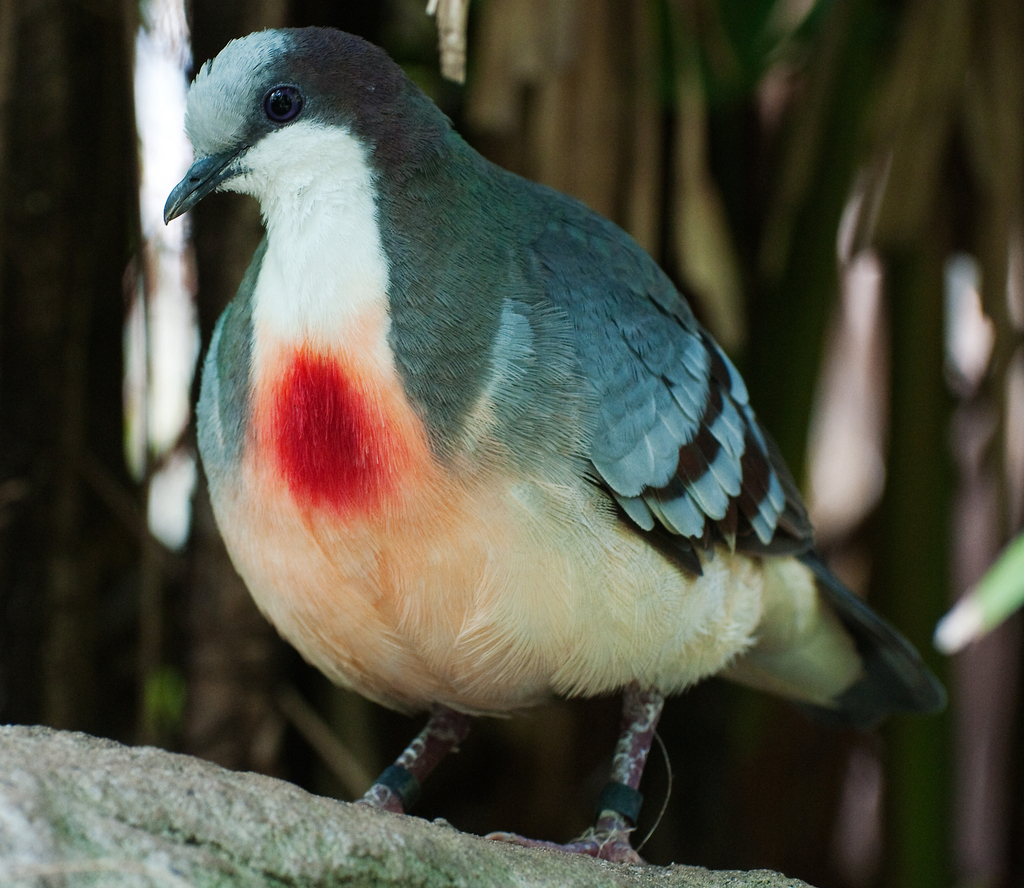
The Luzon bleeding-heart, bleeding-heart dove, bleeding-heart pigeon or punay (Gallicolumba luzonica) is a species of ground dove in the genus Gallicolumba, known as "bleeding-hearts" due to the distinctive red patch on its chest. It was also known as paloma de punalada 'stabbed pigeon' but is nowadays more commonly referred to as just punalada. The Luzon bleeding-heart is the species in which the "blood" feature is most pronounced, while the Mindanao bleeding-heart does have a larger red patch, the Luzon bleeding-heart has a reddish hue extending down the belly, furthering the illusion of a blood stain. It is threatened by habitat loss and hunting for the pet trade and for meat.
It is illegal to hunt, capture or possess Luzon bleeding-hearts under Philippine Law RA 9147.
From the article Luzon bleeding-heart on Wikipedia (CC BY-SA), quoted section by section
Description
It is a medium-sized ground dove. On its upper surfaces, the Luzon bleeding-heart is slate grey in color, but because of its iridescence, it can appear to be purple, royal blue, or bottle-green with varying lighting conditions. On their wings are black bands, while their belly and under wing areas are buff or chestnut. It has a white throat, chest and belly but its most distinctive part is its bright red "bleeding heart" at the center of its chest that has a surrounding faint pink that gives off the appearance of fading blood stains. There is some slight sexual dimorphism; males tend to be larger and have a more pronounced red patch, while in the females it is slightly duller. The body shape is typical of the genus, with a round body, short tail, and long legs. Its call is described as a repeated single mournful coo lasting 1 to 2 seconds that rises and falls. It also has a 5 and 3 note display call that is gruffly delivered.
Subspecies. Three subspecies are recognized: G. l. luzonica – Found on Central and South Luzon and Polillo Islands G. l. rubiventris – Found on North Luzon; darker and more extensive "heart", pale pink brown belly, paler undertail and smaller G. l. griseolateralis – Found on Catanduanes; darker forehead, crown, shoulder, females has darker flanks, undertail but the breast and abdomen is whiter
Wikipedia: “Description and taxonomy”
What it does
They eat seeds, berries and grubs. They are shy and secretive, and very quiet, and rarely leave the ground except when nesting. Unlike the other bleeding-hearts, they usually lay two eggs in each clutch. It has been recorded nesting in May and June.
Wikipedia: “Behaviour and ecology”
Listen
Looking for field recordings…
Where it lives
Recorded sightings
—
geo-referenced records in GBIF, from museums, herbaria and field observers.
Drag the globe to turn it. Dots are where records exist, not a range map; darker means more records.
In the stacks
Searching the stacks…
Every page naming Gallicolumba luzonica in the Biodiversity Heritage Library →
This page is assembled live from iNaturalist, GBIF, Wikipedia, the Source Library and the Internet Archive. It is not yet part of the hand-edited codex. iNaturalist taxon 3168.