- Animals
- ›Chordates
- ›Vertebrates
- ›Reptiles
- ›Snakes and Lizards
- ›Lizards
- ›Iguanas and Allies
- ›Dragons and Chameleons
- ›Dragons
- ›Bearded Dragons, Water Dragons, and Allies
- ›Tympanocryptis
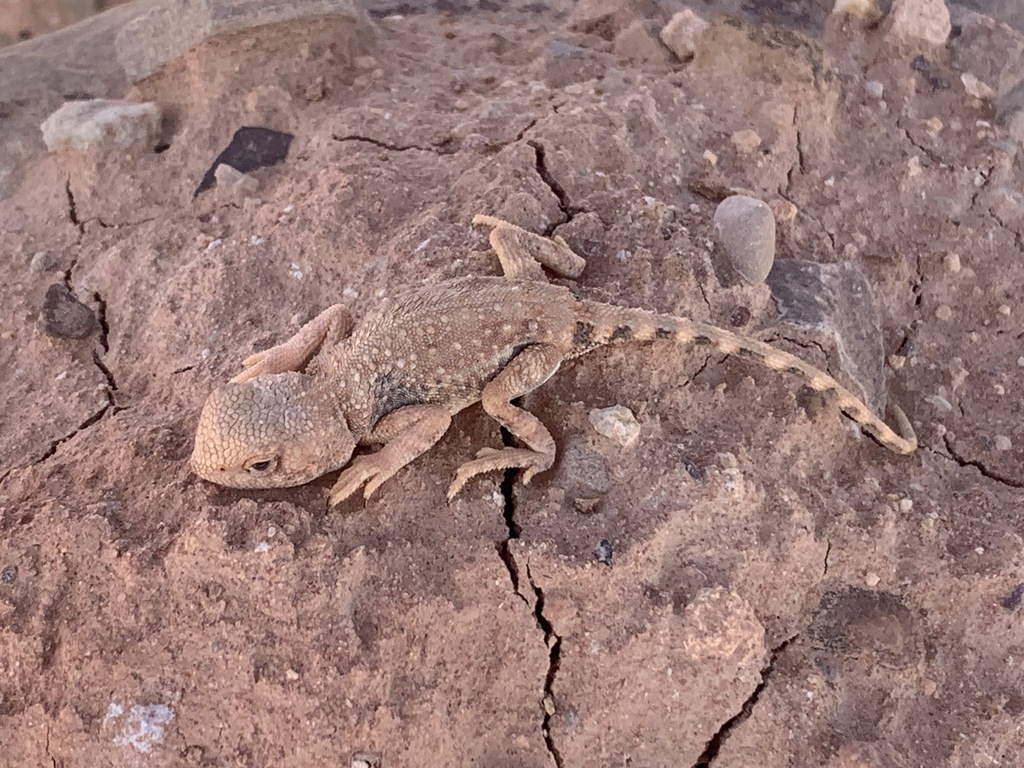
Gibber Earless Dragon
Tympanocryptis intima
The gibber earless dragon (Tympanocryptis intima) also known as the smooth-snouted earless dragon, is a species of agamid lizard endemic to Australia. It is one of a documented species of the genus Tympanocryptis, a group of small terrestrial lizards that feed off invertebrates and are characterised by the absence of an external ear structure.
Tympanocryptis intima, also known as the gibber earless dragon and the smooth snouted dragon, belongs to the family Agamidae and can be distinguished from other genera within the family by a hidden tympanum, lack of dorsal crest and gular sac but has a gular fold. The genus of tympanocryptis includes other documented species, in which one of them is T.intima. This species can be differentiated from other species within the genus by the tubercles as they are enlarged, sparse, are wider than the length and tend to form four longitudinal lines.
From the article Tympanocryptis intima on Wikipedia (CC BY-SA), quoted section by section
Description
Adults of this species have an average snout-vent length (SVL) of 50mm, with a total body length of 110mm. Individuals in this species can range in colour from pale yellowish brown to brick red and often present with pale banding across the body and darker banding along the length of the tail. The head is rounded with predominately smooth or slightly rugose scales. Scales on the body less smooth and interspersed with larger spinose scales. The ventral surface is pale-cream to white in colour peppered by dark brown or black spots. This pale ventral side allows for greater thermal-regulation in extreme temperatures. The evolution of the Gibber Earless Dragon has culminated in the development cryptic colouration in order to remain unseen by predators in its natural environment. The colouration of T. intima ranges form pale yellowish brown to brick red with the colour changing depending on the locality. Pale grey-brown to bright pale back lateral stripes generally occur either side of the mid-line with darker brown blotches of four on either side of the midline. Twelve darker bands along the tail occur with a pale colouration in between the darker areas. A greyish bar occurs on the back of the nape. The underside of T. intima is white and sometimes has fine brown spots on the throat and chest of male species. The total length is 123mm, with a body length of 41mm. …
Range & habitat
This species is known to inhabit parts of the Eyrean Basin, an inland drainage basin covering an area of 1,200,000 square kilometres. The distribution area of the Gibber Earless Dragon is within the arid interior region of north-eastern South Australia and the adjoining states of New South Wales and Queensland and the Northern Territory. Within this region, it inhabits the open gibber deserts and spinifex flats. The Gibber Earless Dragon will stay close to their burrow system, perching itself on a rock or structure nearby, being able to quickly retreat when sensing danger.
Wikipedia: “Distribution and habitat”
What it does
T. intima inhabits areas of high temperatures and can be found basking in direct sunlight with temperatures reaching up to 43 degrees Celsius. Throughout summer, when conditions are warmest and being a ectotherm, the dragon is active during the day and can be found basking with the hind legs propped, pushing their body in a vertical position to expose the underside to the sun. Due to the undersides being white, some heat will be deflected away and can maintain a core body temperature under the surrounding ambient conditions. The dragon alters its behavior and physiology to the high temperature and arid conditions (Wilson). Most other Tympanocryptis species will retreat to burrows or shade when temperatures reach 43 degrees, however T.intima has an extremely high tolerance to temperature. Favourable habitat for T. intima is shrublands with stony gibber substrate and sparse vegetation and open gibber deserts and spinifex flats of the Eyrean Basin. The species is restricted to rocky subhabitats with a high preference to gibber stone substrates. This is usually due to the species being able to use its colouration to blend into the surroundings to avoid predation. T. intima presses its body into the substrate and curls the tail to mimic a gibber stone and reduce its shadow. This strategy acts as a camouflage technique. …
Wikipedia: “Ecology and habitat”
In human culture
The genus name Tympanocryptis refers to the features of the species while the species name is related to the distribution. The etymology of the name is listed below. Tympano – From the word tympanum. Zoology: The tympanic membrane or eardrum Cryptis – From the word cryptic. Zoology: (of coloration or markings) serving to camouflage an animal in its natural environment. Intima – 'innermost', referring to the inland distribution.
== References ==
Wikipedia: “Etymology”
Where it lives
Recorded sightings
—
geo-referenced records in GBIF, from museums, herbaria and field observers.
Drag the globe to turn it. Dots are where records exist, not a range map; darker means more records.
In the stacks
Searching the stacks…
Every page naming Tympanocryptis intima in the Biodiversity Heritage Library →
This page is assembled live from iNaturalist, GBIF, Wikipedia, the Source Library and the Internet Archive. It is not yet part of the hand-edited codex. iNaturalist taxon 31345.