- Animals
- ›Chordates
- ›Vertebrates
- ›Reptiles
- ›Snakes and Lizards
- ›Lizards
- ›Iguanas and Allies
- ›Dragons and Chameleons
- ›Dragons
- ›Flying Dragons and Allies
- ›Calotes
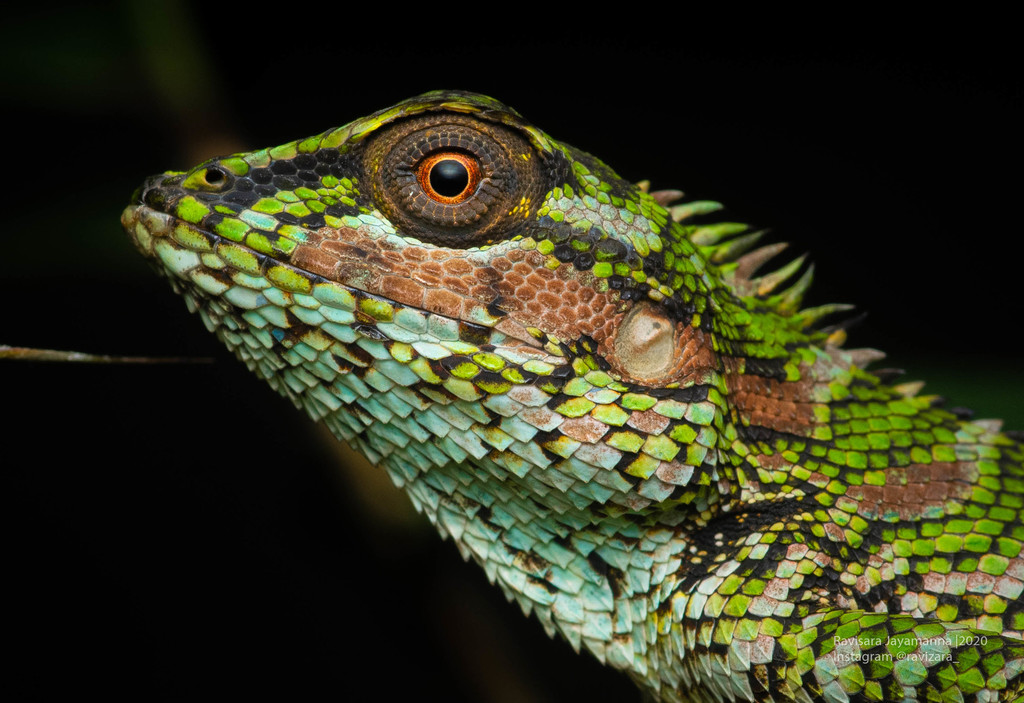
Spineless Forest Lizard
Calotes liocephalus
The spineless forest lizard, crestless lizard or lionhead agama (Calotes liocephalus) is a species of lizard in the family Agamidae. It is endemic to Sri Lanka.
From the article Spineless forest lizard on Wikipedia (CC BY-SA), quoted section by section
Description
Calotes liocephalus grows to 91 mm (3.6 in) in snout–vent length and 33 cm (13 in) in total length. Spineless forest lizard is one of four Calotes species endemic to Sri Lanka, which all share a common set of characteristics. These include a relatively short head, with swollen cheeks, backwards, or backwards and downwards pointing scales on the side of the body, a tail that is strongly swollen at the base in fully grown adult males. This lizard is patterned with a mixture of pale moss-green, dark green and brown indistinct stripes on its body, extending from the back down the sides to the belly, and pale moss-green and dark brown to black rings around its limbs and tail. This cryptic colouration helps camouflage the small lizard from potential predators in the treetops of its habitat. The spineless forest lizard closely resembles the green garden lizard (Calotes calotes) but can be distinguished by the absence of spines above the ear found in other Calotes species, a feature that has earned the lizard its common name.
What it does
Highly arboreal, very rarely comes to the ground, this species is known to be diurnal. Oviparous, and known to lay 5-6 eggs per time.
Wikipedia: “Ecology”
Where it lives
Recorded sightings
—
geo-referenced records in GBIF, from museums, herbaria and field observers.
Drag the globe to turn it. Dots are where records exist, not a range map; darker means more records.
In the stacks
Searching the stacks…
Every page naming Calotes liocephalus in the Biodiversity Heritage Library →
This page is assembled live from iNaturalist, GBIF, Wikipedia, the Source Library and the Internet Archive. It is not yet part of the hand-edited codex. iNaturalist taxon 31264.