On eBird ↗
Band-tailed Pigeon
Live sightings near you, the range map, bar charts of when it is seen, and Macaulay Library photos and recordings.
Band-tailed Pigeon
Patagioenas fasciata
The band-tailed pigeon (Patagioenas fasciata) is a medium-sized bird of the Americas. Its closest relatives are the Chilean pigeon and the ring-tailed pigeon, which form a clade of Patagioenas with a terminal tail band and iridescent plumage on their necks. There are at least 8 sub-species, and some authorities split this species into the northern band-tailed pigeon (Patagioenas fasciata) and the southern band-tailed pigeon (Patagioenas albilinea).
From the article Band-tailed pigeon on Wikipedia (CC BY-SA), quoted section by section
Description
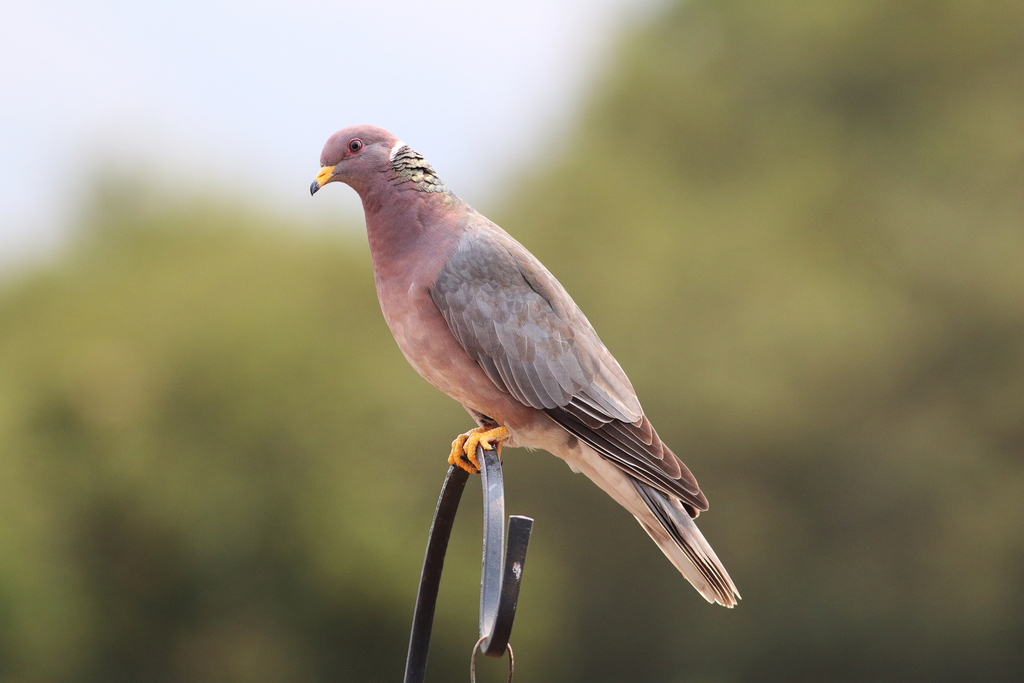
The band-tailed pigeon is one of the largest pigeons in the Americas, measuring 33 to 40 cm (13 to 16 in) long and weighing 226–460 g (8.0–16.2 oz), with the males on average slightly larger than females, but with much overlap. Although sometimes cited as the largest North American pigeon, the red-billed pigeon (P. flavirostris) is about the same size, weighing 268–424 g (9.5–15.0 oz). Band-tailed pigeons have thick-based, pointed wings, with a wingspan of 66 cm (26 in). The plumage is gray, somewhat darker above. The head and underparts have a faint pink cast, especially in the adult male; the belly is nearly white. The distal half of the tail is also pale (except in the subspecies of Baja California) with a darker gray band at the base, whence the English name. The bill and feet are yellow, good identification marks at sufficiently close range. Adults have green iridescence on the back of the neck, adjacent to the thin white collar on the nape. Juvenile birds have pale feather edges above, giving a scaly appearance, and lack the white collar and neck iridescence.
Range & habitat
Unlike the majority of other birds, band-tailed pigeons roam throughout the year, not having a single home range. However, they are usually found at higher elevations, in coniferous forests, oak woodlands, and scrublands. It ranges from British Columbia, Washington, Oregon, California, and southern Arizona south in higher elevations through Mexico and Central America and down the Andes to northern Argentina. It lives primarily in damp forests and conifer-oak woodlands of the western mountains and coasts. Band-tailed pigeons are nomadic feeders, changing their diet along the seasons, and will travel up to 5 km (3 miles) away from their nests to feed. As forest birds, they feed from the floor and from trees. Their diets are centered on acorns, though they will also feed on berries, seeds, flowers, leaves, and even insects. In times of food scarcity, they move closer to urban areas, being found in the suburbs, in forested parks, orchards, and even backyards.
Wikipedia: “Distribution and habitat”
What it does
This species is relatively quiet for a pigeon. Its voice is low-pitched and owl-like, often in two-syllable calls that rise and then fall (huu-ooh) with even spacing between calls. It also makes a variety of harsh squawking sounds for a variety of reasons. They are swift and agile fliers, allowing them to navigate through these high treetops and branches. When flying, they create a "wing whistle", a distinctive noise heard from many other pigeon species as well. It builds a rudimentary platform nest out of twigs, in which it lays one or two eggs. Outside the breeding season, it forms flocks, ranging up to 300 birds, often becomes nomadic, following the acorn crop or moving to lower altitudes or other areas outside its breeding range. They commonly congregate at and drink from mineral springs, although it is not fully understood why.
Reproduction. Band-tailed pigeons form pairs to build nests, with the female building the nests in trees out of twigs, often closely together to form small colonies. Usually, there is just one egg in a clutch, occasionally two; about 8% of nests have two eggs. The eggs hatch after around three weeks after the parents take turns incubating them. Adult band-tailed pigeons can raise multiple broods per year, each typically leaving the nest after 25-30 days. …
Wikipedia: “Behavior and ecology”
Listen
Looking for field recordings…
Where it lives
Recorded sightings
—
geo-referenced records in GBIF, from museums, herbaria and field observers.
Drag the globe to turn it. Dots are where records exist, not a range map; darker means more records.
In the stacks
Searching the stacks…
Every page naming Patagioenas fasciata in the Biodiversity Heritage Library →
This page is assembled live from iNaturalist, GBIF, Wikipedia, the Source Library and the Internet Archive. It is not yet part of the hand-edited codex. iNaturalist taxon 3108.