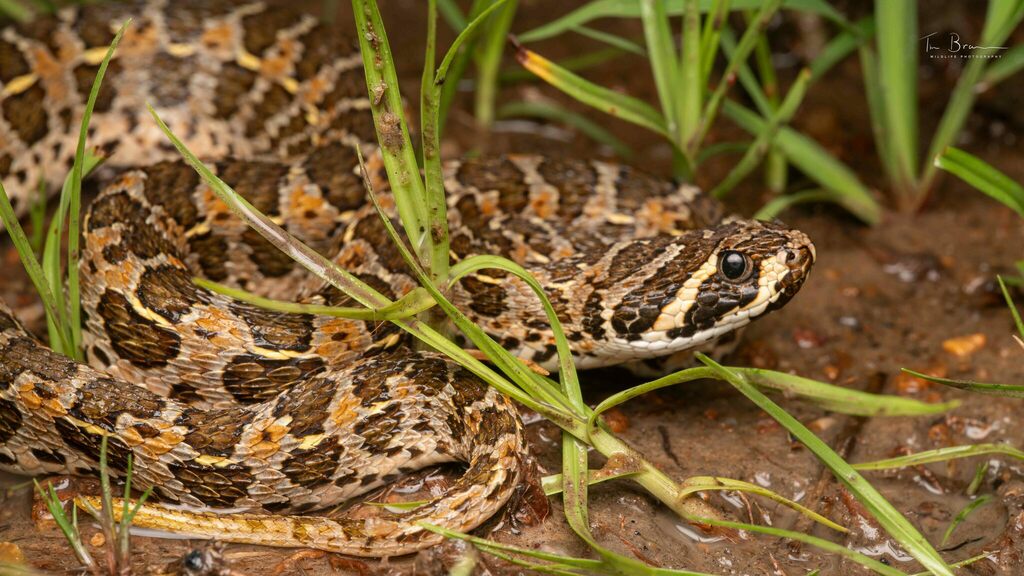
Lowland Swamp Viper
Proatheris superciliaris
Proatheris (commonly referred to as the lowland viper and swamp viper among other names) is a monotypic genus created for the viper species, Proatheris superciliaris. This is a small terrestrial species endemic to East Africa. Like all other vipers, it is venomous. No subspecies are currently recognized.
From the article Proatheris on Wikipedia (CC BY-SA), quoted section by section
Description
Proatheris superciliaris is a small species that averages 40 to 50 cm (about 16 to 20 inches) in total length (body + tail), with a maximum total length of 61 cm (24 in). The females are slightly larger than the males. The head has a somewhat elongated appearance, the top of which is covered with small scales except for a pair of large supraocular scales, which are almost twice as long as they are wide.
Range & habitat
It is found in East Africa. The southern part of its range begins near Beira, in central Mozambique, extends up north over the Mozambique Plain to Quissanga, and through Malawi and as far north as the floodplains of southern Tanzania at the northern end of Lake Malawi. The type locality given is "Terra Querimba" (= Quissanga mainland opposite Ilha Quirimba, Mozambique). Its range is apparently centered on the lower section of the Zambezi River and spreads out into the coastal plain of central Mozambique and the Shire Valley to Lake Chilwa and Malawi. However, other specimens have been found far from this region, such as in Cape Delgado Province, in north-eastern Mozambique, and Mwaya in south-western Tanzania.
Wikipedia: “Geographic range”
What it does
One of the distinguishing characteristics of the Atheris group (to which Proatheris is closely related), is that they have prehensile tails. With Proatheris, the young and subadults have this capability, but it is diminished in the adults.
Wikipedia: “Behaviour”
Toxicity
The first known case of a survivor of snakebite by this species was reported by Els (1988), involving a 20 cm (7.9 in) juvenile and 24-year-old victim penetrated by a single fang. The results were painful, but there were none of the strongly hemotoxic symptoms that had been associated with Atheris venom up to that point. In a second case in 1996, a victim experienced severe hemolysis and complete platelet destruction after which his liver and kidneys began to fail. When it was feared that the patient might die from hemolytic-uremic syndrome, plasmapheresis was performed. Luckily, the patient survived, but it is now obvious that P. superciliaris venom is very hemotoxic.
Wikipedia: “Venom”
Where it lives
Recorded sightings
—
geo-referenced records in GBIF, from museums, herbaria and field observers.
Drag the globe to turn it. Dots are where records exist, not a range map; darker means more records.
In the stacks
Searching the stacks…
Every page naming Proatheris superciliaris in the Biodiversity Heritage Library →
This page is assembled live from iNaturalist, GBIF, Wikipedia, the Source Library and the Internet Archive. It is not yet part of the hand-edited codex. iNaturalist taxon 31007.