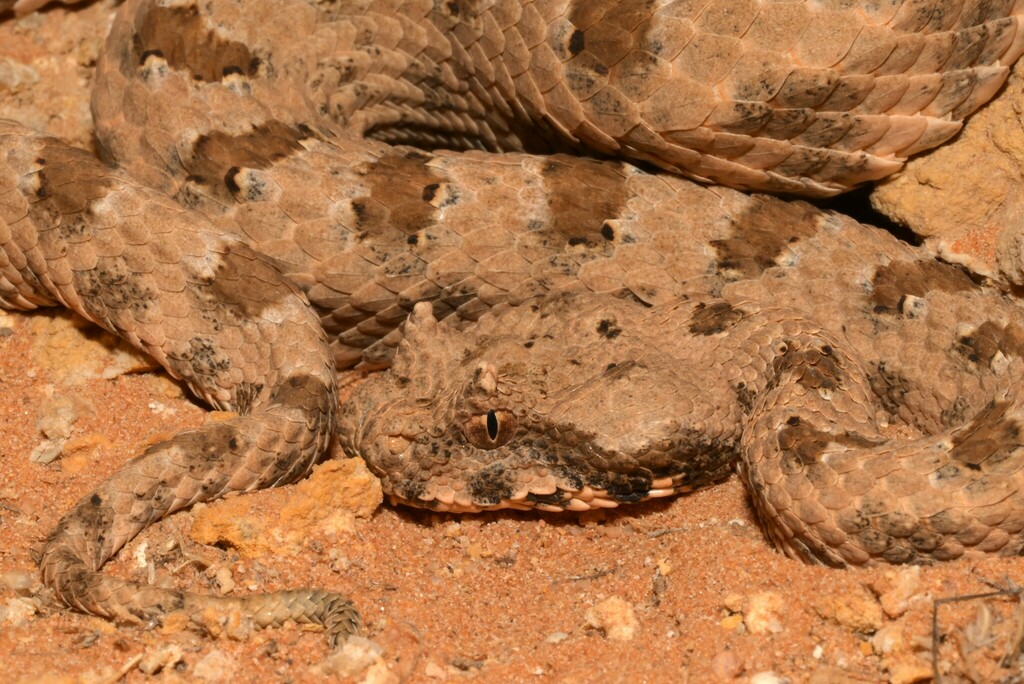
Field's Horned Viper
Pseudocerastes fieldi
Field's horned viper (Pseudocerastes fieldi) is a species of snake in the family Viperidae. The species is native to the deserts of the Middle East. Like all other vipers, it is venomous. It was previously considered a subspecies of the Persian horned viper (Pseudocerastes persicus). The main differences between this species and the Persian horned viper are in scalation and venom composition.
From the article Field's horned viper on Wikipedia (CC BY-SA), quoted section by section
Description
Outwardly, Field's horned viper differs from the Persian horned viper (Pseudocerastes persicus) in certain (lower) scale counts:
Additional differences from the Persian horned viper include much shorter (relatively to the overall body length) tail as well as the fact that while in P. persicus all dorsal and lateral scales are strongly keeled, P. fieldi has several rows of almost smooth lateral scales.
Range & habitat
According to McDiarmid et al. (1999) P. fieldi is found in the Sinai Peninsula, Israel, Jordan, northern Saudi Arabia, northwestern Iraq, and possibly in southern Syria. The type locality given in the original description is "Bair Wells, Transjordania" [Jordan]. According to Mallow et al. (2003) it is found in the Sinai Peninsula, southern Israel, Jordan, extreme northern Saudi Arabia, and southwestern Iraq.
Wikipedia: “Geographic distribution”
Toxicity
There is a more pronounced difference between the two species, P. fieldi and P. persicus, with regard to their venom. While Persian horned viper venom exhibits strong hemorrhagic activity typical of most vipers, the venom of P. fieldi is unusual in that it contains several fractions that show marked neurotoxic activity. No antivenin is available for bites from either species. It is reported that a polyvalent antiserum does offer some protection from the hemotoxins, but none against the neurotoxic effects of P. fieldi venom.
Wikipedia: “Venom”
In human culture
Formerly considered a subspecies of P. persicus, most sources elevate P. fieldi to species level. The first phylogenetic study of the genus Pseudocerastes, published by Fathinia et al. in 2014, shows that P. fieldi has equal genetic distance from both P. persicus and another species of the same genus, P. urarachnoides. The specific epithet fieldi is in honor of American anthropologist Henry Field, who collected the holotype. The Field Museum of Natural History in Chicago and its scientific publication, Fieldiana, in which K.P. Schmidt's original description of this viper appeared, are named for Henry Field's grandfather, Marshall Field.
Wikipedia: “Taxonomy and etymology”
Where it lives
Recorded sightings
—
geo-referenced records in GBIF, from museums, herbaria and field observers.
Drag the globe to turn it. Dots are where records exist, not a range map; darker means more records.
In the stacks
Searching the stacks…
Every page naming Pseudocerastes fieldi in the Biodiversity Heritage Library →
This page is assembled live from iNaturalist, GBIF, Wikipedia, the Source Library and the Internet Archive. It is not yet part of the hand-edited codex. iNaturalist taxon 30993.