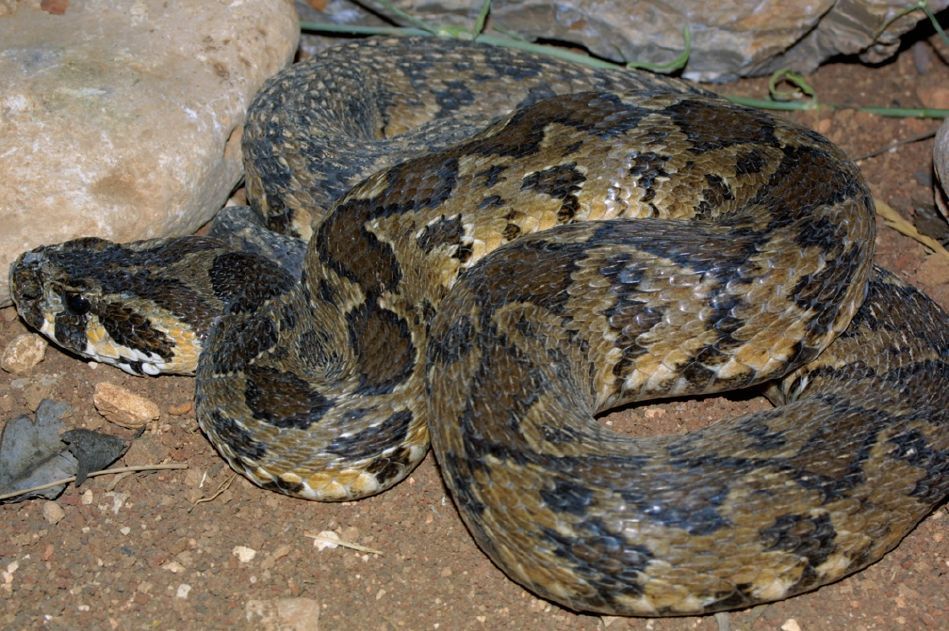
Palestine Viper
Daboia palaestinae
Vipera palaestinae, also known as Daboia palaestinae and as the Palestine viper, is a viper species endemic to the area spanning western Syria, northwestern Jordan, northern and central Israel, Palestine and Lebanon. Like all vipers, it is venomous. It is considered a leading cause of snakebite within its range. No subspecies are currently recognized.
From the article Daboia palaestinae on Wikipedia (CC BY-SA), quoted section by section
Description
It grows to an average total length (body + tail) of 70 to 90 cm (28 to 35 in), with a maximum total length of 130 cm (51 in). The head is triangular, distinct from the neck and covered by small scales. The upper part of the body is colored by large dark rhomboid blotches sometimes forming a zig-zag pattern. The harmless coin-marked snake, which lives in the same areas as the Palestine viper, resembles it in length, coloration and defensive behavior, to the extent that people frequently get confused between them. This is probably a case of Batesian mimicry.
Range & habitat
It is found in northern and central Israel, Palestine, western Syria, northwestern Jordan, and Lebanon. In 2017 a specimen was found in Turkey. Mallow et al. (2003) describe the range as relatively restricted, with the distribution being concentrated in the Mediterranean coastal plains to the inland hills of Lebanon and Israel, along with the adjoining regions of Syria and Jordan. The type locality given is "Haifa, Israel".
Wikipedia: “Geographic range”
What it does
The copulation of this snake takes place around May. Unlike most other vipers, who are viviparous, this snake is oviparous. It lays eggs around August and the eggs hatch 1.5–2 months after that. The young snakes can bite and kill their prey with a developed venom apparatus.
Wikipedia: “Reproduction”
Toxicity
The LD50 of this viper's venom is 0.34 mg/kg. Since the second half of the 20th century there is an antivenom for this snake's venom, which is considered safe and effective. But occasionally people still die from this snake's bite. The mortality rate of people who were bitten is 0.5% to 2%. At least 7 people were reported to die of this snake's bite in the 21st century in Israel so far. The venom includes at least four families of pharmacologically active compounds: (i) neurotoxins; (ii) hemorrhagins; (iii) angioneurin growth factors; and (iv) different types of integrin inhibitors.
Wikipedia: “Venom”
In human culture
This snake is probably mentioned in a list of venomous snakes in ancient Egypt, that appears in the Brooklyn Papyrus from the first millennium BC. Some modern scholars and commentators have identified the צפע (pronounced Tsefa/Zefa) snake mentioned in the Hebrew Bible as this snake species. The name given to this snake in modern Hebrew is צפע מצוי (common Tsefa). The code phrase “Nahash Tsefa” (Viper Snake) was broadcast on the radio and TV to instruct Israeli citizens to put on their gas masks during missile attacks from Iraq against Israel, in the first Gulf War in 1991. In the Israeli Air Force the Bell AH-1 Cobra helicopter was named Tzefa. The IDF's paratroopers battalion #202 is called Tzefa Battalion. In 2018, the Palestine viper was selected as the national snake of Israel, following a public campaign initiated by Avi Zobel and the "Reptiles of Israel" initiative, in collaboration with local environmental organizations.
Wikipedia: “In culture”
Where it lives
Recorded sightings
—
geo-referenced records in GBIF, from museums, herbaria and field observers.
Drag the globe to turn it. Dots are where records exist, not a range map; darker means more records.
In the stacks
Searching the stacks…
Every page naming Daboia palaestinae in the Biodiversity Heritage Library →
This page is assembled live from iNaturalist, GBIF, Wikipedia, the Source Library and the Internet Archive. It is not yet part of the hand-edited codex. iNaturalist taxon 30922.