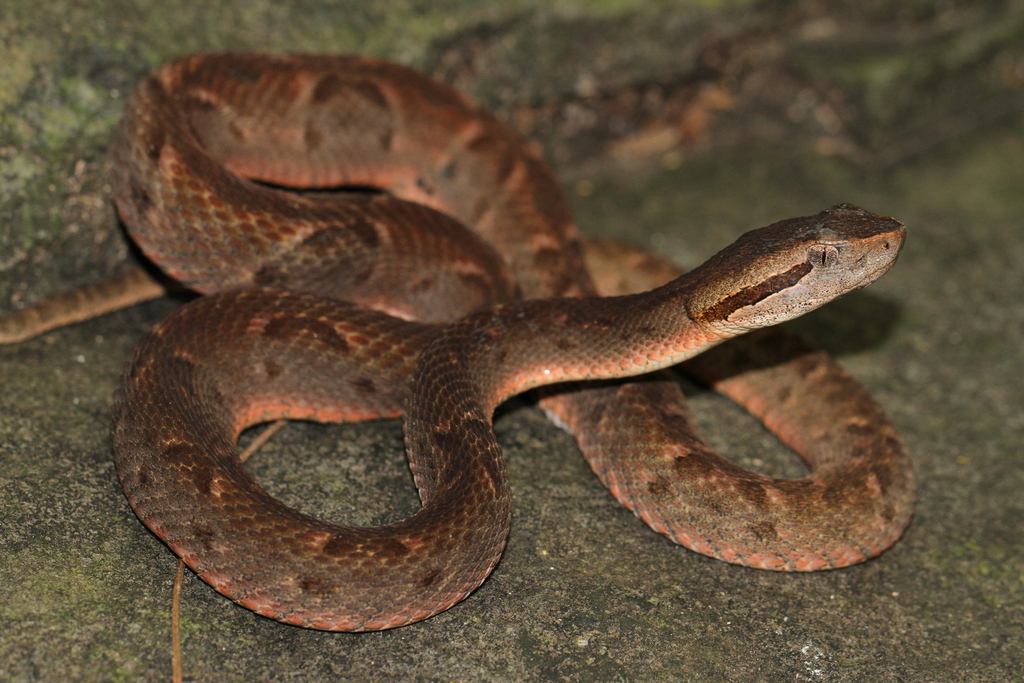
Martinique Lancehead
Bothrops lanceolatus
Bothrops lanceolatus — known as the fer-de-lance, Martinican pit viper, and Martinique lancehead — is a species of pit viper generally considered endemic to the island of Martinique. No one has satisfactorily explained why it has flourished there but is unknown on nearly all other Caribbean islands. Some reserve the common name fer-de-lance for this species, while others apply that name to other Bothrops species as well. No subspecies are currently recognized.
From the article Bothrops lanceolatus on Wikipedia (CC BY-SA), quoted section by section
Range & habitat
Bothrops lanceolatus is generally considered endemic to the island of Martinique in the Lesser Antilles. Along with Bothrops caribbaeus and B. atrox, it is one of three Bothrops species found in the West Indies. The type locality according to Bonnaterre (1790:11) is "La Martinique".
Wikipedia: “Geographic range”
What it does
As ambush predators, Martinique lanceheads typically wait patiently somewhere for unsuspecting prey to wander by. They are known to select a specific ambush site and return to it every year in time for the spring migration of birds. Studies have indicated these snakes learn to improve their strike accuracy over time.
Diet. All of the various species are carnivorous, and eat other animals. Their diet primarily changes based on size and location. Larger individuals can feed on larger prey, while smaller species must eat smaller prey items. Martinican pit vipers hunt rats, mice, birds, rabbits, lizards, frogs, snakes, bats, and more.
Reproduction. With few exceptions, crotalines are ovoviviparous, meaning that the embryos develop within eggs that remain inside the mother's body until the offspring are ready to hatch, at which time the hatchlings emerge as functionally free-living young. In such species, the eggshells are reduced to soft membranes that the young shed, either within the reproductive tract, or immediately after emerging.
Wikipedia: “Behavior”
Toxicity
Their venom has toxins that can cause clotting and bleeding in humans, as well as muscle damage and swelling.
Wikipedia: “Venom”
Where it lives
Recorded sightings
—
geo-referenced records in GBIF, from museums, herbaria and field observers.
Drag the globe to turn it. Dots are where records exist, not a range map; darker means more records.
In the stacks
Searching the stacks…
Every page naming Bothrops lanceolatus in the Biodiversity Heritage Library →
This page is assembled live from iNaturalist, GBIF, Wikipedia, the Source Library and the Internet Archive. It is not yet part of the hand-edited codex. iNaturalist taxon 30788.