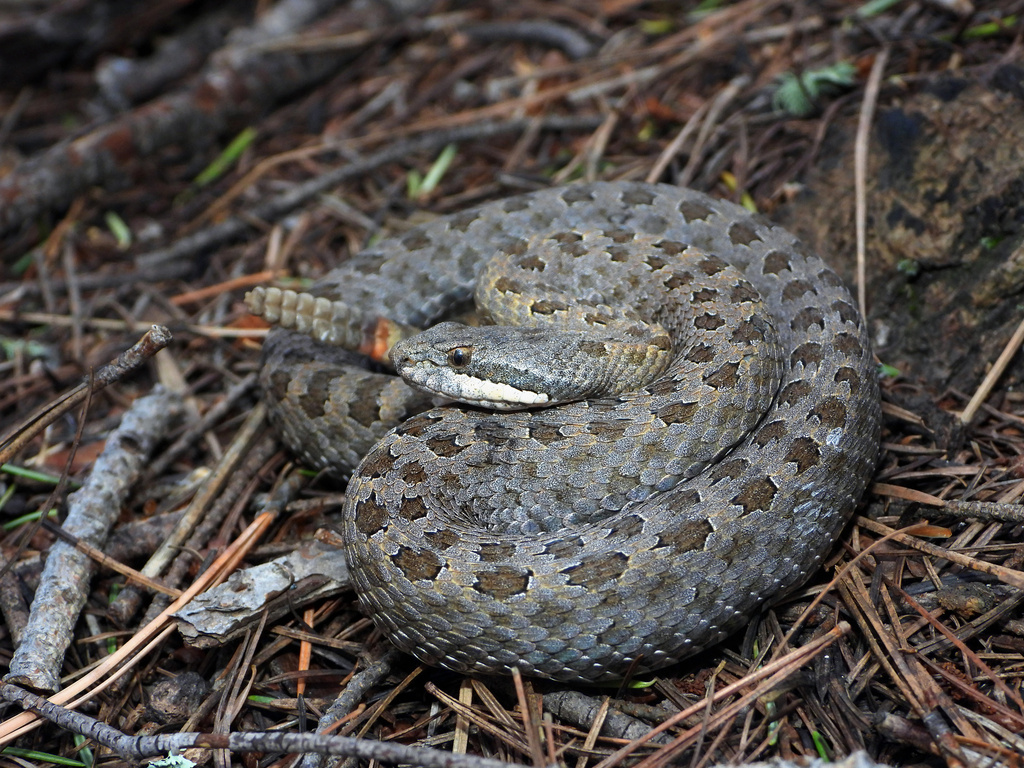
Twin-spotted Rattlesnake
Crotalus pricei
Common names: twin-spotted rattlesnake, western twin-spotted rattlesnake, more
Crotalus pricei is a species of venomous snake, a pit viper in the family Viperidae. The species is endemic to the southwestern United States and northern Mexico. Two subspecies are recognized.
From the article Crotalus pricei on Wikipedia (CC BY-SA), quoted section by section
Description
Adults of C. pricei usually do not exceed 50–60 cm (about 20–24 in) in total length (including tail). The maximum total length recorded is 66 cm (26 in). The color pattern consists of a gray, bluish-gray, brownish-gray, or medium- to reddish-brown ground color, usually with a fine brown speckling. This is overlaid with a series of dorsal blotches that tend to be divided down the median line to form 39–64 pairs.
Range & habitat
C. pricei is found in the United States in southeastern Arizona. In northern Mexico, it occurs in the Sierra Madre Occidental in Sonora, Chihuahua, and Durango. It has also been found in the Sierra Madre Oriental in southeastern Coahuila, Nuevo León, and Tamaulipas, with isolated records in San Luis Potosí and Aguascalientes. The type locality given is "Huachuca Mts., Arizona" (Cochise County, Arizona, United States).
Wikipedia: “Geographic range”
What it does
Amid the mountain rocks where it lives, this small snake may rattle furiously at passing humans yet never be heard. The nights are often cold where it lives. It is driven by hunger, seeking out small rodents and lizards. Though its pattern looks bizarre its protective coloration blends well with the light and shadow of the mountains. Although it has been conjectured that it has a venom of high potency, little is known - there are no recorded bites to humans from this snake.
Wikipedia: “Behavior”
In human culture
The specific name, pricei, is in honor of William Wightman "Billy" Price (1871–1922), a field biologist, who collected the first specimens which became the type series.
Wikipedia: “Etymology”
Where it lives
Recorded sightings
—
geo-referenced records in GBIF, from museums, herbaria and field observers.
Drag the globe to turn it. Dots are where records exist, not a range map; darker means more records.
In the stacks
Searching the stacks…
Every page naming Crotalus pricei in the Biodiversity Heritage Library →
This page is assembled live from iNaturalist, GBIF, Wikipedia, the Source Library and the Internet Archive. It is not yet part of the hand-edited codex. iNaturalist taxon 30729.