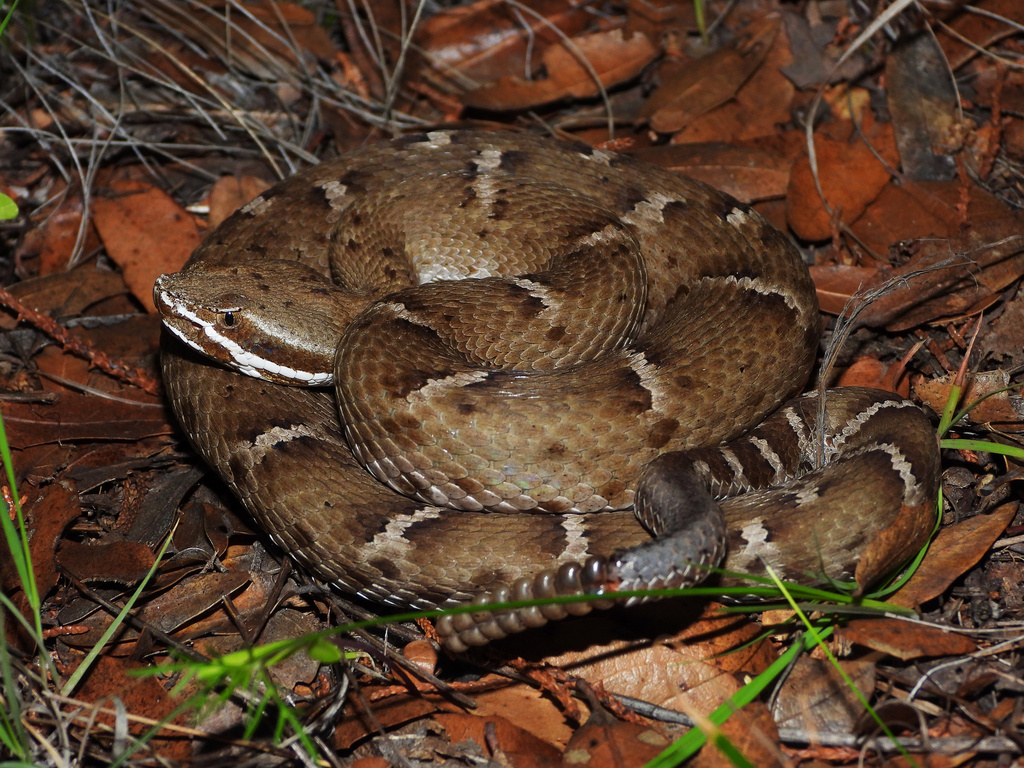
Ridge-nosed Rattlesnake
Crotalus willardi
Common names: ridge-nosed rattlesnake, Willard's rattlesnake, Willard's rattler
Crotalus willardi is a venomous pit viper species found in the southwestern United States and Mexico. This snake is found mainly in the "sky island" region. The IUCN reports this snake's conservation status as being of Least Concern. It is the official state reptile of Arizona.
From the article Crotalus willardi on Wikipedia (CC BY-SA), quoted section by section
Description
Crotalus willardi is a rather small rattlesnake with all subspecies measuring one to two feet (30–60 cm) in length. Color patterns are generally a dark brown base with pale or white horizontal striping, but vary slightly among subspecies. It has the odd distinction of being named last as a new species, as there is no mistaking the clear cut ridge that follows the contour of its snout, a ridge formed by turning up the scales on the end of its nose.
Range & habitat
C. willardi is rarely found outside habitats at high elevation. Wooded mountain ranges, primarily in the southwest, are where this reclusive species is found. Each subspecies' range is limited to select mountain ranges, making human encounters rare events.
Wikipedia: “Habitat”
What it does
Rattlesnakes are primarily ambush hunters; they coil and lie waiting for prey to approach within striking distance. The diet of C. willardi includes small mammals, lizards, birds, and large centipedes. The young feed primarily on large centipedes (Scolopendra spp.) and lizards, whereas adults feed primarily on mammals and birds.
Wikipedia: “Behavior and diet”
Toxicity
Due to the generally small size of C. willardi, venom discharge yields are low; thus, the largely hemotoxic venom is not as life-threatening as that of other rattlesnakes. No documented deaths have been caused by ridge-nosed rattlesnakes, but pain and discomfort can still result from a rare bite.
Wikipedia: “Venom”
In human culture
The specific name, willardi, is in honor of its discoverer, "Professor" Frank Cottle Willard, a businessman from Tombstone, Arizona.
Wikipedia: “Etymology”
Where it lives
Recorded sightings
—
geo-referenced records in GBIF, from museums, herbaria and field observers.
Drag the globe to turn it. Dots are where records exist, not a range map; darker means more records.
In the stacks
Searching the stacks…
Every page naming Crotalus willardi in the Biodiversity Heritage Library →
This page is assembled live from iNaturalist, GBIF, Wikipedia, the Source Library and the Internet Archive. It is not yet part of the hand-edited codex. iNaturalist taxon 30705.