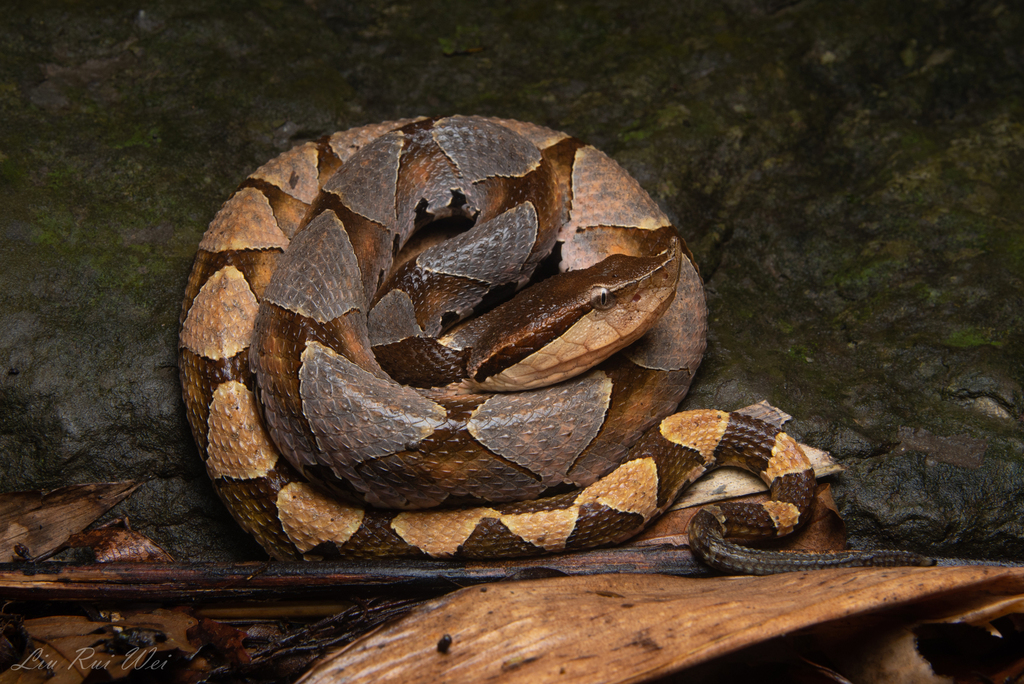
Chinese Moccasin
Deinagkistrodon acutus
Deinagkistrodon is a monotypic genus created for the pit viper species, Deinagkistrodon acutus, which is endemic to Southeast Asia. No subspecies are currently recognized.
From the article Deinagkistrodon on Wikipedia (CC BY-SA), quoted section by section
Description
Deinagkistrodon acutus is light brown or greyish brown dorsally, with a series of dark brown lateral triangles on each side. The two pointed tops of the two opposite triangles meet each other at the mid-line, forming a series of about 20 light brown, squarish blotches on the back. A row of large black spots extends along each side near the belly. The top and upper sides of the head are uniformly black, with a black streak from the eye to the angle of the mouth. D. acutus is yellowish ventrally, spotted with dark brown. The young are much lighter than the adults with essentially the same pattern. The head is large, triangular, with an upturned snout. The body is very stout. The tail is short, ending in a compressed, pointed slightly curved cornified scale. The top of the head is covered with nine large shields. The dorsal scales are strongly and tubercularly keeled. The subcaudals are mostly in pairs, some of the anterior ones are single. This stout snake, usually between 0.8 and 1.0 metre (2.6 and 3.3 ft) in total length (including tail), reaches a maximum total length of 1.57 metres (5.2 ft) in males and 1.41 metres (4.6 ft) in females. The largest specimen on record measured approximately 1.549 metres (5.08 ft).
Range & habitat
Deinagkistrodon acutus is found in southern China (Zhejiang, Fujian, Hunan, Hubei, Guangdong), Taiwan, northern Vietnam, and possibly Laos. The type locality was not included in the original description. It was later given as "Wusueh [Wuxue], Hupeh [Hubei] Province, China" by Pratt (1892) and Pope (1935). Listed as "Mountains N. of Kiu Kiang [Jiujiang]" in the catalogue of the British Museum of Natural History.
Wikipedia: “Geographic range”
What it does
The diet of D. acutus consists of small mammals such as rats and mice, birds, toads, frogs and lizards. Chinese herpetologist Zhao Ermi reported a specimen of a total length of 1.04 metres (3.4 ft) and weighing 600 grams (1.3 lb) having eaten a specimen of Rattus rattus of a total length of 51.5 centimetres (20.3 in) and a weight of 530 grams (1.17 lb).
Wikipedia: “Diet”
In medicine
The venom of this species is commonly used for research purposes. Researchers have found that this venom contains protease activity, meaning it attacks and degrades intra- and extracellular proteins. If injected into mice, within 2 hours the venom begins a process known as mesangiolysis (the degeneration and death of cells that line the inner layer of the glomerulus and regulate glomerular filtration in the kidney). Eventually, the kidneys no longer function and the mouse dies. When controlled, the venom has some clinical application. D. acutus snake venom contains a protein called ACTX-6. This protein was shown to induce apoptosis (cell death) in isolated cancer cells through Fas pathway activation. Fas is a protein that becomes a death receptor in the cellular membrane. When activated, Fas turns on what is called a "caspase cascade". This pathway is made up of a series of proteins called initiator and executioner caspases. Initiator caspases help form an apoptosis initiation factor that eventually activates executioner caspases (see figure 3). Executioner caspases go on to "digest" the cell from the inside out. They cleave cytoskeleton filaments and DNA until the cell completely implodes.
Wikipedia: “Venom use in research and medicine”
Toxicity
Dangerous animals often have exaggerated reputations and the species D. acutus is no exception. The popular name "hundred pacer" refers to a local belief that, after being bitten, the victim will only be able to walk 100 steps before dying. In some areas, it has even been called the "fifty pacer" or, in extreme examples, the "five-step snake". This often causes bite victims to needlessly amputate or burn bitten fingers or limbs, resulting in further complications like the loss of the amputated body part or gangrene. Nevertheless, this species is considered dangerous, and fatalities are not unusual. An antivenom is produced in Taiwan. Brown (1973) mentions a venom yield of up to 214 mg (dried) and LD50 (toxicity) values of 0.04 mg/kg IV, 4.0 mg/kg IP and 9.2–10.0 mg/kg SC. The venom contains at least four hemorrhagins Acutolysin A, B, C and D. According to the US Armed Forces Pest Management Board, the venom is a potent hemotoxin that is strongly hemorrhagic. Bite symptoms include severe local pain and bleeding that may begin almost immediately. This is followed by considerable swelling, blistering, necrosis, and ulceration. Systemic symptoms, which often include heart palpitations, may occur suddenly and relatively soon after the bite. …
Wikipedia: “Venom”
In human culture
The snake has been an object of veneration by indigenous Taiwanese peoples. The Paiwan believe it as the parent of their hero Aljis who saved them from famine and taught them agriculture; he transforms into a mountain hawk-eagle after his work is done and gives them his feathers in memory which their chiefs have worn since. The viper (vulung) also adorns their homes as a symbol of power. In Rukai legend, a hundred pacer saved the life of a tribal leader. In return, the leader named the viper palrata, meaning "our companion". The vipers were henceforth treated as Rukai warriors and companions of the tribe. Patterns and totems of hundred pacers are reserved for tribal leaders.
Wikipedia: “In culture”
Where it lives
Recorded sightings
—
geo-referenced records in GBIF, from museums, herbaria and field observers.
Drag the globe to turn it. Dots are where records exist, not a range map; darker means more records.
In the stacks
Searching the stacks…
Every page naming Deinagkistrodon acutus in the Biodiversity Heritage Library →
This page is assembled live from iNaturalist, GBIF, Wikipedia, the Source Library and the Internet Archive. It is not yet part of the hand-edited codex. iNaturalist taxon 30685.