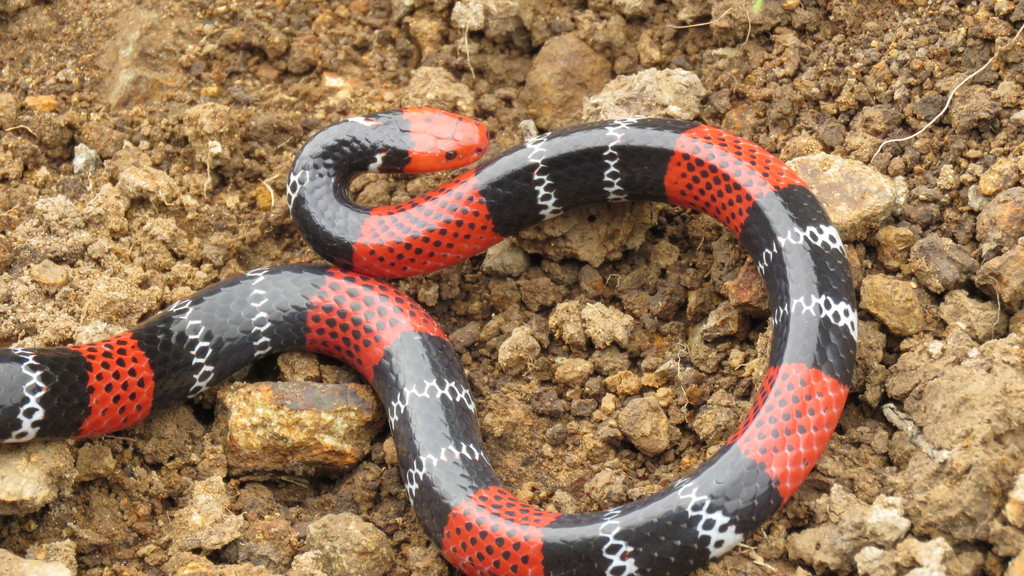
Regal Coralsnake
Micrurus ancoralis
Micrurus ancoralis, also known commonly as the anchor coral snake and the regal coral snake, is a species of venomous snake in the family Elapidae. The species is native to extreme southeastern Central America and adjacent northwestern South America. There are two recognized subspecies.
From the article Micrurus ancoralis on Wikipedia (CC BY-SA), quoted section by section
Description
Dorsally, Micrurus ancoralis has a red head, followed by a black anchor-shaped marking on the neck. The body color pattern consists of black, white, and red rings. The black rings are in triads enclosing white rings, and the triads are separated by red rings. The ventrals number 248–266 in males and 271–290 in females. Long and heavy-bodied for its genus, as an adult M. ancoralis is usually 0.90 m (3.0 ft) in total length (tail included), but the maximum recorded total length is 1.486 m (4.88 ft).
Range & habitat
Micrurus ancoralis is found in southeastern Panama, western Colombia, and western Ecuador.
Wikipedia: “Geographic distribution”
What it does
Micrurus ancoralis preys on amphisbaenians, such as Amphisbaena fuliginosa, and small snakes, such as Ninia atrata.
Wikipedia: “Diet”
Where it lives
Recorded sightings
—
geo-referenced records in GBIF, from museums, herbaria and field observers.
Drag the globe to turn it. Dots are where records exist, not a range map; darker means more records.
In the stacks
Searching the stacks…
Every page naming Micrurus ancoralis in the Biodiversity Heritage Library →
This page is assembled live from iNaturalist, GBIF, Wikipedia, the Source Library and the Internet Archive. It is not yet part of the hand-edited codex. iNaturalist taxon 30610.