On eBird ↗
Trocaz Pigeon
Live sightings near you, the range map, bar charts of when it is seen, and Macaulay Library photos and recordings.
Trocaz Pigeon
Columba trocaz
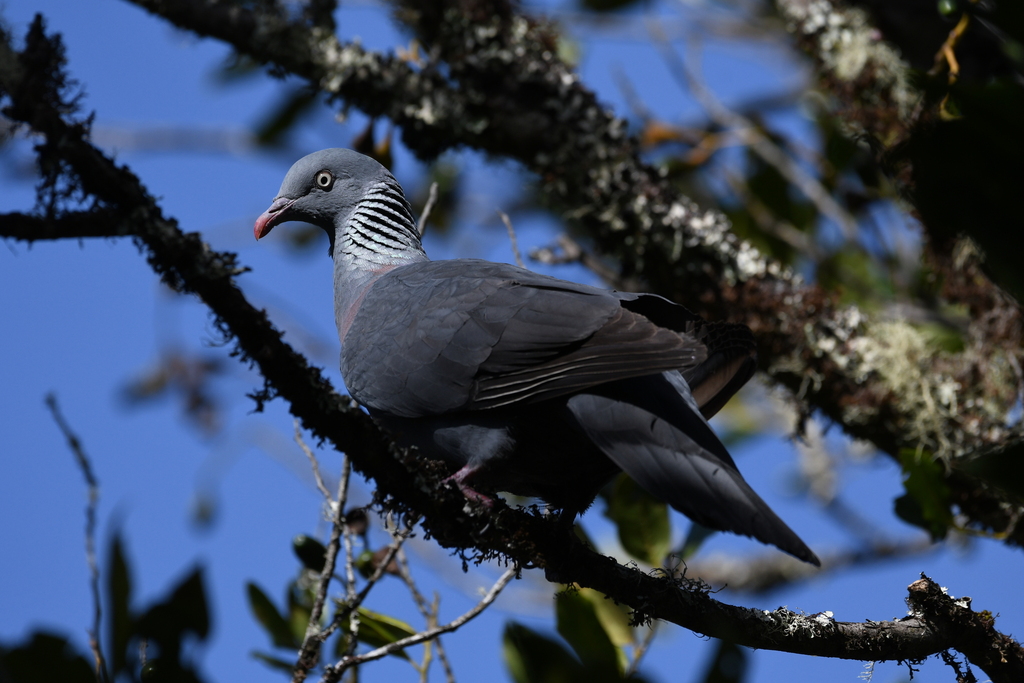
The trocaz pigeon, Madeira laurel pigeon or long-toed pigeon (Columba trocaz) is a pigeon endemic to the island of Madeira, Portugal. It is a mainly grey bird with a pinkish breast; its silvery neck patch and lack of white wing markings distinguish it from its close relative and probable ancestor, the common wood pigeon. Its call is a characteristic six-note cooing, weaker and lower-pitched than that of the wood pigeon. Despite its bulky, long-tailed appearance, this pigeon has a fast, direct flight.
A scarce resident breeder in laurisilva forests, the trocaz pigeon lays one white egg in a flimsy twig nest. Its numbers fell sharply after human colonisation of the Madeira archipelago, and it vanished altogether from Porto Santo Island. The major cause of its population decline was habitat loss from forest clearance, but hunting and nest predation by introduced rats were also contributory factors. Protection of the laurel forests and a ban on hunting have enabled numbers to increase, so that the species is no longer endangered.
From the article Trocaz pigeon on Wikipedia (CC BY-SA), quoted section by section
Description
The trocaz pigeon is a rather plain, dark grey bird 40–45 cm (15.7–17.7 in) long with a 68–74 cm (26.8–29.1 in) wingspan. The upper back has a violet sheen, becoming green on the back of the neck, and the neck sides are patterned with silver-white. The tail is blackish with a wide, pale grey band, and the flight feathers are mainly black. The upper breast is pinkish, the eye is yellow, the bill has a yellow tip and a reddish-purple base, and the legs are red. The sexes are similar in appearance, but the juvenile has generally browner plumage, with limited or no development of the silvery neck patch. Its closed wings have a scaly appearance due to pale buff feather edges. The trocaz pigeon's voice is weaker and deeper than that of common wood pigeon, typically consisting of six syllables with the middle pair of notes extended and stressed: uh-uh hrooh-hrooh ho-ho. When flying, it appears heavy and large-tailed, although its flight is rapid and direct. The common wood pigeon had a poorly defined Madeiran subspecies, Columba palumbus maderensis. This was paler than the trocaz pigeon and had white wing patches and a more extensive green iridescence on the nape, but it became extinct before 1924. Bolle's pigeon is more similar in appearance to the trocaz pigeon, although it lacks the whitish neck patch and has a more extensively pink breast. …
Range & habitat
The trocaz pigeon is endemic to the mountainous subtropical Atlantic main island of Madeira, although it formerly also bred on the neighbouring Porto Santo Island. It mainly occurs on the northern slopes of the mountains, but smaller numbers are found in the south where suitable patches of laurel forest remain. The natural habitat is tall laurisilva forest or dense tree heaths which are cloud-covered for much of the year. The forests consist mainly of laurel, Ocotea foetens, Madeira mahogany, Canary laurel, faya, lily-of-the-valley-tree and Picconia excelsa. The trocaz pigeon prefers primary forests, but secondary growth is used for feeding, and agricultural land is also visited, especially at times of fruit shortage. Most of the pigeons are found below 1,000 m (3,300 ft), and their prime environment appears to be steep ravine-indented slopes along artificial watercourses, with the occasional large dead laurel tree and much tree heath. This species is highly mobile between different areas at different times of year.
Wikipedia: “Distribution and habitat”
What it does
The trocaz pigeon is exclusively herbivorous. Nearly 60% of its diet is fruit, with most of the rest being leaves, and just 1% is flowers. The fruits of Til, Azores Laurel and Persea indica, and the fruits and leaves of small-leaved holly are the most frequently detected food items. Most seeds pass through the digestive system intact, apart from those of Azores Laurel, which are usually damaged. Fruit is the main component of the diet when it is readily available in autumn and winter, and leaves are consumed in spring and summer when fruits are scarce. In one study, 27% of the leaves consumed came from native trees, especially Small-leaved Holly, 61% from herbs and shrubs, and nearly 10% from introduced trees, mainly apples and peaches. This pigeon will feed in agricultural areas, where cabbage is the most commonly taken crop plant. Pigeon faeces from agricultural areas contain few native plants, and samples from forests have few crop species, so some individual birds may concentrate on crops. Feeding in cultivated land is commonest in winter, when fruit is readily available, so it appears not to be a shortage of natural foods that causes them to leave the forest, but is mostly opportunistic, resulting from the birds' movements through nearby forest. …
Wikipedia: “Feeding”
Listen
Looking for field recordings…
Where it lives
Recorded sightings
—
geo-referenced records in GBIF, from museums, herbaria and field observers.
Drag the globe to turn it. Dots are where records exist, not a range map; darker means more records.
In the stacks
Searching the stacks…
Every page naming Columba trocaz in the Biodiversity Heritage Library →
This page is assembled live from iNaturalist, GBIF, Wikipedia, the Source Library and the Internet Archive. It is not yet part of the hand-edited codex. iNaturalist taxon 3054.