Many-banded Krait
Bungarus multicinctus
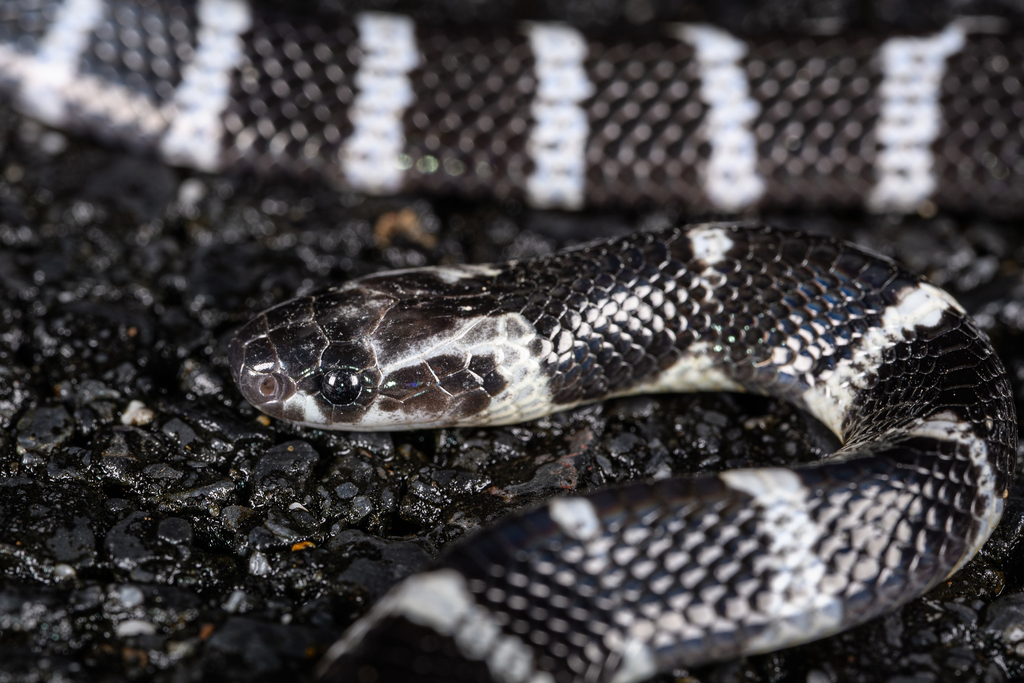
The many-banded krait (Bungarus multicinctus), also known as the Taiwanese krait or the Chinese krait, is an extremely venomous species of elapid snake found in much of central and southern China and Southeast Asia. The species was first described by the scientist Edward Blyth in 1861. Averaging 1 to 1.5 m (3.5 to 5 ft) in length, it is a black or bluish-black snake with many white bands across its body. The many-banded krait mostly inhabits marshy areas throughout its geographical distribution, though it does occur in other habitat types.
From the article Many-banded krait on Wikipedia (CC BY-SA), quoted section by section
Description
The many-banded krait is a medium to large sized species of snake, averaging 1 to 1.5 m (3.5 to 5 ft) in length, with maximum lengths reaching 1.85 m (6.1 ft). Its body is slender and moderately compressed. The scales of this species are smooth and glossy, with a noticeably distinct vertebral ridge. The colour of the snake is black to dark bluish-black with approximately 21–30 white or creamy white cross bands along the entire length of its upper body. More banding is seen in longer than average sized specimens. The tail is short and pointed, that is also black in colour with alternating white cross bands, of which there are 7–11. The belly of the snake is usually white in colour, but could be an off white or creamy white. The head is primarily black in colour, is broad and oval in shape, but flat and slightly distinct from the body. The eyes are small and black in colour. The pupils are black in colour, thus making them hardly noticeable as they blend in with the rest of the eyes. This species has large nostrils. The fangs are small, fixed and are located in the anterior of the upper jaw. Juveniles of this species usually have whitish blotches on the lower side of their heads.
Scalation. The number and arrangement of scales on a snake's body are a key element of identification to species level. …
Range & habitat
This species is found throughout Taiwan (including the Archipelagos of Matsu and Kinmen), Hong Kong, Myanmar (Burma), Laos, and northern Vietnam. It may also be found in Thailand.
In China, kraits with white cross-bands were assumed to be the many-banded krait, however a 2017 genetic study found that most museum specimens classified thus were actually the Malayan krait, and that true many-banded kraits were restricted to southern China (Fujian, Jiangxi, Hubei, Hunan, Hainan, Zhejiang, Guangdong, and Guangxi). The study authors raised the possibility that other specimens tagged as many-banded kraits from Vietnam, Thailand, and Myanmar may also be Malayan kraits. Although it can be found in elevations up to about 1,500 m (4,900 ft), it is far more commonly found in humid lowland areas, and most often observed in subtropical, marshy regions of its range. It is also frequently found in shrublands, woodlands, agricultural fields, and mangroves, often adjacent to water, such as rivers, streams, rice paddies, and ditches. It may also sometimes be found in villages and suburban areas. It is able to survive in other habitats also.
Wikipedia: “Distribution and habitat”
What it does
The snake is nocturnal, and may be more defensive at night. It is, however, a timid and placid species of snake. In the daytime, it hides under stones or in holes. The snake appears from April and retreats into hibernation in November. It is considered to be more defensive than the banded krait (Bungarus fasciatus), thrashing about as it is handled. Unlike other Bungarus species, who are primarily snake-eaters, the many-banded krait usually feeds on fish, but it is also preys on other species of snakes, including members of its own species. This species also feeds on rodents, eels, frogs, and occasionally lizards.
Reproduction. There is limited information on the reproductive habits of this snake. Like many elapids, many-banded kraits are oviparous. Mating occurs between the months of August and September. Females usually deposit 3–15 eggs, although up to 20 eggs can be produced. The eggs are deposited in late spring or early summer, usually in the month of June. Eggs usually hatch about a month and a half later. The hatchlings are around 25 centimetres (9.8 in) in length. The oldest recorded many-banded krait was a captive specimen that lived 13.7 years.
Wikipedia: “Behaviour and diet”
Toxicity
The venom of the many-banded krait consists of both pre- and postsynaptic neurotoxins (known as α-bungarotoxins and β-bungarotoxins, among others). By weight, almost half of the protein content of the venom is composed of β-bungarotoxins. The average venom yield from specimens kept on snake farms is about 4.6 mg—19.4 mg per bite. The venom is highly toxic with LD50 values of 0.09 mg/kg—0.108 mg/kg SC, 0.113 mg/kg IV and 0.08 mg/kg IP on mice. Based on numerous LD50 (MLD) studies on mice dating back to 1943, the many-banded krait is among the most venomous land snakes in the world. To & Tin (1943) reported 0.07 mg/kg (IV), Lee et al (1962) reported 0.16 mg/kg (SC), Fischer and Kabara (1967) list 0.2 mg/kg (IP), Lee and Tseng (1969) list 0.16 mg/kg (SC), Kocholaty et al (1971) listed 0.07 mg/kg (IV) and 0.08 mg/kg (IP), Minton (1974) listed 0.07 mg/kg (IV) and 0.08 mg/kg (IP), which are identical MLD values Kocholaty et al had reported in 1971 for the IV and IP routes, Minton further listed 0.19 mg/kg (SC). α-Bungarotoxin is important for neuromuscular histology, it is known to bind irreversibly to receptors of the neuromuscular junction, and can be labelled with fluorescent proteins such as green fluorescent protein or the rhodamine dye tetramethylrhodamine isothiocyanate.
Clinical symptoms. …
Wikipedia: “Venom and toxins”
Where it lives
Recorded sightings
—
geo-referenced records in GBIF, from museums, herbaria and field observers.
Drag the globe to turn it. Dots are where records exist, not a range map; darker means more records.
In the stacks
Searching the stacks…
Every page naming Bungarus multicinctus in the Biodiversity Heritage Library →
This page is assembled live from iNaturalist, GBIF, Wikipedia, the Source Library and the Internet Archive. It is not yet part of the hand-edited codex. iNaturalist taxon 30442.