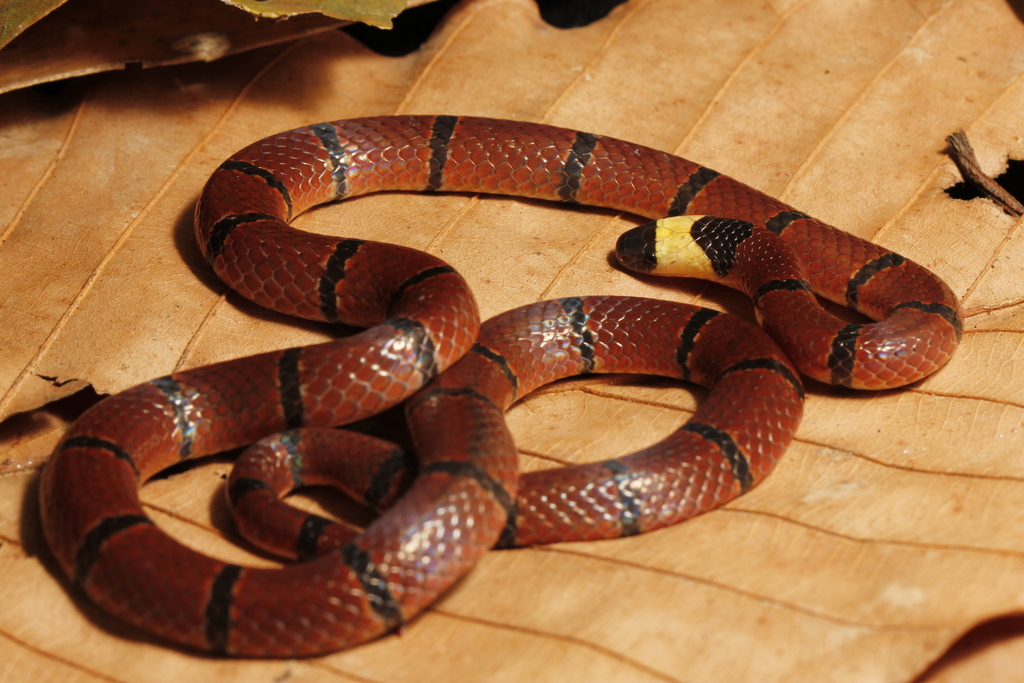
MacClelland’s Coral Snake
Sinomicrurus macclellandi
Sinomicrurus macclellandi, commonly known as MacClelland's coral snake, is a species of venomous snake in the family Elapidae. The species is native to southern and eastern Asia. There are three recognized subspecies.
From the article Sinomicrurus macclellandi on Wikipedia (CC BY-SA), quoted section by section
Description
Sinomicrurus macclellandi is a small snake, about 40–80 centimetres (16–31 in) in total length (tail included), and has a thin body. Dorsally, it is reddish-brown, with thin, black cross bars, and its belly is creamy white. The head is small, round and black in color, with a broad, creamy white transverse band, and black outlines at the middle of the head. The dorsal scales on the body are smooth, and they are arranged, at midbody, in 13 parallel longitudinal rows.
Range & habitat
Sinomicrurus macclellandi is found in northern and northeastern India, Bangladesh, Bhutan, Nepal, northern Myanmar, Thailand, Vietnam, central and southern China (including Hong Kong, Hainan, north to Gansu and Shaanxi), Taiwan, and the Ryukyu Islands (Japan). It is also found in Laos. It has been recorded from elevations of 150–2,483 m (492–8,146 ft).
Wikipedia: “Geographic range”
What it does
Sinomicrurus macclellandi is mainly nocturnal and terrestrial. It occurs in forest litter, hillside, and lowland. It is often found hiding under leaves. Although this is a venomous species, it is quite docile and not likely to strike actively.
Wikipedia: “Behavior and habitat”
Toxicity
Like other elapids, Sinomicrurus macclellandi possesses a potent neurotoxic venom, which is capable of killing a person. Bite symptoms include numbness of lips and difficulty of speech and breathing, followed by blurred vision. Severe bite victims may die of instant heart failure, although there have been only a few human deaths recorded in Thailand.
Wikipedia: “Venom”
In human culture
The specific name, macclellandi, is in honor of John McClelland, a physician and naturalist, who worked for the East India Company.
Wikipedia: “Etymology”
Where it lives
Recorded sightings
—
geo-referenced records in GBIF, from museums, herbaria and field observers.
Drag the globe to turn it. Dots are where records exist, not a range map; darker means more records.
In the stacks
Searching the stacks…
Every page naming Sinomicrurus macclellandi in the Biodiversity Heritage Library →
This page is assembled live from iNaturalist, GBIF, Wikipedia, the Source Library and the Internet Archive. It is not yet part of the hand-edited codex. iNaturalist taxon 30419.