- Animals
- ›Chordates
- ›Vertebrates
- ›Reptiles
- ›Snakes and Lizards
- ›Snakes
- ›Colubrid Snakes
- ›Colubrine Snakes
- ›Elaphe
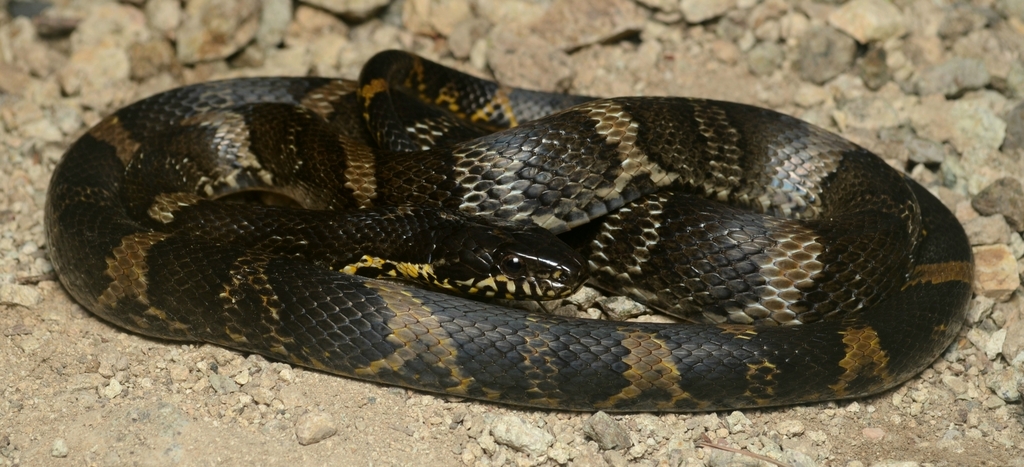
Manchurian Black Ratsnake
Elaphe schrenckii
Elaphe schrenckii is a nonvenomous colubrid snake species, which is endemic to Northeast Asia (China, Korea, Russia, Mongolia). Elaphe schrenckii is a relatively large colubrid.
From the article Elaphe schrenckii on Wikipedia (CC BY-SA), quoted section by section
Description
E. schrenckii can reach average lengths (including tail) of 1.2–1.6 m (3.9–5.2 ft). It is among the most robust of all the rat snake species. It varies greatly in colouration, from creme saddles to dark brown saddles. Many captive bred specimens have been line bred to produce clean yellow saddles. The northern, darker, is the most common variety. This species has 200-236 ventral scales, 55-78 subcaudal scales, and 21-23 rows of dorsal scales.
Range & habitat
Endemic to Northeast Asia, E. schrenckii is found in China, Korea, Mongolia, and Russia. It occurs in Russia and China, to the east to Khabarovsk in the Amur region, west to the Chingan mountains, and north to Manchuria (Northeastern China). The common name, Russian rat snake, is misleading as only a small portion of the geographic range of E. schrenckii is in Russia. It has been reported from Chinese provinces of Jilin, Heilongjian, and the Quingyuan area of Liaoning. (Ji Daming e.a., 1985). In the Netherlands the species occurs as an introduced exotic around Groningen airport near Eelde, where it was first seen in the mid nineteen nineties. Reportedly, pet snakes were released into the wild by someone who did not expect that they would survive the winter. However, the snakes which were hardier than expected bred, and the species is now gradually increasing its range.
Wikipedia: “Geographic range”
What it does
E. schrenckii feeds primarily on small mammals, birds, and bird eggs. It is often found in wetlands, but also found in a wide variety of mainly moist environments such as scrub land, farmland, river banks, swamp land, gardens, stones, log piles, forests, and up in trees. The Manchurian black water snake is an excellent swimmer (hence one common name) and is a very good climber, as it is semi-arboreal. This snake is believed to be mostly crepuscular (active only at dawn and dusk).
Wikipedia: “Behavior”
Where it lives
Recorded sightings
—
geo-referenced records in GBIF, from museums, herbaria and field observers.
Drag the globe to turn it. Dots are where records exist, not a range map; darker means more records.
In the stacks
Searching the stacks…
Every page naming Elaphe schrenckii in the Biodiversity Heritage Library →
This page is assembled live from iNaturalist, GBIF, Wikipedia, the Source Library and the Internet Archive. It is not yet part of the hand-edited codex. iNaturalist taxon 30231.