On eBird ↗
Silvery Wood-Pigeon
Live sightings near you, the range map, bar charts of when it is seen, and Macaulay Library photos and recordings.
Silvery Wood-Pigeon
Columba argentina
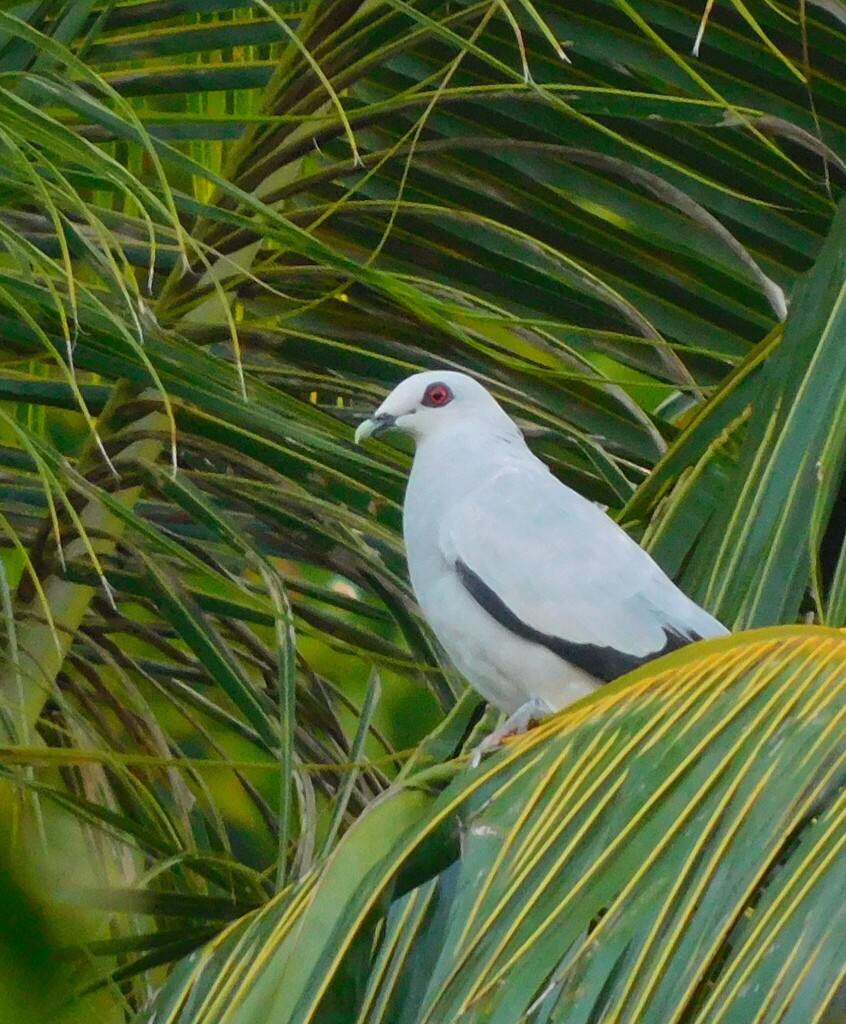
The silvery pigeon (Columba argentina), also known as silvery wood-pigeon or grey wood-pigeon, is a species of pigeon found in Indonesia and Malaysia. It was thought to be extinct but wild populations rediscovered in 2008 near Masokut Island of the Mentawai archipelago might represent this species, and photographs from Simeulue confirm its existence there.
From the article Silvery pigeon on Wikipedia (CC BY-SA), quoted section by section
Description
The silvery pigeon is indistinguishable from the pied imperial pigeon at a distance, although this is not necessarily true vice versa; as the pied imperial pigeon can vary between a pale grey, pure white and even yellowish colouration, it is often possible to tell that a bird is not a C. argentina. At close quarters, the silvery pigeon may be recognized by a few characteristics: The plumage is always a pale silvery grey, with black remiges and ends of the tail feathers; there may be a slight greenish sheen on the feathers of the backsides of the neck. The black part of the tail is equal in length in all feathers, whereas it forms a black triangle pointing headwards on the underside of the pied imperial pigeon's tail. Most distinguishing characteristics are located on the head, which is shaped differently, with a sloping forehead (rounded in the PIP), conspicuous dark red or purplish eye-wattles (none in the PIP) and eyes, and a bill that is darker at the base (lighter at the base in the PIP), being dusky purple with a pale apple-green tip. The feet are bluish-grey, mottled with varying amounts of red. The birds are slightly smaller than the PIP, with a total length of around 36 cm, females being marginally larger and darker than males on average, and juvenile birds are apparently more sandy-coloured on the upperpart feather fringes and breast. …
Range & habitat
This species was recorded during the late 19th and early 20th century from offshore islands of the Natuna Sea (west of Borneo) and west of Sumatra, Indonesia, and on the adjacent mainland. The oldest record is that of a specimen supposedly taken near Pontianak before 1850. Verifiable records exist from Burong Island, Sarawak (1899), Saya in the Lingga Islands (same year), Simeulue (e.g. Teluk Dalam and Teluk Labuan Bajau, 1901), South Pagai (1902) and Sipura in the Mentawai Islands, the Riau Islands (several times), Tuangku Airdingin (1913), Jemaja Andriabu in the Anamba Islands (1925), the North Natuna Islands (1928), and in Sumatra's Jambi and possibly South Sumatra provinces. Locations recorded earlier included Bintan in the Riau Islands (June 1930) and Pulau Gurungan Besar in the Karimata islands (March 1931) and (unconfirmed, before 1937) from Pulau Jarak in the Straits of Malacca. The species was rediscovered by a photograph - "2008 one individual was photographed between the islets of Mastokut Island and Simaimu Islands, off the southern tip of Siberut in the Mentawai Islands, Indonesia, confirming that the species survives in the wild." Bulletin of the British Ornithologists' Club Vol. 129, (September) 2009. LEE, M. T., DONG, D. L. & ONG, T. P. …
Wikipedia: “Distribution”
What it does
The silvery pigeon is known from mangrove forests and other woodland in the low-lying offshore islands and adjacent coastal regions, at an altitude below 100 m ASL. It is believed to wander around following fruit in season, and was often found in association with much larger flocks of the pied imperial pigeon. It also breeds in these birds' nesting colonies, probably over a period of several months from March/April on. Like most other pigeons, it builds a flimsy stick nest in trees and lays a single white egg, which has a chalky, not glossy shell (as opposed to that of the PIP).
Wikipedia: “Ecology”
Listen
Looking for field recordings…
Where it lives
Recorded sightings
—
geo-referenced records in GBIF, from museums, herbaria and field observers.
Drag the globe to turn it. Dots are where records exist, not a range map; darker means more records.
In the stacks
Searching the stacks…
Every page naming Columba argentina in the Biodiversity Heritage Library →
This page is assembled live from iNaturalist, GBIF, Wikipedia, the Source Library and the Internet Archive. It is not yet part of the hand-edited codex. iNaturalist taxon 3014.