On eBird ↗
Blue Ground Dove
Live sightings near you, the range map, bar charts of when it is seen, and Macaulay Library photos and recordings.
Blue Ground Dove
Claravis pretiosa
The blue ground dove (Claravis pretiosa) is a small New World tropical dove. It is a resident breeder from southeastern Mexico to northwestern Peru and northern Argentina, and on Trinidad in the Caribbean.
From the article Blue ground dove on Wikipedia (CC BY-SA), quoted section by section
Description
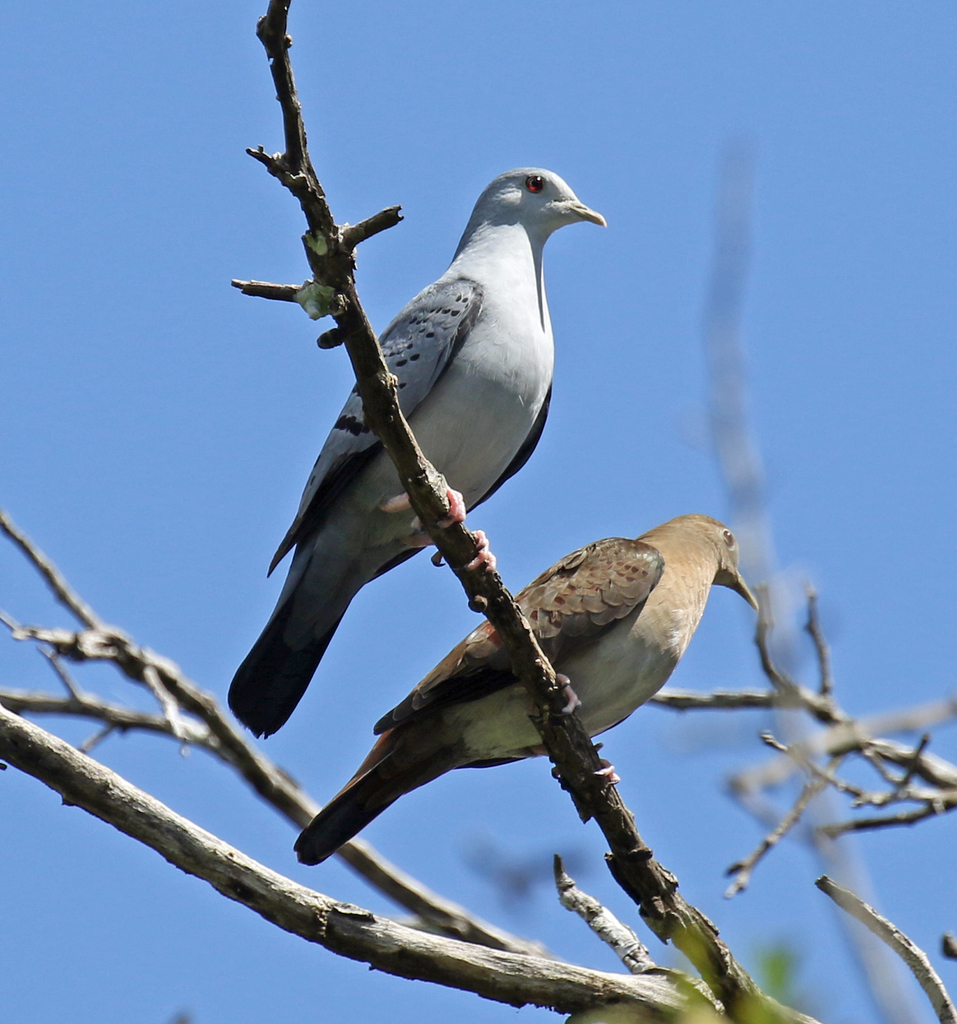
Blue ground doves are small pigeons, 20 cm long with a weight of 65–72 g. Adult males have blue-grey upperparts and paler grey underparts, becoming grey-white on the face. The flight feathers and outer tail feathers are blackish, and the wings are boldly spotted black (these spots often forming distinct bands). The iris is red or yellow, the bare eyering is green, and the legs are flesh-pink. The female has a grey-brown head neck and breast, becoming pale blue-grey on the underwings and belly. The back is ruddy brown, contrasting with the chestnut rump and tail. The spots in the wings are chestnut-brown. Young birds resemble the female, but have ruddy scaling on the back. In most of its range, the male is unlikely to be confused with other species, but can locally be confused with the members of the genus Paraclaravis. The female also resembles the females of the members of the genus Paraclaravis, but at most localities it is more likely to be confused with the female ruddy ground dove, which is smaller and has blackish (not chestnut-brown) markings on the wings. In most regions where the blue ground dove occurs, a blue-grey and a brown bird flying through the trees together is bound to be this species.
Range & habitat
The blue ground dove is relatively common in open woodland, forest edges, clearings and roadsides, especially in more humid areas. It is found from sea level to about 1200 m altitude. It builds a flimsy dish nest of twigs 1–11 m high in a tree and lays two white eggs.
Wikipedia: “Habitat and breeding”
What it does
Blue ground doves occur singly, in pairs or sometimes in small groups. They feed mainly on the ground on seeds and small insects, and take grit. The male's song, given from the treetops, is a loud boop.
Wikipedia: “Diet and behaviour”
Listen
Looking for field recordings…
Where it lives
Recorded sightings
—
geo-referenced records in GBIF, from museums, herbaria and field observers.
Drag the globe to turn it. Dots are where records exist, not a range map; darker means more records.
In the stacks
Searching the stacks…
Every page naming Claravis pretiosa in the Biodiversity Heritage Library →
This page is assembled live from iNaturalist, GBIF, Wikipedia, the Source Library and the Internet Archive. It is not yet part of the hand-edited codex. iNaturalist taxon 2998.