- Animals
- ›Arthropods
- ›Crustaceans
- ›Typical Crustaceans
- ›Malacostracans
- ›Decapods, Isopods, and allies
- ›Decapods and Krill
- ›Decapods
- ›Crabs, Lobsters, Shrimps, and Allies
- ›Coral and Glass Sponge Shrimps
- ›Coral Shrimps
- ›Stenopus
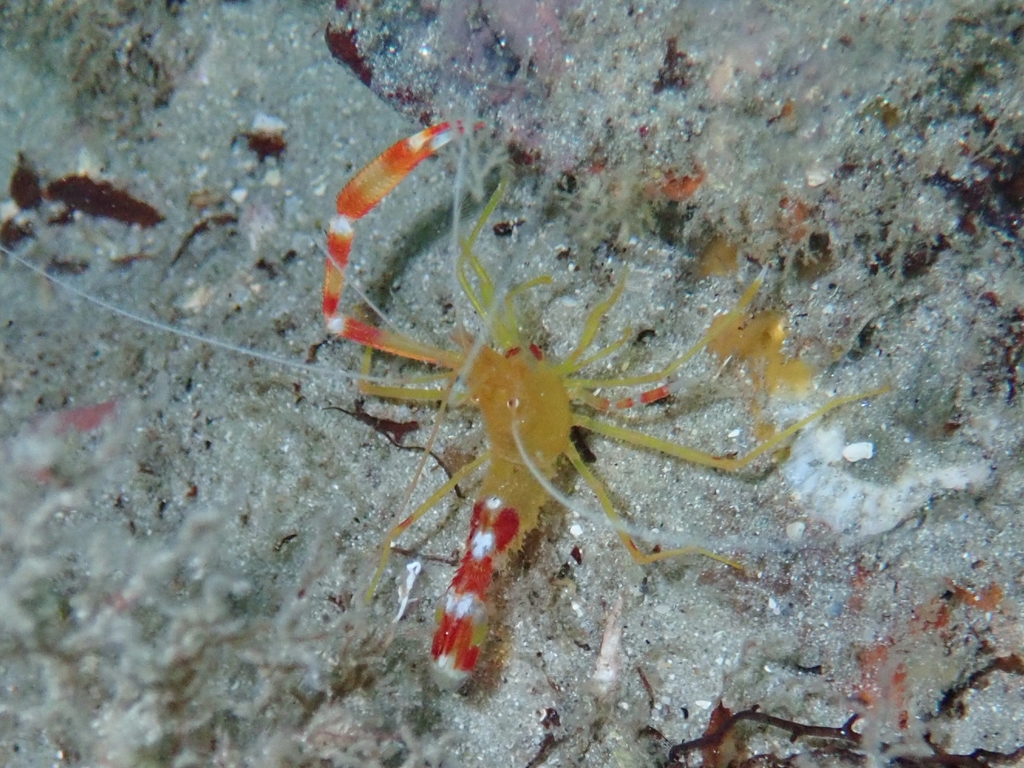
Yellowbanded Coral Shrimp
Stenopus scutellatus
Stenopus scutellatus, commonly known as the gold coral banded shrimp or golden coral shrimp, is a boxer shrimp, a shrimp-like decapod crustacean belonging to the family Stenopodidae. It is found in suitable habitats in the western Atlantic and the Caribbean Sea.
From the article Stenopus scutellatus on Wikipedia (CC BY-SA), quoted section by section
Description
Stenopus spinosus can grow up to 4 centimetres (1.6 in) long, and has a yellow spiny carapace and abdomen and long white antennae. The third pair of pereiopods (walking legs) are spiny and bear long claws and are much larger than the other pairs. They are boldly barred in red and white while the other legs are yellow. The tip of the abdomen, uropods and telson are also marked with orangeish-red and white.
Range & habitat
Stenopus scutellatus is commonly found in shallow waters in the western Atlantic Ocean, Bermuda, the West Indies, the Gulf of Mexico and southwards to northern Brazil at depths between 10 and 113 metres (33 and 371 ft). They are found on coral reefs, in caves and among lumps of coral but are also found on rocks near turtle grass (Thalassia testudinum) meadows and on detritus on the seabed.
Wikipedia: “Distribution”
What it does
These shrimps are usually found in pairs, one of each sex, and have elaborate mating behaviours. They lurk in crevices with their long antennae visible and waving to advertise their presence. They offer cleaning services to fish which will approach and adopt special attitudes while parasites, such as isopods, and pieces of dead skin are removed and eaten by the shrimp. They are rather more shy than the banded cleaner shrimp (Stenopus hispidus) and approach the fishes that attend the cleaning station more cautiously. They sometimes just remain inside their niches picking at the side of the visiting fish immediately outside.
Wikipedia: “Behaviour”
Where it lives
Recorded sightings
—
geo-referenced records in GBIF, from museums, herbaria and field observers.
Drag the globe to turn it. Dots are where records exist, not a range map; darker means more records.
In the stacks
Searching the stacks…
Every page naming Stenopus scutellatus in the Biodiversity Heritage Library →
This page is assembled live from iNaturalist, GBIF, Wikipedia, the Source Library and the Internet Archive. It is not yet part of the hand-edited codex. iNaturalist taxon 295428.