- Animals
- ›Arthropods
- ›Crustaceans
- ›Typical Crustaceans
- ›Malacostracans
- ›Decapods, Isopods, and allies
- ›Decapods and Krill
- ›Decapods
- ›Crabs, Lobsters, Shrimps, and Allies
- ›True Crabs
- ›Eubrachyuran Crabs
- ›Thoracotrematan Crabs
- ›Shore and marsh crabs
- ›Shore Crabs
- ›Geograpsus
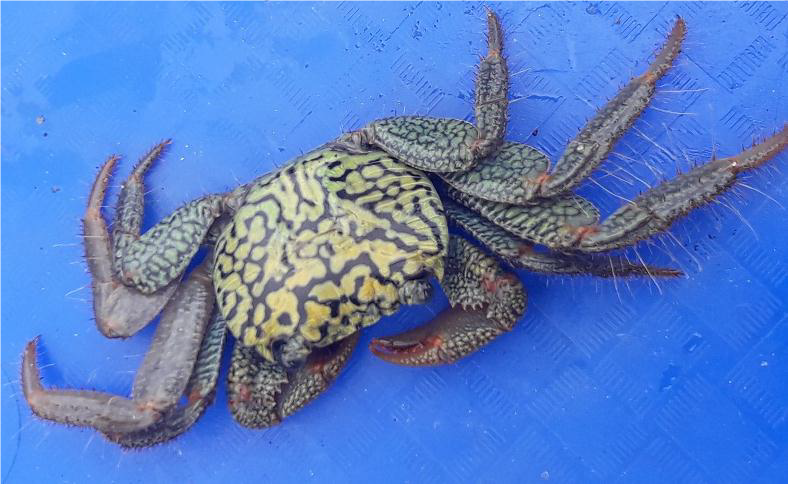
American Nipper
Geograpsus lividus
Geograpsus lividus is a species of crab in the family Grapsidae. Little research has been conducted on this species. It was originally classified as belonging to the genus Grapsus; however, this name is no longer used.
From the article Geograpsus lividus on Wikipedia (CC BY-SA), quoted section by section
Description
Megaopae G. lividus can reach a width of about 25–35 mm (0.98–1.38 in). They are yellowish red in color and have distinct hairs on their legs. The cephalothorax is globose, smooth and without tubercles. Chelar tubercles are restricted to the upper half of the chelae, the pincer on the end of the claw. Morphology differs between G. lividus populations in different habitats, particularly when comparing those in the Atlantic and those in the Pacific. Zoeae G. lividus found in the Atlantic possess more outer minute spines on the furcal arms of the telson as well as more aesthetase setae, bristles, on the antennule. There are eight recognized developmental zoeal stages of G. lividus which take place over the span of at least 60 days, making it the longest-recorded crab developmental pathways. On its way to entering the megalopae, post-larval stage, the larvae undergoes exponential growth rates becoming up to 7200% of its initial biomass which also makes it one of the fastest observed growth rates in the infraorder Brachyura. The largest larvae are from the Gulf of Mexico while the smallest are found in Jamaica. The ratio of sternum width to posterolateral margin width is larger for males than females.
Range & habitat
Geograpsus lividus is native to east Africa, the Cook Islands, Hawaii, and the western Atlantic. It is currently present throughout the East Pacific and West Atlantic oceans. Within the Atlantic ocean they are found throughout the Gulf of Mexico and along the coast from Florida to Brazil. It can be found on both coasts of America from the central Gulf to Chile and in the waters near the Galapagos Islands.
Wikipedia: “Distribution”
What it does
Few behavioral patterns have been tracked in G. lividus, but they are fast swimmers and can be difficult to catch when chased. Since they are a nocturnal species, they take refuge terrestrially during the day and are active primarily during the night.
Wikipedia: “Behavior”
Where it lives
Recorded sightings
—
geo-referenced records in GBIF, from museums, herbaria and field observers.
Drag the globe to turn it. Dots are where records exist, not a range map; darker means more records.
In the stacks
Searching the stacks…
Every page naming Geograpsus lividus in the Biodiversity Heritage Library →
This page is assembled live from iNaturalist, GBIF, Wikipedia, the Source Library and the Internet Archive. It is not yet part of the hand-edited codex. iNaturalist taxon 295346.