- Animals
- ›Chordates
- ›Vertebrates
- ›Reptiles
- ›Snakes and Lizards
- ›Snakes
- ›Colubrid Snakes
- ›Colubrine Snakes
- ›Pituophis
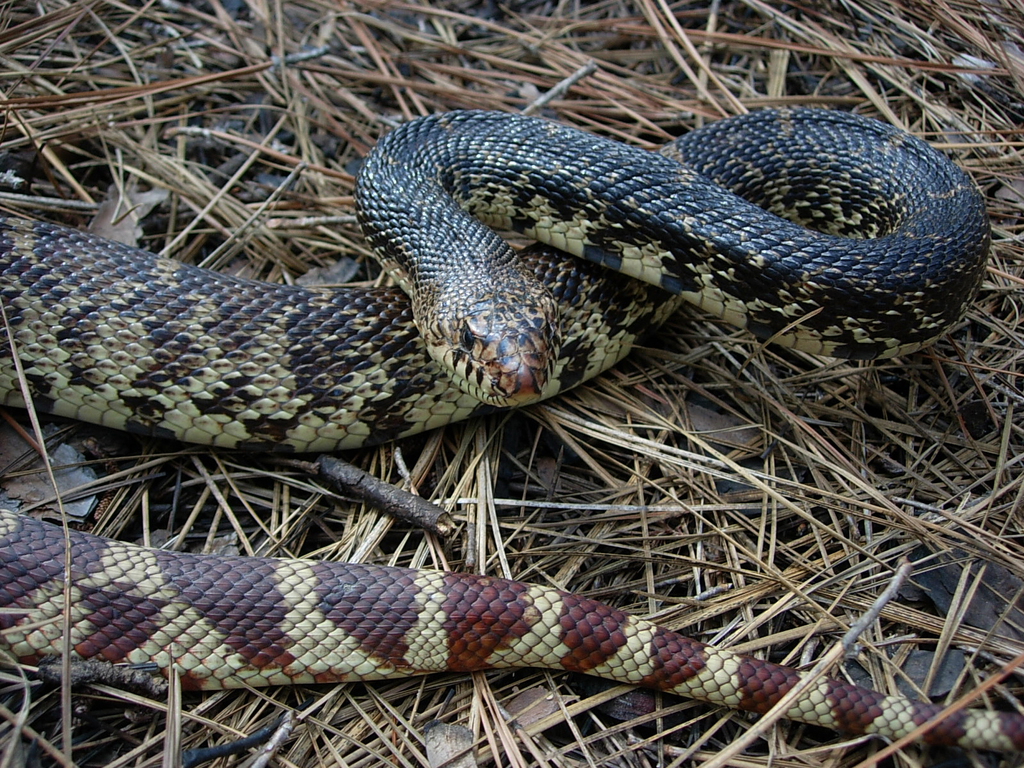
Louisiana Pinesnake
Pituophis ruthveni
The Louisiana pine snake (Pituophis ruthveni) is a species of large, non-venomous, constrictor in the family Colubridae. This powerful snake is notable because of its large eggs and small clutch sizes. The Louisiana pine snake is indigenous to west-central Louisiana and East Texas, where it relies strongly on Baird's pocket gophers for its burrow system and as a food source. The Louisiana pine snake is rarely seen in the wild, and is considered to be one of the rarest snakes in North America. The demise of the species is due to its low fecundity coupled with the extensive loss of suitable habitat - the longleaf pine savannas in the Gulf Coastal Plain of the southeastern United States. Management activities are being conducted to promote the species' recovery.
Recovery efforts to counter extirpation resulted in around 300 snakes having been reintroduced into the wild. In 2018 the snake was added to the List of Endangered and Threatened Wildlife. A species-specific rule on 27 February 2020, means interfering with the species could result in criminal charges.
From the article Louisiana pine snake on Wikipedia (CC BY-SA), quoted section by section
Description
Dorsally, the color is buff or lion-like yellow with dark brown blotches and spots that are very similar throughout the body. The marking patterns are visibly different from one end to another. The neck region is "busier", the dark reticulates and blends more with the lighter coloration. Towards midbody, the dark markings become more distinct and contrasting, and continue to be more distinct toward the tail, yet reduced in marking thickness. These markings number 28-42 middorsally. Furthermore, the very pointed head may only be marked slightly with some small dots and a faded bar in front and between the orbitals above. The ventrals never appear to be immaculate, but are intermediately blotched with brown. Nevertheless, there usually is no true checkered pattern. The rostral scale is exceptionally large, and usually 8 or 9 supralabials and from about 10-15 (generally 14) infralabials are present.
Range & habitat
The Louisiana pine snake is generally associated with sandy, well-drained soils; open pine forests, especially longleaf pine savannas; moderate to sparse midstory; and a well-developed herbaceous understory dominated by grasses. Its activity appears to be heavily concentrated on low, broad ridges overlain with sandy soils. Baird's pocket gophers appear to be an essential component of their habitat. They create the burrow systems in which the pine snakes are most frequently found, and serve as a major source of food for the species. Up to 90% of radio-tagged snake relocations have been underground in pocket gopher burrow systems, and movement patterns are typically from one pocket gopher burrow system to another. Snakes disturbed on the surface retreated to nearby burrows, and hibernation sites were always within burrows. Both native and captive-released snakes were found most frequently in areas containing an ample number of pocket gopher mounds, and snakes stayed active longer and moved greater distances where pocket gopher burrows were abundant. Pocket gopher abundance is dependent upon an abundance of herbaceous groundcover and loose, sandy soils. The amount of herbaceous vegetation is related to canopy cover. Generally, a rich ground layer requires a high degree of solar penetration into the forest floor. …
Wikipedia: “Habitat”
What it does
Growth is rapid; snakes may reach 2–3 ft (61–91 cm) in total length at 1 year and 3–4 ft (91–122 cm) at 2 years. The largest reported specimen was 5.8 ft (180 cm) in total length. Sexual maturity may be attained at a minimal total length of 4 ft (120 cm) and an age of at least 3 years. The species is oviparous, with a gestation period around 21 days, followed by 60 days of incubation. This species exhibits a remarkably low reproductive rate, which magnifies other threats to the Louisiana pine snake. It has the smallest clutch size (three to five) of any North American colubrid and the largest eggs, generally 5 in (13 cm) long by 2 in (5.1 cm) wide, of any snake in the United States. It also produces the largest hatchlings reported for any North American snake, ranging 18–22 in (46–56 cm) in total length, and up to 0.8 oz (23 g) in weight. The large size of the pine snake hatchlings may be an adaptation to enable young to feed relatively early.
Wikipedia: “Growth and reproduction”
In human culture
The species was first described by Olive Griffith Stull in 1929 as a subspecies of P. melanoleucus. In 1940, the Louisiana pine snake was promoted to the rank of species in another of Stull's articles. Its scientific name honors Alexander Grant Ruthven, the late herpetologist of the University of Michigan Museum of Zoology.
Wikipedia: “Taxonomy and etymology”
Where it lives
Recorded sightings
—
geo-referenced records in GBIF, from museums, herbaria and field observers.
Drag the globe to turn it. Dots are where records exist, not a range map; darker means more records.
In the stacks
Searching the stacks…
Every page naming Pituophis ruthveni in the Biodiversity Heritage Library →
This page is assembled live from iNaturalist, GBIF, Wikipedia, the Source Library and the Internet Archive. It is not yet part of the hand-edited codex. iNaturalist taxon 29041.