On eBird ↗
Andaman Cuckoo-Dove
Live sightings near you, the range map, bar charts of when it is seen, and Macaulay Library photos and recordings.
Andaman Cuckoo-Dove
Macropygia rufipennis
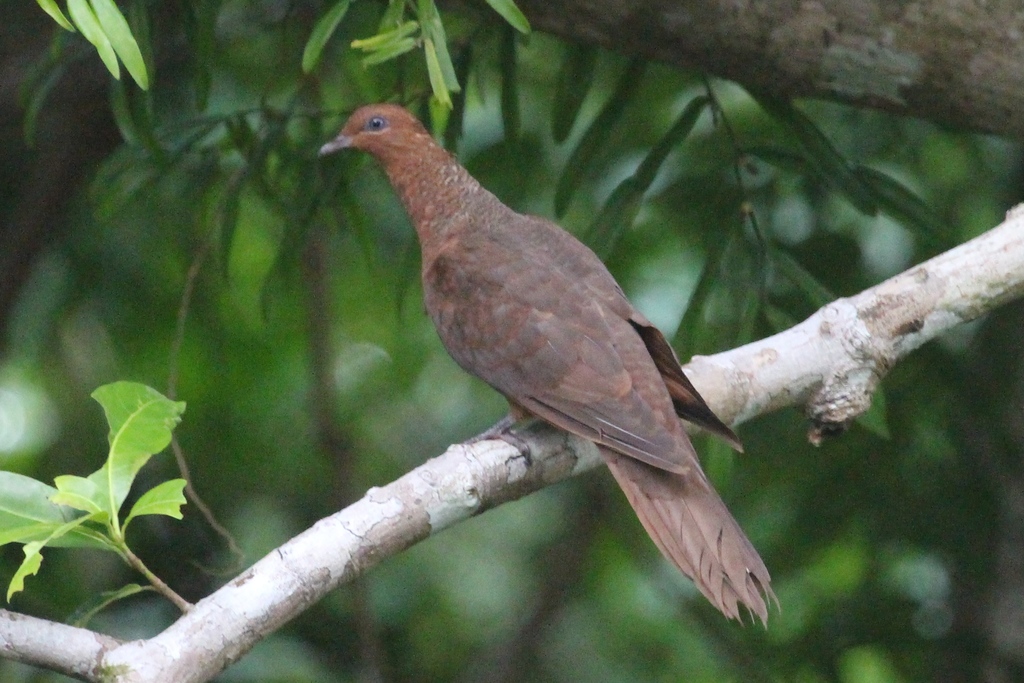
The Andaman cuckoo-dove (Macropygia rufipennis) is a species of bird in the family Columbidae. It is endemic to the Andaman and Nicobar Islands. It is characterized by its small body and rusty color. Its call is a repeated cooing "koo". Due to habitat loss and hunting, the species is becoming rare, yet it is listed as Least Concern. The Department of Environment and Forests, Andaman and Nicobar Islands, and the Zoological Survey of India are monitoring, surveying, and bringing awareness to the species' population. The species is frequently discovered in or around forest areas, with a diet that consists of mostly fruits and berries. The Andaman cuckoo-dove's breeding season is believed to be from February to April, but little information is known about this species.
From the article Andaman cuckoo-dove on Wikipedia (CC BY-SA), quoted section by section
Description
It is characterized by its slim build, small head, long tail, and rust color throughout its body. The call of the Andaman cuckoo-dove is a repeat of the double-noted "whoo-whup." The first note is slurred and the second is shorter and more pitched.
Range & habitat
The Andaman Cuckoo-Dove lives in heavy evergreen and secondary forests. They are commonly found yet hidden in forests, along forest edges, and typically remain closer to the canopy. They have a high forest dependence and normally occur at altitudes that range from 0 to 100 meters. These species are endemic to India and distributed in the Andaman and Nicobar Islands. The Important Bird and Biodiversity Areas (IBA) of these cuckoo-dove species are Nicobar, Nancowry and Trinkat.
Wikipedia: “Habitat”
What it does
The primary food source for the species is predominantly fruits and berries, particularly sourced from Vitis spp and Leae spp.
Wikipedia: “Diet”
Listen
Looking for field recordings…
Where it lives
Recorded sightings
—
geo-referenced records in GBIF, from museums, herbaria and field observers.
Drag the globe to turn it. Dots are where records exist, not a range map; darker means more records.
In the stacks
Searching the stacks…
Every page naming Macropygia rufipennis in the Biodiversity Heritage Library →
This page is assembled live from iNaturalist, GBIF, Wikipedia, the Source Library and the Internet Archive. It is not yet part of the hand-edited codex. iNaturalist taxon 2890.