- Animals
- ›Chordates
- ›Vertebrates
- ›Reptiles
- ›Snakes and Lizards
- ›Snakes
- ›Colubrid Snakes
- ›Natricine Snakes
- ›Rhabdophis
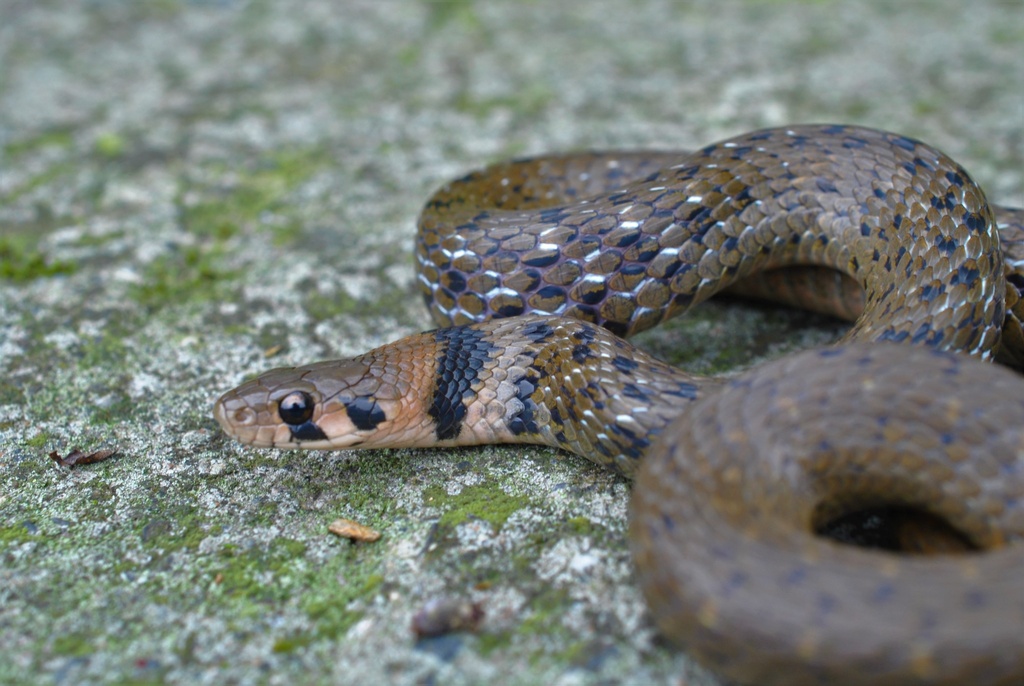
Taiwan Keelback
Rhabdophis swinhonis
Rhabdophis swinhonis is a keelback snake in the family Colubridae. It is endemic to Taiwan. It is also known as Taiwan keelback and Swinhoe's grass snake. It is named for Robert Swinhoe, a British diplomat and naturalist stationed in China in mid-19th century and who collected the holotype.
From the article Rhabdophis swinhonis on Wikipedia (CC BY-SA), quoted section by section
Description
R. swinhonis can reach a maximum total length (including tail) of 70 cm (28 in). It has 15–17 rows of keeled dorsal scales. The head is oval, the body is moderately stout, and the tail is moderately long. The medium to large eye has a dark grey-brown iris and a round, jet black pupil surrounded by a grey ring. The body is dorsally dark grey-brown with ill-defined or fairly prominent square areas of black. The underside is cream to light grey and is mottled with deposits of coarse dark pigment. The head is uniform dark olive grey to olive brown above, while the sides are lighter. There is an oblique black band below the eye as well as a larger black band on the side of head, above the corner of mouth. The nape bears a distinct, thick, and black backward-pointing chevron. The anal scale is divided and the subcaudal scales are paired.
Range & habitat
R. swinhonis occurs throughout Taiwan at elevations of 500–1,000 m (1,600–3,300 ft) above sea level. It is a diurnal snake that lives on the forest floor, bushlands, and other humid environments. They also occur in agricultural fields.
Wikipedia: “Geographic range and habitat”
What it does
R. swinhonis is non-venomous and docile; when threatened it may expand its throat and neck transversely, but is unlikely to bite. It has nuchal glands that secrete a brown liquid; this may act as a predator deterrent, although its precise function remains unknown.
Wikipedia: “Defensive behaviour”
In human culture
The specific name, swinhonis, is in honour of Robert Swinhoe, a British diplomat and naturalist stationed in China in mid-19th century, who collected the holotype.
Wikipedia: “Etymology”
Where it lives
Recorded sightings
—
geo-referenced records in GBIF, from museums, herbaria and field observers.
Drag the globe to turn it. Dots are where records exist, not a range map; darker means more records.
In the stacks
Searching the stacks…
Every page naming Rhabdophis swinhonis in the Biodiversity Heritage Library →
This page is assembled live from iNaturalist, GBIF, Wikipedia, the Source Library and the Internet Archive. It is not yet part of the hand-edited codex. iNaturalist taxon 28832.