On eBird ↗
Henderson Island Fruit-Dove
Live sightings near you, the range map, bar charts of when it is seen, and Macaulay Library photos and recordings.
Henderson Fruit Dove
Ptilinopus insularis
The Henderson fruit dove (Ptilinopus insularis), also known as scarlet-capped fruit dove, is a species of bird in the family Columbidae. It is endemic to Henderson Island in the South Pacific Pitcairn Island group.
From the article Henderson fruit dove on Wikipedia (CC BY-SA), quoted section by section
Description
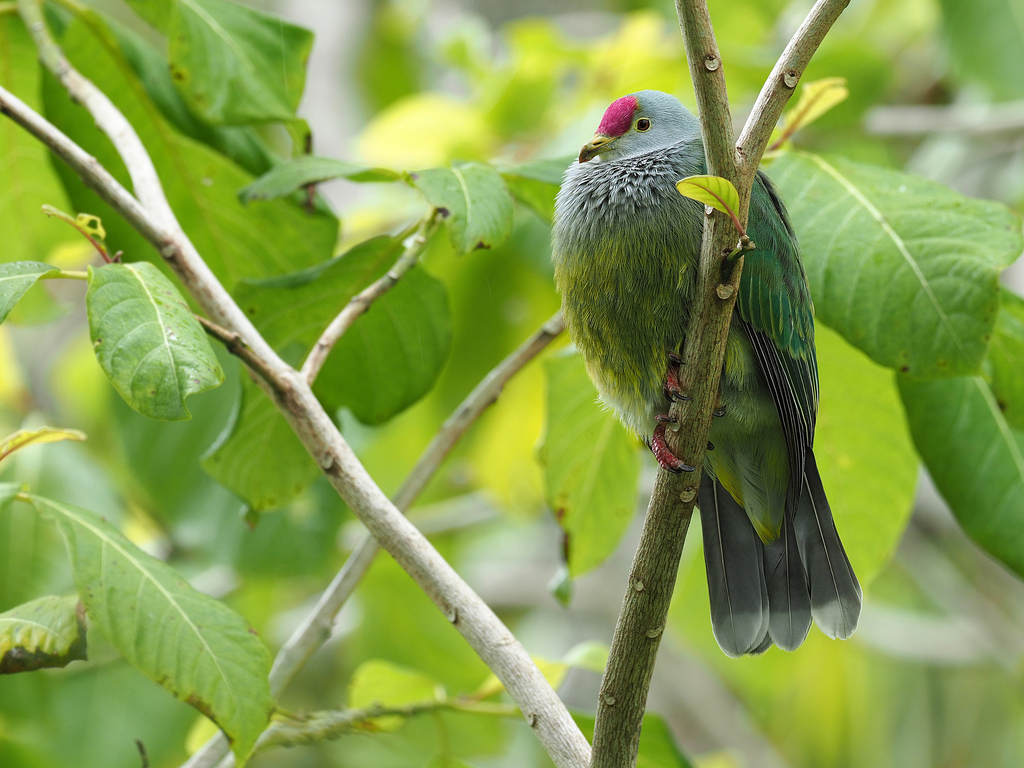
The Henderson Fruit Dove ranges from 20–25 cm (7.9–9.8 in) in size. The forehead and crown are a crimson-purple color with a narrow border of yellow surrounding them. Its throat and back of the head are white. Its nape, neck, and chest are light gray, leading to a bright yellow stomach. Its back and wings are a darker green with yellow on the edge. The tip of the tail is a mix of gray and yellow. The feet are a bright pink color. The female appearance is a little different. While the majority of it is the same, its crown is a darker green color, and its wings and chest have yellow margins.
Wikipedia: “Appearance”
Range & habitat
The Henderson Fruit Dove is endemic to Henderson Island in the South Pacific Pitcairn Island group. Its natural habitat is tropical moist lowland scrub forest, which it formerly shared with three other endemic species of pigeon, now extinct.
Wikipedia: “Habitat”
What it does
The Henderson Fruit Dove is mainly frugivorous, meaning its diet consists of fruit pulp and, specifically, intact fruit from Nesoluma and Ixora. The fruits of Procris pedunculata, a plant known to grow from the West Indian Ocean to the Pacific, are especially important in the diet, but all available fruits are consumed. These fruits form most of their diet, but they also consume young shoots of the fern Phymatosorus scolopendria when the fruits are unavailable. A preference for fruit with a high water content suggests that the species relies on its food for water consumption, especially during dry spells. There are no permanent freshwater ponds or marshy habitats on Henderson Island, meaning that they do not have a constant water supply.
Wikipedia: “Diet”
Listen
Looking for field recordings…
Where it lives
Recorded sightings
—
geo-referenced records in GBIF, from museums, herbaria and field observers.
Drag the globe to turn it. Dots are where records exist, not a range map; darker means more records.
In the stacks
Searching the stacks…
Every page naming Ptilinopus insularis in the Biodiversity Heritage Library →
This page is assembled live from iNaturalist, GBIF, Wikipedia, the Source Library and the Internet Archive. It is not yet part of the hand-edited codex. iNaturalist taxon 2848.