- Animals
- ›Chordates
- ›Vertebrates
- ›Reptiles
- ›Snakes and Lizards
- ›Snakes
- ›Colubrid Snakes
- ›Natricine Snakes
- ›Thamnophis
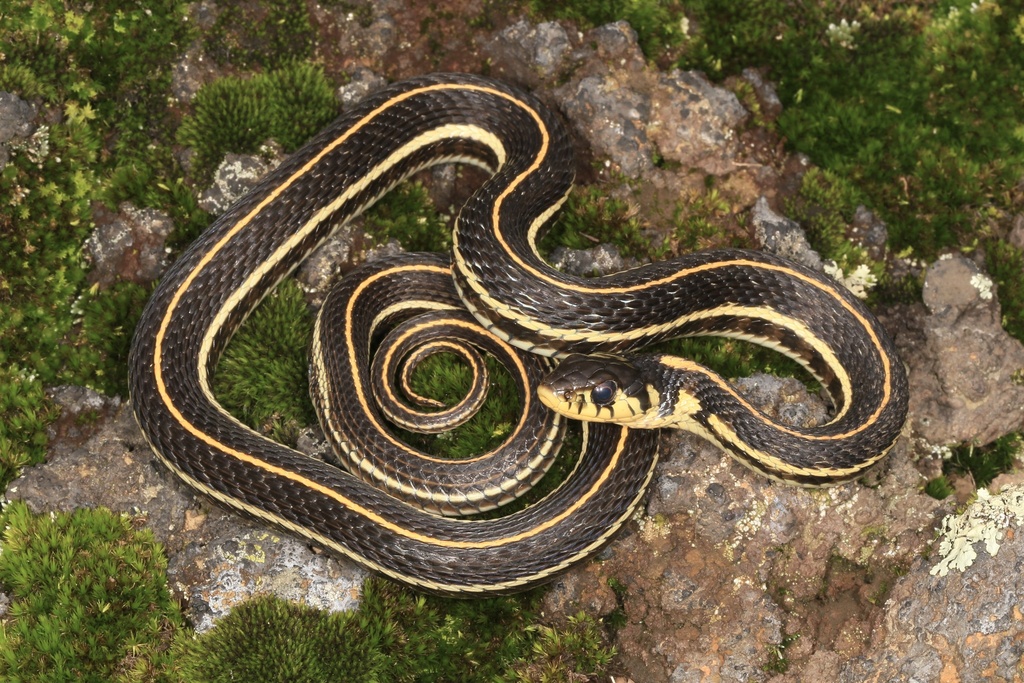
Yellow-throated Garter Snake
Thamnophis pulchrilatus
The yellow-throated garter snake (Thamnophis pulchrilatus) is a species of snake in the family Colubridae. It is found in Mexico. Very little is known for certain about this snake, but it has been observed to reach lengths of 18–36 in (46–91 cm). They are distinguishable by their characteristic coloring, having a dark brown or black dorsal side accented with a yellow to light green stripe along the spine. A checkered yellow and black pattern can be observed along the sides, and the throat of the snake is bright yellow. Thamnophis pulchrilatus are relatively slender and light snakes.
From the article Yellow-throated garter snake on Wikipedia (CC BY-SA), quoted section by section
Range & habitat
It is found mainly in wooded areas, specifically oak and pine forests at high elevations, but has occasionally been found in grassy fields as well. Some sources report that they inhabit the southwestern United States, but no sightings have ever been confirmed outside of Mexico, and these U.S. reports are likely T. cyrtopsis or T. eques.
Wikipedia: “Distribution and habitat”
What it does
These snakes are believed to eat small fish, lizards, frogs, toads, and even worms. There have been two confirmed cases of predation: the first involved a captured female that regurgitated a mountain tree frog (Dryophytes eximius), and the second was a captured snake that was discovered to have eaten a Bell's false brook salamander (Isthmura belli).
Wikipedia: “Diet”
In human culture
This species has been considered a synonym of Thamnophis cyrtopsis or of Thamnophis eques. It was first described by Cope in 1885 as Eutaenia pulchrilatus.
Wikipedia: “Taxonomic history”
Where it lives
Recorded sightings
—
geo-referenced records in GBIF, from museums, herbaria and field observers.
Drag the globe to turn it. Dots are where records exist, not a range map; darker means more records.
In the stacks
Searching the stacks…
Every page naming Thamnophis pulchrilatus in the Biodiversity Heritage Library →
This page is assembled live from iNaturalist, GBIF, Wikipedia, the Source Library and the Internet Archive. It is not yet part of the hand-edited codex. iNaturalist taxon 28350.