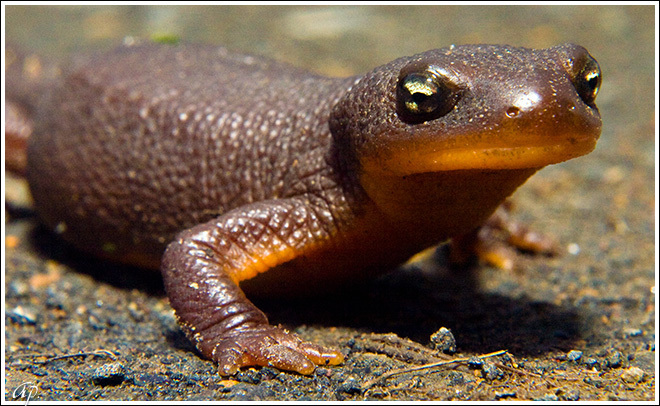
Rough-skinned Newt
Taricha granulosa
The rough-skinned newt or roughskin newt (Taricha granulosa) is a North American newt known for the strong toxin exuded from its skin.
From the article Rough-skinned newt on Wikipedia (CC BY-SA), quoted section by section
Description
A stocky newt with rounded snout, it ranges from light brown to olive or brownish-black on top, with the underside, including the head, legs, and tail, a contrasting orange to yellow. The skin is granular, but males are smooth-skinned during breeding season. They measure 6 to 9 cm (2.4 to 3.5 in) in snout-to-vent length, and 11 to 18 cm (4.3 to 7.1 in) overall. They are similar to the California newt (Taricha torosa) but differ in having smaller eyes, yellow irises, V-shaped tooth patterns, and uniformly dark eyelids. Males can be distinguished from females during breeding season by large swollen vent lobes and cornified toe pads.
Wikipedia: “Appearance”
Range & habitat
Rough-skinned newts are found throughout the Pacific Northwest. Their range extends south to Santa Cruz, California, and north to Alaska. They are uncommon east of the Cascade Mountains, though occasionally are found (and considered exotic, and possibly artificially introduced) as far as Montana. One isolated population lives in several ponds just north of Moscow, Idaho, and was most likely introduced. A number of subspecies have been defined based on local variants, but only two subspecies have wider recognition:
Taricha granulosa – rough-skinned newt Taricha granulosa mazamae – Crater Lake newt (Crater Lake, Oregon)
It is now believed that the Taricha granulosa mazamae subspecies is no longer valid, as specimens that look similar to T.g.m. have been found in areas of Alaska as well.
Wikipedia: “Distribution and subspecies”
Toxicity
Many newts produce toxins from skin glands as a defense against predation, but the toxins of the genus Taricha are particularly potent. In this species the toxin seems to be produced by their skin microbiome. An acrid smell radiates from the newt, which acts as a warning for animals to stay away. Toxicity is generally experienced only if the newt is ingested, although some individuals have been reported to experience skin irritation after dermal contact, particularly if the eyes are touched after handling the animal without washing hands. In 1979, a 29-year-old man from Oregon died after ingesting a rough-skinned newt.
Tetrodotoxin binding. The newt produces a neurotoxin called tetrodotoxin (TTX), which in this species was formerly called "tarichatoxin". It is the same toxin found in pufferfish and a number of other marine animals. This toxin targets voltage-gated sodium channels via binding to distinct but allosterically coupled sites. Because TTX is much larger than a sodium ion, it acts like a cork in a bottle and prevents the flow of sodium. The reverse binding to sodium channels in nerve cells blocks electrical signals necessary for conducting nerve impulses. This inhibition of firing action potentials has the effect of inducing paralysis and death by asphyxiation.
Toxin resistance and predation. …
Listen
Looking for field recordings…
Where it lives
Recorded sightings
—
geo-referenced records in GBIF, from museums, herbaria and field observers.
Drag the globe to turn it. Dots are where records exist, not a range map; darker means more records.
In the stacks
Searching the stacks…
Every page naming Taricha granulosa in the Biodiversity Heritage Library →
This page is assembled live from iNaturalist, GBIF, Wikipedia, the Source Library and the Internet Archive. It is not yet part of the hand-edited codex. iNaturalist taxon 27826.