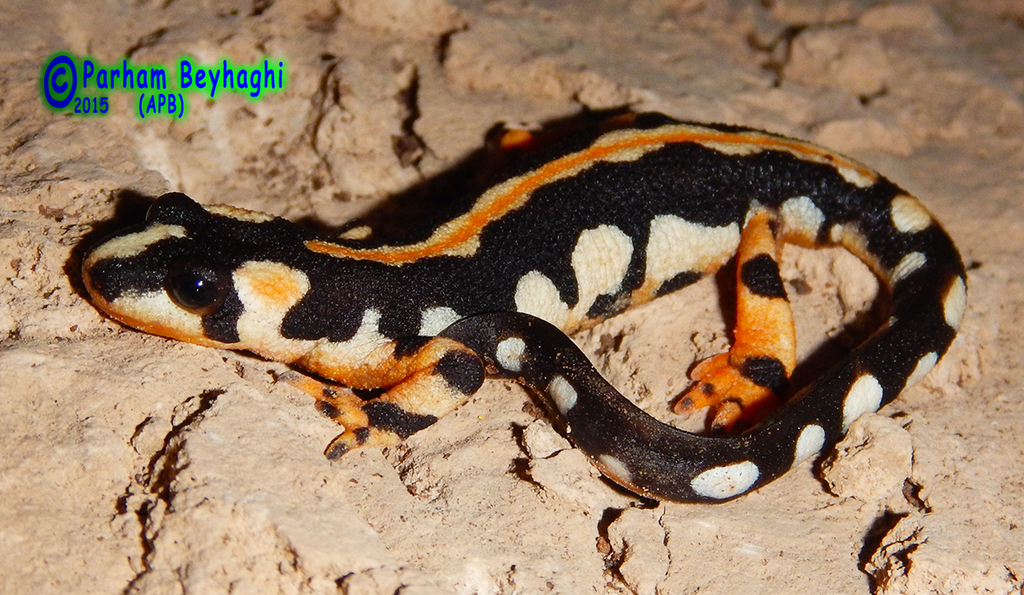
Lorestan Newt
Neurergus kaiseri
Neurergus kaiseri, the Luristan newt, Kaiser's mountain newt, Kaiser's spotted newt or emperor spotted newt (not to be confused with Tylototriton shanjing), is a species of salamander in the family Salamandridae. It is endemic to the southern Zagros Mountains in Iran where it is known from just four streams. Populations of this newt have been declining and the International Union for Conservation of Nature has rated it as "vulnerable". A captive breeding programme has been established in several zoos.
From the article Neurergus kaiseri on Wikipedia (CC BY-SA), quoted section by section
Range & habitat
The Luristan newt is endemic to the southern Zagros Mountains in Iran. It is primarily found in highland streams surrounded by arid scrubland, but can also be found in ponds and pools. It is known only from four streams in a single catchment area and has a total inhabited area of 8,948 km2 (3,454.8 mi2). In a recent study it was found that the area of suitable habitat within their study area was 18,159 km2 (7,011.2 mi2). Water is absent from its habitat for a significant part of the year and it moves out into the surrounding woodland which is predominantly oak and pistachio, during which time this species is known to estivate. Currently the Luristan newt is found in the Zagros Mountains in Iran, but in recent studies it has been concluded that small portions of southern Iran that include Kermanshah, Ilam, Chaharmahal-Bakhtiari, and Kohgiluye-Boyerahmad are habitats that these species will be distributing themselves in the future due do climate change affecting their current habitats.
Wikipedia: “Distribution and habitat”
Listen
Looking for field recordings…
Where it lives
Recorded sightings
—
geo-referenced records in GBIF, from museums, herbaria and field observers.
Drag the globe to turn it. Dots are where records exist, not a range map; darker means more records.
In the stacks
Searching the stacks…
Every page naming Neurergus kaiseri in the Biodiversity Heritage Library →
This page is assembled live from iNaturalist, GBIF, Wikipedia, the Source Library and the Internet Archive. It is not yet part of the hand-edited codex. iNaturalist taxon 27773.