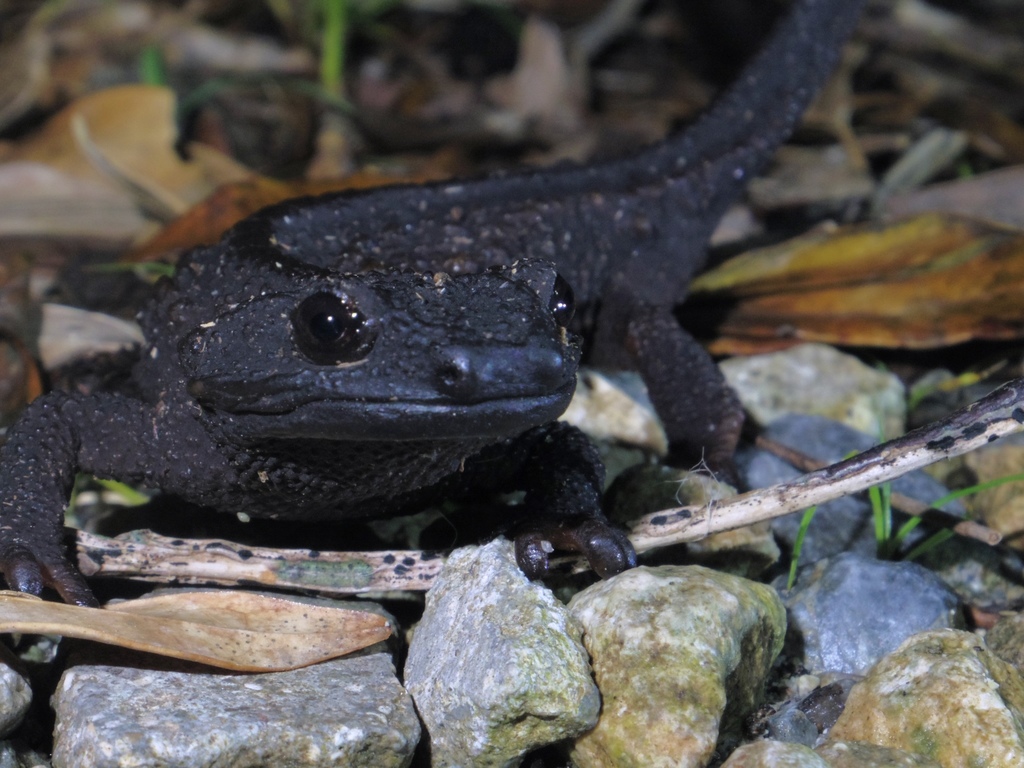
Anderson's Crocodile Newt
Echinotriton andersoni
Anderson's crocodile newt, Anderson's newt, Ryukyu spiny newt, or Japanese warty newt (Echinotriton andersoni) is a species of salamander in the Salamandridae family found in the Ryukyu Islands of Japan, and, at least formerly, Mount Guanyin in northern Taiwan, where it is now believed to be extinct.
From the article Anderson's crocodile newt on Wikipedia (CC BY-SA), quoted section by section
Description
Echinotriton andersoni is a stout, flat salamander. Head is broad and triangular in shape. There are 12–15 conspicuous knob-like lateral glands. Colouration is uniformly dark brown or black, only the underside of the tail, cloacal region, and the soles of the feet are yellow-orange. The maximum size is at least 80 mm (3.1 in) in snout–vent length and 169 mm (6.7 in) in total length.
Range & habitat
Its natural habitats are broad-leaved evergreen forests, secondary forests, grasslands and swamps. It has also been found in and near sugar cane fields. It breeds in standing water such as ponds and temporary pools; outside breeding season it is difficult to observe as adult salamanders live in leaf litter, in rocky crevices, and under rocks and logs. Anderson’s crocodile newt is distributed across five of the central Ryukyu Islands: Okinawajima, Sesokojima, and Tokashikijima of the Okinawa group, and Amami-o-shima and Tokunoshima of the Amami group (although sightings on the latter group appear to be rare or nonexistent).
Wikipedia: “Habitat and distribution”
What it does
This species breeds from February to July, with activity peaking from March to May. The female lays her small clutch of eggs in leaf litter, humus soil, or beneath small objects like leaves or rocks; usually not further than a metre or two away from a body of still water. The later age hatch after 22–27 days, and after another 2–3 months they metamorphose into their terrestrial adult forms.
Wikipedia: “Behaviour”
Toxicity
Echinotriton andersoni protects itself from predators through the uncommon ability to use their ribs to envenomate the threat. This is done by the ribs puncturing through their epidermis and lateral granular glands, which produce tetrodotoxin and piercing the threat. The mechanisms that are used for this method of protection are unusual due to their lack of muscular attachment at the ends of their ribs and the concentration of the granular glands. Occasionally their glands can appear as a lighter color than the surrounding area, hypothesized to be due to higher concentration of the tetrodotoxin in the area around their glands.
Wikipedia: “Venomous”
Listen
Looking for field recordings…
Where it lives
Recorded sightings
—
geo-referenced records in GBIF, from museums, herbaria and field observers.
Drag the globe to turn it. Dots are where records exist, not a range map; darker means more records.
In the stacks
Searching the stacks…
Every page naming Echinotriton andersoni in the Biodiversity Heritage Library →
This page is assembled live from iNaturalist, GBIF, Wikipedia, the Source Library and the Internet Archive. It is not yet part of the hand-edited codex. iNaturalist taxon 27768.